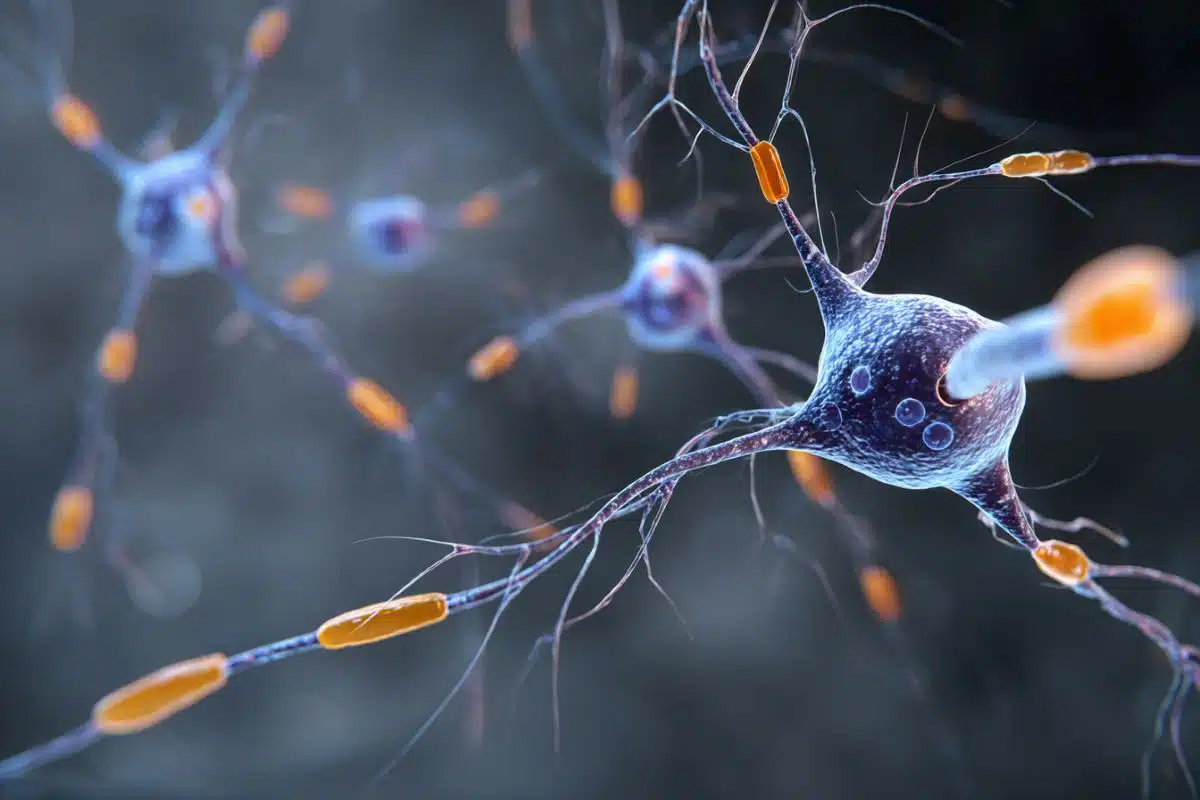
Summary: Researchers demonstrated that an experimental, systemic gene therapy can shield the central nervous system from the devastating cognitive decline and structural damage caused by TDP-43-related proteinopathy. The research introduces a neuron-centric treatment track that utilizes a modified, harmless virus to deliver the SynCav1 gene throughout the brain and spinal cord.
Rather than trying to merely scrub toxic proteins away, this systemically delivered therapy dramatically boosts caveolin-1, a master neuroprotective protein, to reinforce the structural machinery of vulnerable neurons, preserving cellular communication and learning retention across multiple age-related brain diseases.
Key Facts
- The TDP-43 Crisis: The abnormal accumulation of TDP-43 protein is increasingly recognized by neuroscientists as a primary, catastrophic driver of frontotemporal dementia (FTD), amyotrophic lateral sclerosis (ALS), and over half of all clinical Alzheimer’s disease (AD) cases. Its presence drastically accelerates brain atrophy, memory loss, and cognitive decline.
- Systemic Delivery Breakthrough: While traditional gene therapies targeting the central nervous system rely on highly invasive, direct tissue injections, this novel approach uses a modified, harmless virus delivered systemically. The treatment successfully crosses the blood-brain barrier to up-regulate caveolin-1 expression across the entire brain and spinal cord.
- Organizing the Scaffold: Caveolin-1 is a critical neuroprotective protein that organizes essential signaling pathways and preserves membrane lipid rafts, the subcellular structures that neurons use to communicate with one another.
- The Vulnerability Shift: Frontline neurodegenerative treatments traditionally focus on clearing toxic protein buildups, often failing because the underlying neurons have already lost their ability to survive metabolic stress. SynCav1 flips this paradigm by strengthening the neuron’s intrinsic resilience, allowing it to withstand severe disease-related stress even when toxic proteins are actively present.
- Multi-Level Structural Preservation: In preclinical mouse models, the SynCav1 intervention lowered pathological TDP-43 levels in the cortex and hippocampus while preserving complex behavioral learning, memory, and fear extinction. Inside the cell, it shielded energy-producing mitochondria and kept TDP-43 from invading the wrong subcellular compartments.
- A Unified Treatment Track: Because protection was observed simultaneously across behavior, synapses, axons, membrane signaling, and mitochondrial architecture, senior authors Brian Head, PhD, and Shanshan Wang, MD, PhD, emphasize that SynCav1 serves as a universal, neuron-centric treatment candidate applicable across highly complex denerative disorders regardless of disease origin.
Source: UCSD
A new study led by researchers at the University of California San Diego School of Medicine suggests that an experimental gene therapy could help protect the brain from the damage and cognitive decline linked to TDP-43-related proteinopathy, a type of neurodegeneration that is a major driver of frontotemporal dementia (FTD) and is also common in Alzheimer’s disease (AD) and amyotrophic lateral sclerosis (ALS).
The study is published in Alzheimer’s & Dementia: The Journal of the Alzheimer’s Association.

Though TDP-43 is not a household name, this protein is increasingly recognized among neuroscientists as one of the most important factors in age-related brain diseases. Abnormal TDP-43 accumulation has been linked to ALS — also known as Lou Gehrig’s disease — and to FTD, which has drawn broader public attention in recent years following actor Bruce Willis’s diagnosis in 2023. Researchers also estimate that TDP-43 is present in more than half of AD cases, and its presence has been associated with faster cognitive decline, greater brain atrophy and worsening memory loss.
The new therapy utilizes a modified, harmless virus to deliver a beneficial gene, called SynCav1, to brain cells. While most gene therapies targeting the brain and spinal cord heavily depend on direct tissue injections, this approach used a novel virus that can be delivered systemically to boost the production of caveolin-1, a neuroprotective protein that helps organize critical signaling pathways in the brain.
Unlike many therapeutic approaches to treating neurodegeneration, which only focus on treating immediate damage, the new approach is designed to help vulnerable neurons better withstand disease-related stress and preserve brain function regardless of disease origin.
“Many therapies for neurodegenerative disease focus on removing toxic proteins, but neurons are also losing their ability to cope with that stress,” said senior author Brian Head, PhD, senior author of the study who is a professor of anesthesiology at UC San Diego School of Medicine and research career scientist at the Veterans Affairs San Diego Healthcare System. “Our findings suggest that strengthening the neuron’s resilience itself may be a powerful therapeutic strategy, even when toxic proteins are already present.”
Testing the approach in mice, the researchers found:
- The therapy was able to cross the blood-brain barrier and boosted expression of caveolin 1 in neurons across the brain and spinal cord
- In mice who received the treatment, SynCav1 preserved learning, memory and fear extinction – the process by which a person or animal becomes less scared of a frightening stimulus after repeated exposures
- In mice who received the treatment, SynCav1 lowered levels of pathological TDP-43 in the cortex and hippocampus, regions of the brain associated with higher cognitive function, voluntary movement and social behavior
- The therapy also showed benefits inside the cell, including protecting energy-producing structures (mitochondria) and preserving subcellular structures that neuronal cells use to communicate with each other (membrane lipid rafts)
In addition to testing a treatment approach, the findings also help improve our overall understanding of neurodegeneration at the cellular and molecular level, which could help scientists discover further treatment candidates in the future.
“This study gives us an important new mechanistic clue as to what’s really going on in the brain during neurodegeneration,” said Shanshan Wang, MD, PhD, co-corresponding author of the study and assistant professor of anesthesiology at UC San Diego School of Medicine. “We found that TDP-43 is not only accumulating in the wrong subcellular compartments (i.e., membrane lipid rafts), but also disrupts cellular processes that are essential for neurons to communicate with one another. SynCav1 appears to help preserve this molecular machinery and subcellular localization.”
While additional research is needed to refine the approach before it is available to patients, the findings demonstrate the potential of SynCav1 as a neuron-centric treatment candidate that could be applicable across many neurodegenerative diseases.
“What is especially exciting is that we saw protection across multiple levels — behavior, synapses, axons, membrane signaling and mitochondrial structure,” Head added. “That kind of broad neuroprotection is exactly what is needed in complex disorders like TDP-43-related dementias, and we’re excited to continue exploring its potential.”
Additional co-authors on the study include: Dongsheng Wang, Vinh Ta, Hongxia Wang, Jerica Ju, Chun Wang, Christine Chehadeh, Albertina Torreblanca-Zanca, Yessenia Magaña and Michael J. Castle, all at UC San Diego.
Funding: The study was funded, in part, by the National Institutes of Health (grants UM1TR005449, K12TR005441, KL2TR001444) the U.S. Department of Veterans Affairs (BX003671, BX006318), Congressionally Directed Medical Research Programs (AL210059, AL230115) and the UC San Diego Gene Therapy Initiative (2039592).
Disclosure: Brian P. Head holds equity in and serves as a non-paid scientific advisory board member for Eikonoklastes Therapeutics LLC. Other authors reported no competing interests.
Key Questions Answered:
A: Because it acts as a silent, universal engine for neurodegeneration. While it is the direct cause of frontotemporal dementia (FTD) and ALS, neuroscientists have discovered it is also present in more than half of all Alzheimer’s cases. When TDP-43 accumulates abnormally, it moves into the wrong parts of a cell, hijacking the machinery neurons use to talk to each other and triggering rapid brain atrophy and memory loss.
A: The therapy uses a modified, harmless virus as a cellular delivery vehicle. Instead of undergoing invasive brain surgery, the virus can be injected systemically, where it effortlessly crosses the blood-brain barrier. Once inside, it delivers a beneficial gene called SynCav1, which tells brain cells to produce more caveolin-1, a protective protein that stabilizes the cell’s structure and keeps its internal communication lines open.
A: Yes, and that is exactly why the medical community is so excited. Most modern drugs try to treat just one specific disease by clearing out one specific toxic protein. SynCav1 ignores the origin of the disease entirely; it focuses strictly on making the neurons themselves hyper-resilient to stress. By protecting the cell’s energy centers and structural scaffolding, it guards brain function across ALS, FTD, and Alzheimer’s alike.
Editorial Notes:
- This article was edited by a Neuroscience News editor.
- Journal paper reviewed in full.
- Additional context added by our staff.
About this genetics and neurology research news
Author: Miles Martin
Source: UCSD
Contact: Miles Martin – UCSD
Image: The image is credited to Neuroscience News
Original Research: Open access.
“Systemic delivery of synapsin-promoted caveolin-1 overexpression ameliorates pathological TDP-43–induced cognitive decline and neurodegenerative changes” by Dongsheng Wang, Vinh Ta, Hongxia Wang, Jerica Ju, Chun Wang, Christine Chehadeh, Albertina Torreblanca-Zanca, Yessenia Magaña, Michael J. Castle, Shanshan Wang, Brian P. Head. Alzheimer’s & Dementia
DOI:10.1002/alz.71450
Abstract
Systemic delivery of synapsin-promoted caveolin-1 overexpression ameliorates pathological TDP-43–induced cognitive decline and neurodegenerative changes
INTRODUCTION
Transactive response DNA-binding protein 43 (TDP-43) proteinopathy is associated with frontotemporal dementia and Alzheimer’s disease (AD). We previously demonstrated that synapsin-promoted caveolin-1 (SynCav1) preserves cognitive function in the mouse model of AD. This study investigated the therapeutic potential of SynCav1 in a mouse model of TDP-43 proteinopathy.
METHODS
AAV-PhP.eB-SynCav1 was delivered systemically to the TDP-43A315T mouse, followed by cognitive evaluation and biochemical and ultrastructural analysis of brain tissue.
RESULTS
SynCav1 exerted robust neuroprotective effects on cognition. Mechanistically, pathological TDP-43 mislocalized to membrane lipid rafts (MLRs), resulting in decreased MLR-associated GluN2A expression and degenerative changes in neuronal ultrastructure. In contrast, SynCav1 delivery alleviated TDP-43 mislocalization on MLRs, stabilized MLR-associated GluN2A expression, and preserved synaptic ultrastructure. Furthermore, SynCav1 mitigated TDP-43–induced mitochondrial hyper-fragmentation and excessive mitochondrial fission signaling.
DISCUSSION
These findings establish a novel link between TDP-43 proteinopathy and MLR instability, supporting SynCav1 as a “neuron-centric” candidate for treating TDP-43–related neurodegeneration.