

Researchers Find Missing Link Between the Brain and Immune System

Implications profound for neurological diseases from autism to Alzheimer’s to multiple sclerosis.

In a stunning discovery that overturns decades of textbook teaching, researchers at the University of Virginia School of Medicine have determined that the brain is directly connected to the immune system by vessels previously thought not to exist. That such vessels could have escaped detection when the lymphatic system has been so thoroughly mapped throughout the body is surprising on its own, but the true significance of the discovery lies in the effects it could have on the study and treatment of neurological diseases ranging from autism to Alzheimer’s disease to multiple sclerosis.

“Instead of asking, ‘How do we study the immune response of the brain?’ ‘Why do multiple sclerosis patients have the immune attacks?’ now we can approach this mechanistically. Because the brain is like every other tissue connected to the peripheral immune system through meningeal lymphatic vessels,” said Jonathan Kipnis, PhD, professor in the UVA Department of Neuroscience and director of UVA’s Center for Brain Immunology and Glia (BIG). “It changes entirely the way we perceive the neuro-immune interaction. We always perceived it before as something esoteric that can’t be studied. But now we can ask mechanistic questions.”

“We believe that for every neurological disease that has an immune component to it, these vessels may play a major role,” Kipnis said. “Hard to imagine that these vessels would not be involved in a [neurological] disease with an immune component.”

New Discovery in Human Body

Kevin Lee, PhD, chairman of the UVA Department of Neuroscience, described his reaction to the discovery by Kipnis’ lab: “The first time these guys showed me the basic result, I just said one sentence: ‘They’ll have to change the textbooks.’ There has never been a lymphatic system for the central nervous system, and it was very clear from that first singular observation – and they’ve done many studies since then to bolster the finding – that it will fundamentally change the way people look at the central nervous system’s relationship with the immune system.”

Even Kipnis was skeptical initially. “I really did not believe there are structures in the body that we are not aware of. I thought the body was mapped,” he said. “I thought that these discoveries ended somewhere around the middle of the last century. But apparently they have not.”

‘Very Well Hidden’

The discovery was made possible by the work of Antoine Louveau, PhD, a postdoctoral fellow in Kipnis’ lab. The vessels were detected after Louveau developed a method to mount a mouse’s meninges – the membranes covering the brain – on a single slide so that they could be examined as a whole. “It was fairly easy, actually,” he said. “There was one trick: We fixed the meninges within the skullcap, so that the tissue is secured in its physiological condition, and then we dissected it. If we had done it the other way around, it wouldn’t have worked.”

After noticing vessel-like patterns in the distribution of immune cells on his slides, he tested for lymphatic vessels and there they were. The impossible existed. The soft-spoken Louveau recalled the moment: “I called Jony [Kipnis] to the microscope and I said, ‘I think we have something.'”
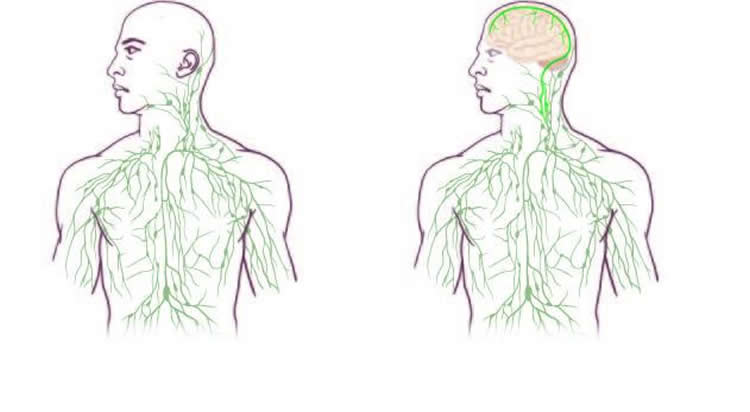
This shows the maps of the lymphatic system: old (left) and updated to reflect UVA's discovery.

Maps of the lymphatic system: old (left) and updated to reflect UVA’s discovery. Image credit: University of Virginia Health System.

As to how the brain’s lymphatic vessels managed to escape notice all this time, Kipnis described them as “very well hidden” and noted that they follow a major blood vessel down into the sinuses, an area difficult to image. “It’s so close to the blood vessel, you just miss it,” he said. “If you don’t know what you’re after, you just miss it.”

“Live imaging of these vessels was crucial to demonstrate their function, and it would not be possible without collaboration with Tajie Harris,” Kipnis noted. Harris, a PhD, is an assistant professor of neuroscience and a member of the BIG center. Kipnis also saluted the “phenomenal” surgical skills of Igor Smirnov, a research associate in the Kipnis lab whose work was critical to the imaging success of the study.

Alzheimer’s, Autism, MS and Beyond

The unexpected presence of the lymphatic vessels raises a tremendous number of questions that now need answers, both about the workings of the brain and the diseases that plague it. For example, take Alzheimer’s disease. “In Alzheimer’s, there are accumulations of big protein chunks in the brain,” Kipnis said. “We think they may be accumulating in the brain because they’re not being efficiently removed by these vessels.” He noted that the vessels look different with age, so the role they play in aging is another avenue to explore. And there’s an enormous array of other neurological diseases, from autism to multiple sclerosis, that must be reconsidered in light of the presence of something science insisted did not exist.

About this neuroscience research

The findings have been published online by the prestigious journal Nature and will appear in a forthcoming print edition. The article was authored by Louveau, Smirnov, Timothy J. Keyes, Jacob D. Eccles, Sherin J. Rouhani, J. David Peske, Noel C. Derecki, David Castle, James W. Mandell, Lee, Harris and Kipnis.

Funding: The study was funded by National Institutes of Health grants R01AG034113 and R01NS061973. Louveau was a fellow of Fondation pour la Recherche Medicale.

Source: Debra Kain – University of Virginia Health System
Image Source: The image is credited to the University of Virginia Health System
Original Research: Abstract for “Structural and functional features of central nervous system lymphatic vessels” by Antoine Louveau, Igor Smirnov, Timothy J. Keyes, Jacob D. Eccles, Sherin J. Rouhani, J. David Peske, Noel C. Derecki, David Castle, James W. Mandell, Kevin S. Lee, Tajie H. Harris and Jonathan Kipnis in Nature. Published online June 1 2015 doi:10.1038/nature14432


Abstract

Structural and functional features of central nervous system lymphatic vessels

One of the characteristics of the central nervous system is the lack of a classical lymphatic drainage system. Although it is now accepted that the central nervous system undergoes constant immune surveillance that takes place within the meningeal compartment1, 2, 3, the mechanisms governing the entrance and exit of immune cells from the central nervous system remain poorly understood4, 5, 6. In searching for T-cell gateways into and out of the meninges, we discovered functional lymphatic vessels lining the dural sinuses. These structures express all of the molecular hallmarks of lymphatic endothelial cells, are able to carry both fluid and immune cells from the cerebrospinal fluid, and are connected to the deep cervical lymph nodes. The unique location of these vessels may have impeded their discovery to date, thereby contributing to the long-held concept of the absence of lymphatic vasculature in the central nervous system. The discovery of the central nervous system lymphatic system may call for a reassessment of basic assumptions in neuroimmunology and sheds new light on the aetiology of neuroinflammatory and neurodegenerative diseases associated with immune system dysfunction.

“Structural and functional features of central nervous system lymphatic vessels” by Antoine Louveau, Igor Smirnov, Timothy J. Keyes, Jacob D. Eccles, Sherin J. Rouhani, J. David Peske, Noel C. Derecki, David Castle, James W. Mandell, Kevin S. Lee, Tajie H. Harris and Jonathan Kipnis in Nature. Published online June 1 2015 doi:10.1038/nature14432

Feel free to share this Neuroscience News.
Sponsored link

50 Responses

  1. Aynsley Evoli

    This is a very interesting discovery. I would be interested to further discover the possible link with the Governing Vessel and Bladder meridian in acupuncture which runs through the same area and if this would connect at all. Would welcome other thoughts.

  2. Harvey Stelman

    AS A PATIENT WITH SECONDARY CHRONIC- PROGRESSIVE MS, THIS MAY BE THE BEST NEWS I’VE READ IN 40 YEARS. PREVIOUSLY EVERY DOCTOR SAID, WE’RE GETTING CLOSER TO A CURE. CLOSER MAY NOW BE HERE.

  3. Eli Anderson

    Greetings.
    This “breakthrough” has been known thousands years ago, by our ancient civilisations Egyptians, Dogons, Essenes, Hellenic, Druidic, First Nation Shamanic, etc. But this information naturally supports Narrative healing approaches which include, narrative coaching, narrative medicine, etc. The notion of mind, body and spirit takes on a whole new perspective. And will change the way neuroscience interacts with other disciplines, i.e. Neurobiology, medical anthropology, neurolinguistics, etc. This has fundamentally enhanced my work in neuro-rehabilitation and purpose.
    Powerful discovery.
    Well done.
    Stay blessed.
    OL.
    Eli
    (Director : StoryAID)

  4. Dr. Roy A. Teel Jr.

    While interesting I did not see where this study was done in humans… did I miss something? Yes mouse brains are similar to human brains that’s why we use them for drug trials. However, as a person who has had MS for twenty years and is now secondary progressive as well as spent 12 years in human subject research at UCLA as a test subject for several high profile MS drugs. I think that this needs to be met with a bit of skepticism and further research in humans. However, this study was done on a living mouse I don’t know of any living human who wants to have their skull opened and then have their brains dissected through the skull cap. While this is a hopeful sign I know from personal experience that this development is a very, very early stage discovery in an animal model I would not be jumping up and down thinking that there are going to be any great advancements to any of the human disease process in most of our lifetimes. I don’t want to throw a wet blanket over the discovery but it is a long way from the lab and mice to humans and until that is one hundred percent proven they can’t even begin to start the process of dissecting humans and then trying to figure out how the brains lymphatic system differs from the general bodies system.

    This study also would end the theory of the blood brain barrier. It has always been believed that the brain and spinal cord are cut off from the rest of the bodies immune system and that the brain and its systems reside in a vacuum, if this study proves true then the whole human system has to be re-thought and the reality is the brain is no different from the rest of the body and is open to infections that we thought never entered the physical structure of the brain and or its immunologic system. This will only lead to more questions than answers especially in the early years of study. It will be a long road and not one as I stated will resolve any issues for any of us with any illness of the brain and autoimmune diseases. While interesting I think it was a little reckless that this study was released to the general public who doesn’t understand the general workings of research and the distance from studies to treatments in any disease process. I feel that people read article like this and from reading many of the comments folks think that there will be a cure for their ailment whatever it may be any day. Not so… this is but the first step in what will most likely be decades of research and if this proves out in humans several decades more before humans might see treatments for these ailments. Once again, I don’t want to throw a wet blanket on this but there is a reality here that must be understood so people don’t start running around thinking there will be a cure for any disease any time soon.

    Peace,

    Dr. Roy A. Teel Jr.

    • Nancy

      Everything you are saying is true. The discovery is very exiting even when looking at it from your viewpoint. Hard facts backed by empirical, accurately tested data over the years will tell us the truth. We may not be alive to see it but there is joy in knowing the future may be a better place because of the journey. Hope and faith are not concrete and tangential but they are beautifully expressed here in these posts.

  5. Cheryl Bentley

    As an RN I am amazed by this discovery. I would be very interested in what is found out about this discovery that could help people with MS to avoid the degeneration that causes their disability. If a drug could be found that would help patient’s with MS it would end so much suffering.

  6. DEBORAH

    I am so thankful for.continued research. 8 years ago a seeping mengioma that.is located in the pons area of my brain stem. I have many issues that have now developed along the way but try to overcome and move.forward. I have been diagnosed with fibromyalgia, rumitoid arthritis. With MS.in my.family, there are.early concerns. Both of my big toes are numb, I have the pins and needles in my.legs and feet. My.memory is terrible. I stay away from med as much as possible.but have found Lyrica, Cymbalta, Celebrates and a flexed al at night I can move forward in daily.life. I refuse to give up. Thanks to research more.and.more is being uncovered all the.time.

    • J. Inouye

      Deborah. You have just described everything that is happening to me for the past 8 years. Where can I get more information. Sted of Lyrica, Cymbalta. These meds have side-effects I did not like. I am taking Tylenol, Aspirin, Statins, and BP meds. Some days are worse than others.

      • Lee Schelin

        J. Inouye and Deborah: My wife has fibromyalgia and I was taking 250k tablets of Serrapeptase to reduce my inflammation. She asked if I thought it would help her fibromyalgia, I said “Try it and see what happens” She has been taking it for over a month now and she said it really helps her and no side effects at all

  7. 22227z

    I am pretty excited about this study and research. I have fibromyalgia, and have always believed it comes from something in the lymph/immune system. There are so many conditions out there that can’t be explained, I am hoping this will lead to some new treatments. I would gladly participate in clinical trials. I live in Cville, so I am also very proud of people at “The University” that discovered this. Kudos!

    I also hope and pray this will find some answers for Autism, MS, Lupus, and all the other maladies people suffer from w/out having any answers. Sometimes just knowing the cause can make a huge difference mentally as opposed to people saying “it’s all in your head, or not real”. Now that response is the truth!!! It is in your head, as in your BRAIN!

    • Mike78

      Odd that we have been injecting billions of children/people with vaccine neurotoxins over and over to trigger the immune system over and over. What could go wrong?

      • 22227z

        There is too much money and corruption in pharmaceuticals and medicine. There are so many things out there that help people that science and others refuse to investigate, study, research if they can’t make a profit. It will be interesting to see how this new information is handled and treated.

      • DM

        Except the single study that claimed vaccines were the problem has not only been repeatedly discredited, the doctor had to give up his license.

        The risk of not vaccinating far outweighs the risk of vaccinating

  8. Joan Murphy

    Could this possibly have any connection to ITP, which has to do with the immune system – low platelets?

  9. Allison Amundsen Poirier

    This is absolutely amazing and encouraging. I have MS, and the long list of things it has robbed me of are too many to remember. I am so hopeful that this discovery will translate into eradication of this miserable disease.
    The possibility that it could lead to further research for Autism is very promising. With a young nephew with Autism, I watch that child suffer in so many ways, and now I know his future could be brighter.
    Bravo!!!

  10. Edi Irwin

    These findings will likely shed some light on Chronic Fatigue Syndrome/Myalgic Encephalomyelitis.

  11. VC

    Could it also explain epilepsy? Specifically nocturnal seizures, when the body is going through its rinse cycle.

  12. Norbert Fritsch

    I hope that this also has some benefit in the treatment of Devic’s Disease.
    Aside from the effects on my eyesight and other MS like conditions
    I often have symptoms of a running nose for no reason..