

Summary:
MIT neuroscientists discovered that the APOE4 gene variant suppresses critical Wnt signaling in oligodendrocytes, trapping essential fatty acids inside toxic lipid droplets rather than deploying them as protective myelin around neural axons. Using whole-genome CRISPR screening and chromatin profiling, the team proved that pharmacologically inhibiting GSK3b reactivates Wnt signaling, dissolving the lipid droplets and restoring myelination across human brain organoids and Alzheimer’s mouse models.
Key Facts:
- Genome-Wide CRISPR Screen: A systematic knockout of every protein-coding gene in human APOE4 oligodendrocytes revealed that suppressed Wnt pathway activity directly drives pathological lipid droplet accumulation.
- Biochemical Imbalance: APOE4 downregulates the Wnt activator beta-catenin and elevates its inhibitor GSK3b, preventing cells from using lipids to insulate axons with myelin.
- Therapeutic Reversal: Inhibiting GSK3b with the small molecule CHIR99021 restored Wnt activity, eliminated lipid droplets, promoted axonal growth, and restored myelination in the hippocampus of Alzheimer’s model mice.
Source: Picower Institute for Learning and Memory at MIT
The APOE4 gene variant is the strongest genetic risk factor for late-onset Alzheimer’s disease. While scientific attention has long focused on how APOE4 influences amyloid plaques and neuroinflammation, emerging evidence indicates that it also compromises the brain’s white matter wiring by damaging myelin, the protective fatty sheath produced by oligodendrocytes to insulate axons and optimize electrical transmission.
Now, a study led by neuroscientists at The Picower Institute for Learning and Memory at the Massachusetts Institute of Technology (MIT) has identified the exact molecular defect responsible for this breakdown in insulation.
Publishing in the journal Cell Stem Cell, the research team demonstrated that APOE4 suppresses the fundamental Wnt signaling pathway within oligodendrocytes. Without adequate Wnt signaling, these cells accumulate structural fats inside toxic intracellular droplets rather than deploying them to wrap and protect axon branches.
Crucially, the investigators proved that restoring Wnt signaling clears this lipid accumulation and repairs myelination in both human cell cultures and animal models of Alzheimer’s disease.
An Unbiased Genetic Hunt
In 2022, researchers in the lab of Li-Huei Tsai, PhD, showed that APOE4 triggers lipid droplet accumulation in oligodendrocytes, disrupting normal myelination. However, because lipid accumulation can stem from various metabolic disruptions, identifying the exact root cause required an unbiased approach.
To map the upstream pathway, lead author Leyla Akay, PhD, systematically knocked out every protein-coding gene across the human genome using CRISPR gene editing in cultured human APOE4 oligodendrocytes. The screen demonstrated that removing genes that promote Wnt activity worsened lipid accumulation, whereas silencing genes that repress Wnt eliminated the droplets.
In parallel, the researchers analyzed the chromatin accessibility of DNA using ATAC-seq on human oligodendrocyte cultures and post-mortem human brain samples, comparing APOE4 carriers with those carrying the neutral APOE3 variant. The chromatin data confirmed the genetic screen: genes promoting Wnt signaling were significantly less accessible for transcription in APOE4 carriers.
“There was a striking overlap between ATAC-seq and CRISPR screen results,” said senior author Li-Huei Tsai, Picower Professor of Neuroscience and Director of MIT’s Aging Brain Initiative. “Both pointed to a dysregulation of the Wnt signaling pathway.”
Overcoming the Wnt Deficit
Bench experiments revealed the biochemical driver behind this deficit. Wnt signaling is regulated by competition between two key proteins: beta-catenin, which promotes Wnt activity, and GSK3b, which suppresses it.
In APOE4 oligodendrocytes, beta-catenin levels were depleted while GSK3b expression was excessively high.
The team then tested pharmacological interventions targeting this imbalance:
- In healthy APOE3 cells, increasing GSK3b using a compound called Dif3 induced lipid droplet accumulation.
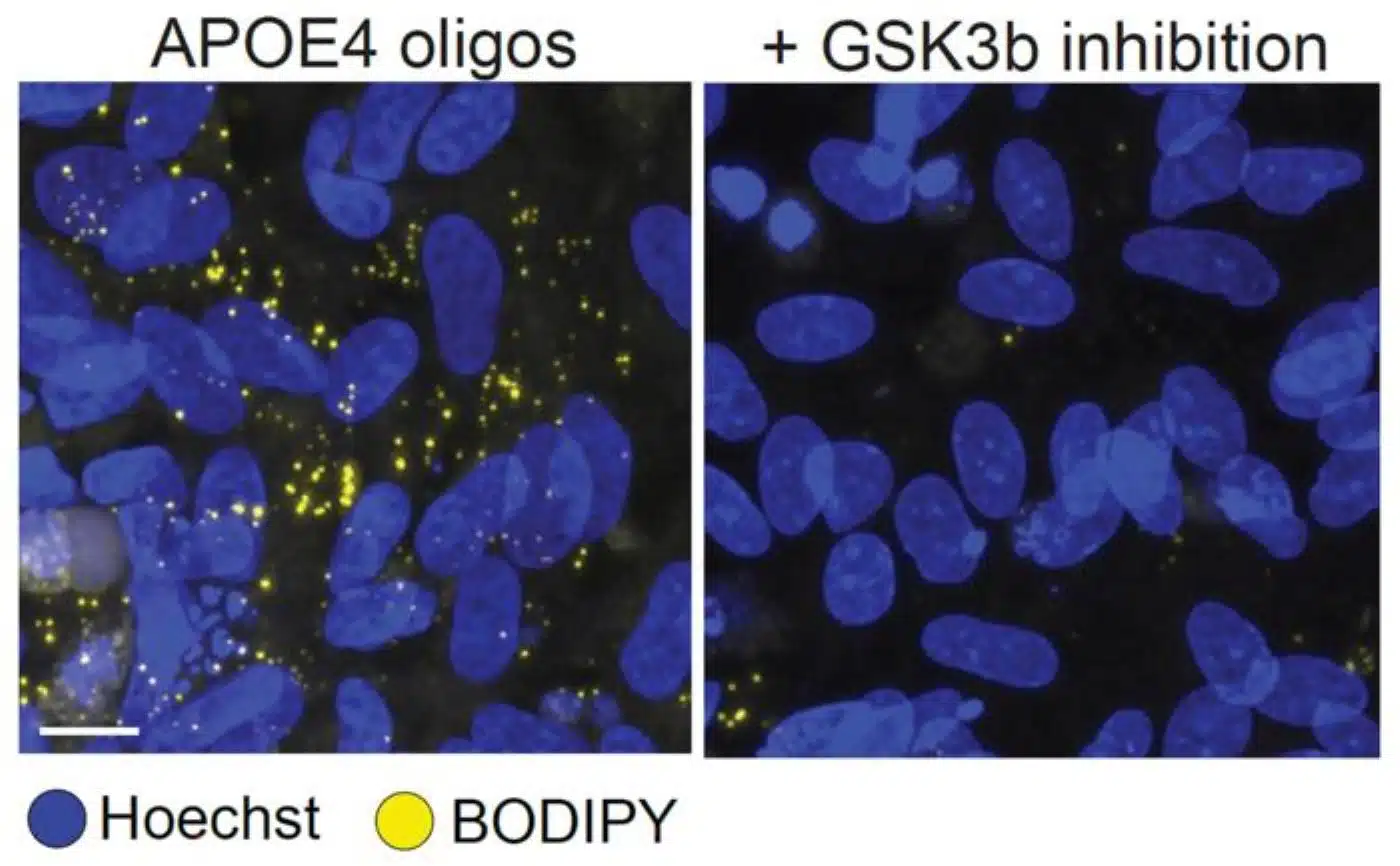
- In APOE4 cells, inhibiting GSK3b with the small molecule CHIR99021 reduced lipid droplets.
- In complex human brain organoids combining APOE4 oligodendrocytes and neurons, inhibiting GSK3b promoted axon growth and restored myelination.
In Vivo Restoration in the Hippocampus
To test the approach in a living system, the researchers administered CHIR99021 to mice carrying human APOE4 and modeling Alzheimer’s tau pathology.
Treated mice exhibited a marked reduction in lipid droplets within the hippocampus, a brain region essential for memory formation. Furthermore, the treated animals showed a significant increase in healthy myelination compared to untreated controls.
“This proof of principle of doing CRISPR screens for genetic modifiers of APOE4-associated lipid accumulation in a central nervous system cell type is very exciting,” Tsai said. “I think this type of screen not only provides new insights into cellular pathways contributing to lipid metabolism defects, but really also has the potential to provide new targets for drug development.”
Because GSK3b is also directly implicated in tau hyperphosphorylation, a hallmark pathology of Alzheimer’s, targeting the Wnt-GSK3b axis offers a dual therapeutic opportunity to repair brain insulation while mitigating tau damage.
Funding: The National Institutes of Health, the Robert and Renee E. Belfer Family Foundation, the Manthripragada McManama Alzheimer’s Fund, the CAMA Seed Fund, the J. Crayton Pruitt Foundation, Joseph P. DiSabato and Nancy Sakamoto and the Freedom Together Foundation provided funding for the study.
Editorial Notes:
- This article was edited by a Neuroscience News editor.
- Journal paper reviewed in full.
- Additional context added by our staff.
About this Alzheimer’s disease Research:
- Media Contact: David Orenstein
- Source: MIT
- Image Credit: Image credited to Tsai Lab/MIT PIcower Institute
- Original Research is Open Access: Cell Stem Cell (Oct 1, 2026). “Genome-wide CRISPR screen reveals Wnt signaling as a potential therapeutic target for lipid accumulation and impaired myelination in APOE4 oligodendrocytes.” Authors: Leyla Anne Akay, Anna Bright, Daiyun Dong, Ethan D. Smith, Robert C. Hurt, Carles A. Boix, Kate Louderback, Janine Medrano, Dingcheng Sun, Haonan Lin, Oisín King, Gwyneth M. Welch, Hiba Nawaid, Emre Agbas, Alan Jiang, Adele Bubnys, Ji-Xin Cheng, Joel W. Blanchard, and Li-Huei Tsai.
- DOI: 10.1016/j.stem.2026.09.012
Abstract
Genome-wide CRISPR screen reveals Wnt signaling as a potential therapeutic target for lipid accumulation and impaired myelination in APOE4 oligodendrocytes
APOE4 is the strongest genetic risk factor for late-onset Alzheimer’s disease, yet the cellular mechanisms linking APOE variants to disease risk remain unclear. We previously found that APOE4 expression causes lipid droplet accumulation in oligodendrocytes, reducing myelination, but the underlying mechanisms were unknown.
Using a genome-wide CRISPR screen and assay for transposase-accessible chromatin (ATAC) sequencing in human-induced pluripotent stem cell (iPSC)-derived oligodendrocytes, we identified decreased Wnt signaling and overactive glycogen synthase kinase-3 beta (GSK3B) as key regulators of lipid-droplet accumulation.
Genetic and pharmacological inhibition of GSK3B reduced lipid droplets in APOE4 oligodendrocytes and increased myelination in three-dimensional iPSC-derived brain organoids. Pharmacological GSK3B inhibition also reduced lipid droplets and improved myelination in APOE4;PS19 tau transgenic mice.
Together, these findings establish a mechanistic framework linking Wnt/GSK3B signaling to APOE4-driven disruptions in oligodendrocyte lipid metabolism and myelination, pointing to GSK3B as a potential therapeutic target for APOE4-associated Alzheimer’s disease.


