

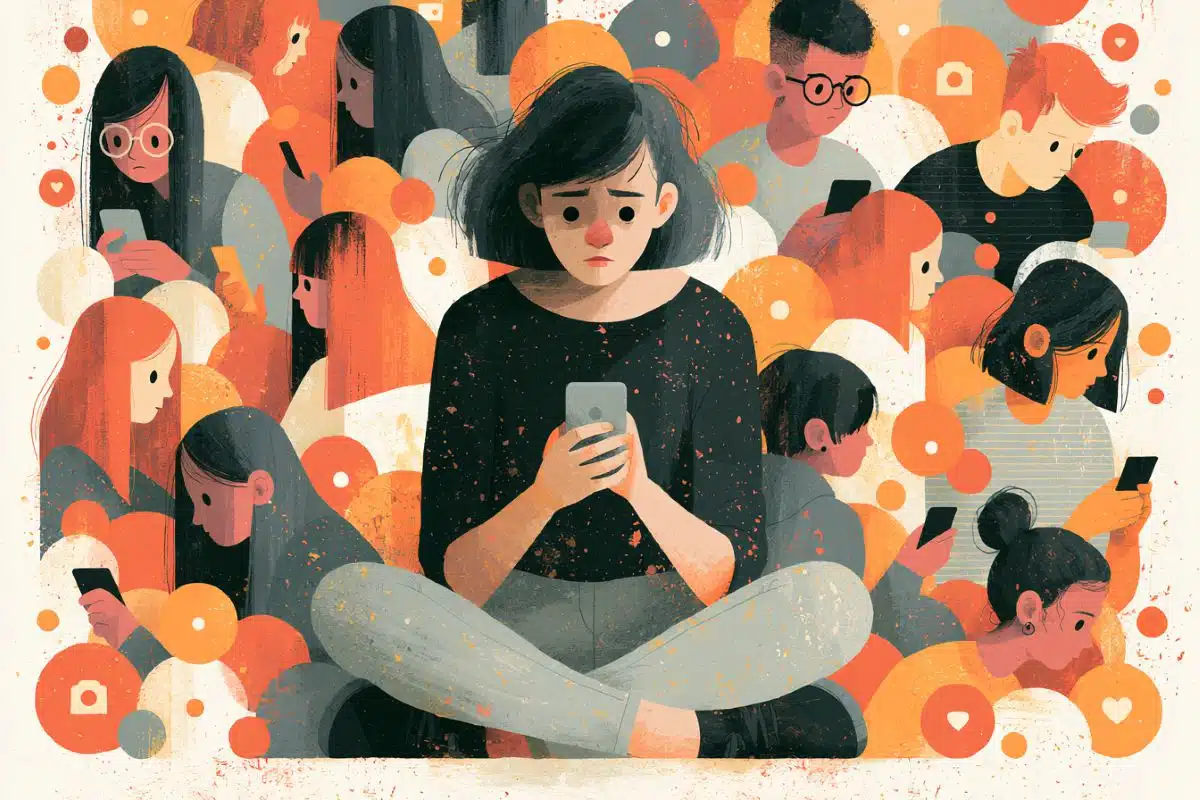
Summary: New research tracked a cohort of 1,066 individuals from age 12 onward through annual surveys from 2018 to 2025. The study addresses modern platforms like TikTok and highlights gender-specific vulnerabilities, showing that girls report higher daily usage and a more pronounced link between social media exposure and anxiety.
The findings underscore dual mechanisms: social comparison coupled with the displacement of real-world prosocial activities, alongside potential reverse causality where distressed youth seek social media for escape.
Key Facts
- Dose-Dependent Mental Health Risks: Teenagers spending six or more hours daily on social media are twice as likely to exhibit anxiety symptoms and three times as likely to report suicidal ideation compared to peers using platforms under one hour daily.
- Longitudinal Cohort Data: The team tracked 1,066 youth starting at average age 12, using annual self-reported data collected between 2018 and 2025 to capture the rise of modern short-form video platforms.
- Usage Demographics: 8.5% of participants used social media for less than one hour daily, over one-third spent one to three hours daily, and more than 17% spent six or more hours daily on these platforms.
- Gender Disparities: Female participants reported higher total social media usage than male participants, and the association between high usage and anxiety symptoms was significantly stronger among girls.
- Validated Clinical Assessments: Psychological distress was evaluated using standardized instruments including the Center for Epidemiological Studies Depression (CES-D) scale and the Generalized Anxiety Disorder (GAD) scale.
Source: UT Houston
Teenagers who spent six or more hours a day on social media were twice as likely to experience symptoms of anxiety and three times as likely to report suicidal ideation than those who spent less than an hour on social media each day, according to researchers at UTHealth Houston.
The findings were published today in Pediatrics Open Science and led by Jeff Temple, PhD, professor and associate dean for clinical research at UTHealth Houston School of Behavioral Health Sciences.
“When teens are using social media, they’re comparing themselves to others. People only post the good on social media, typically, so they only see this happy life where everything’s perfect, and so we compare ourselves to others,” said Temple, who is the Betty and Rose Pfefferbaum Chair in Child Mass Trauma and Resilience at McGovern Medical School at UTHealth Houston. “It could also be that because they’re spending so much time on social media, they’re not spending time in the real world getting typical prosocial stuff that makes us happy and makes us less anxious.”
The opposite could also be true—young adults who are already experiencing symptoms of anxiety and depression may use social media more as a form of escape, Temple said.
Unlike previous studies, which focused heavily on high school or college students and predated new social media platforms like TikTok, Temple’s team focused on emerging adults who were, on average, age 12 when the research began.
Temple and his team used data from a group of 1,066 young adults who self-reported their social media use through annual surveys between 2018 and 2025.
Of the group, 8.5% reported using social media less than an hour a day, while more than a third reported using social media between one and three hours each day. Slightly more than 17% reported using social media for six or more hours each day, with girls reporting higher levels of usage than boys.
Additionally, the association between symptoms of anxiety and social media use was more pronounced among girls, according to the data.
Depression and anxiety symptoms were assessed using the Center for Epidemiological Studies Depression and Generalized Anxiety Disorder scales. The scales ask respondents to self-report how many days in the past week they’ve experienced certain symptoms, such as a poor appetite, trouble sleeping, feeling on edge, or trouble relaxing.
Temple said the study confirms what children and families report anecdotally about mental health and social media use.
“It’s easy to blame what’s in our face, quite literally—phones. Without studies, it’s just opinion,” Temple said. “Once we understand the problem and recognize the problem, then we can start answering the who, what, when, where, why, and how, and determine what we need to do to either make folks look at their smartphones and social media less, or make social media higher quality and less likely to contribute to poor mental health.”
Additional authors with UTHealth Houston include Elizabeth Baumler, PhD, and Leila Wood, PhD.
Key Questions Answered:
A: Older studies primarily examined older high school or college students before the rise of short-form, algorithm-driven video platforms. This study followed a younger cohort starting at age 12 from 2018 to 2025, tracking them through critical developmental stages as modern platforms like TikTok emerged.
A: The researchers highlight two primary drivers: upward social comparison (where youth compare their lived reality to curated highlight reels) and displacement (where excessive screen time replaces real-world social interactions, exercise, and sleep that build resilience).
A: The relationship is likely bi-directional. While exposure to idealized social feeds and sleep loss can heighten anxiety and suicidal ideation, youth experiencing pre-existing emotional distress or depression may also turn to social media as a coping mechanism or form of digital escape.
Editorial Notes:
- This article was edited by a Neuroscience News editor.
- Journal paper reviewed in full.
- Additional context added by our staff.
About this neurodevelopment and mental health research news
Author: Catherine Marfin
Source: UT Houston
Contact: Catherine Marfin – UT Houston
Image: The image is credited to Neuroscience News
Original Research: Open access.
“Associations Between Social Media Use and Mental Health in Emerging Adulthood” by Jeff R. Temple, Elizabeth Baumler, Leila Wood. Pediatrics Open Science
DOI:10.1177/21677026261450607
Abstract
Associations Between Social Media Use and Mental Health in Emerging Adulthood
Introduction
Social media is a central component of daily life for adolescents and young adults. Although moderate engagement can foster belonging, extensive use has been linked to poorer mental health. Most research relies on high school or college students, limiting generalizability to diverse US emerging adults.
Previous work is largely limited to college students, COVID-19 era data, and predates platforms like TikTok. Thus, we examined the cross-sectional association between daily social media use and anxiety, depression, and suicidal ideation among a racially and socioeconomically diverse sample of contemporary emerging adults.
Methods
We used data from the control arm of a longitudinal randomized controlled trial. We recruited and conducted baseline assessments in 2018 (mean age = 12.7), with annual follow-ups. The current sample included participants who completed wave 7 (n = 1066; mean age = 19.7; fielded February-August 2025) when social media questions were included.The sample was 51.7% female, 46.3% Hispanic, and diverse (28.7% Black, 30.3% white, 16.0% Asian, 19.0% other, 5.9% multiracial). We assessed symptoms of depression and anxiety with the Center for Epidemiological Studies Depression and Generalized Anxiety Disorder scales, respectively. Cut points of at least 10 and at least 8 indicated probable depression and anxiety.
We used the Diagnostic and Statistical Manual of Mental Disorders5 Level 1 Cross-Cutting Symptom Measure to assess suicidal ideation (past year; yes/no). We assessed social media use with the following question: “On average, how much time do you spend on social media (eg, Twitter/X, Snapchat, Instagram, TikTok) each day?” Responses were “none,” “over 1 hour,” “between 1 and 3 hours,” “between 3 and 6 hours,” and “over 6 hours.” Because of low endorsement of none (n = 18), we combined the initial 2 responses.
To enhance accuracy, participants were instructed to consult their phone-reported screen time data before responding. We used multilevel linear regression for anxiety and depression symptoms and logistic regression for probable depression and suicidal ideation. We controlled for sex, race, ethnicity, perceived income, and intraclass correlation in all analyses. Race and ethnicity were included as covariates to account for structural and social inequities associated with both social media use and mental health outcomes. The study was approved by the author’s institutional review board.
Results
A total of 8.5% (n = 91) of emerging adults reported using social media less than 1 hour per day, 36.3% (n = 387) reported using it 1 to 3 hours per day, 37.9% (n = 404) reported using it 3 to 6 hours per day, and 17.3% (n = 184) reported using it more than 6 hours per day. Social media use differed by sex (P < 0.001), with girls increasingly represented at higher levels of use.
Anxiety and depression increased robustly and linearly with frequency of social media use (Table 1). Past-year suicidal ideation followed a similar pattern. Associations persisted for anxiety, depression and suicidal ideation, even after accounting for sex, race, ethnicity, and income (Table 2). Relative to emerging adults with less than an hour of daily use, those with over 6 hours of daily use had higher anxiety (OR = 2.63, P < 0.01) and suicidal ideation (OR = 3.23, P = 0.013).
Those reporting over 6 hours of daily use also reported higher depressive symptoms (Beta = 1.73, P = 0.017) and anxiety symptoms (Beta = 2.28, P = 0.001) than those with less than 1 hour per day. Stratification by sex revealed similar overall patterns of association for probable depression, probable anxiety, suicidal ideation, and depression scores.
For anxiety scores, the association with social media use was more pronounced among girls. Formal tests of interaction between sex and social media use were conducted for all outcomes. Interaction terms were not statistically significant for probable anxiety, probable depression, suicidal ideation, or depression symptoms. Formal tests of interaction between sex and social media use were conducted for all outcomes. Interaction terms were not statistically significant for probable anxiety, probable depression, suicidal ideation, or depression symptoms.
A significant interaction was observed only for anxiety symptoms at the highest level of social media use (>6 hours per day), suggesting a stronger association among girls. Given the limited power to detect interaction effects, sex-stratified models are presented for descriptive purposes.


