

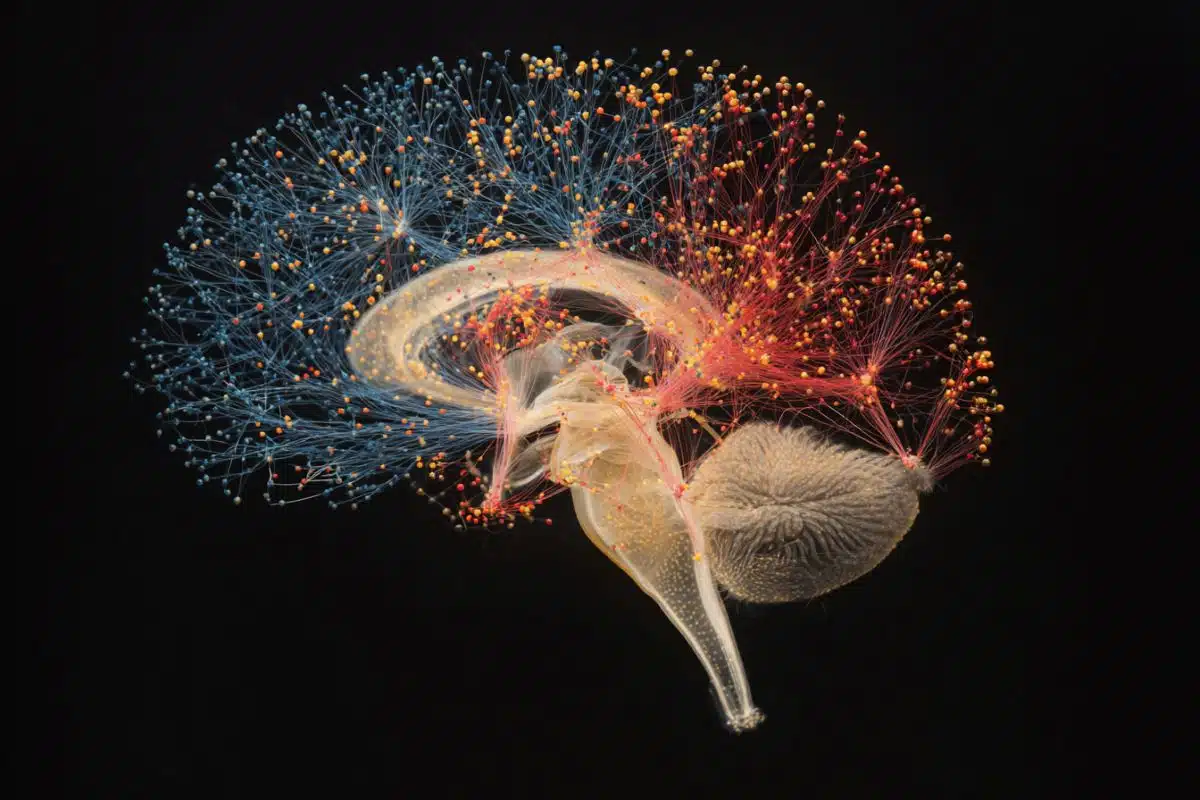
Summary: Researchers uncovered a sex-specific molecular process that dictates how the female brain forms and consolidates fear memories. The study demonstrates that women are twice as likely as men to develop post-traumatic stress disorder (PTSD), despite reporting no higher frequency of traumatic exposure.
By monitoring animal models, the research team isolated a previously unstudied molecular tag, K27 polyubiquitination, that is elevated inside the female hippocampus following a traumatic event. This pathway is entirely absent during male memory formation, proving that the female brain leverages a distinct biological blueprint to encode fear and establishing a new paradigm for sex-tailored PTSD treatments.
Key Facts
- The PTSD Sex Disparity: Women face double the statistical risk of developing PTSD compared to men, yet their reported exposure to traumatic events remains parallel, pointing directly to a hidden neurobiological vulnerability factor.
- The K27 Molecular Signature: Investigators unmasked an active molecular tracking tag known as K27 polyubiquitination that functions as a critical storage mechanism for fear memory exclusively inside the female brain.
- Anatomical Localized Isolation: Using rat models, researchers tracked two separate brain regions responsible for processing emotional trauma:
- The Hippocampus (Contextual Memory Hub): Levels of the K27 molecular tag spiked dramatically in females after a fear-learning experience, while males displayed zero molecular movement.
- The Amygdala (Emotional Processing Center): Surprisingly, no significant changes in K27 polyubiquitination occurred in the amygdala for either sex, showing the mechanism is restricted to broader spatial and contextual memory zones.
- Gene-Editing Disruption Proof: To confirm the pathway’s structural necessity, scientists used target gene-editing techniques to suppress K27 ubiquitination. Following the edit, female models lost the ability to retain fear memories, while male memory consolidation remained completely unimpeded.
- The ACAT1 Protein Attachment: During female memory formation, the K27 tag attaches directly to a protein called ACAT1 inside the hippocampus. Because ACAT1 is a known genetic biomarker linked to Alzheimer’s disease, this discovery suggests the protein serves a dual role in both memory synthesis and cognitive decay.
- The Eight-Tag Polyubiquitination System: Polyubiquitination is an internal eight-part cellular signaling array used to regulate proteins. Early evidence from the National Institute of Mental Health-funded project suggests that while K27 governs female pathways, at least one alternative tag is more active in males.
Source: Virginia Tech
Women are twice as likely as men to develop post-traumatic stress disorder (PTSD) — and new research may offer a biological clue as to why.
A Virginia Tech study found that the female brain forms fear memories using a molecular process not seen in the male brain.
The findings suggest that treatments for PTSD may need to be tailored differently for men and women, said the study’s lead researcher, Timothy Jarome, an associate professor of neurobiology in the School of Animal Sciences located within the College of Agriculture and Life Sciences.
“Women are more likely to have PTSD than men, but they don’t report experiencing more traumatic events,” Jarome said. “This points to a neurobiological mechanism that’s engaged in females during a traumatic event, and it may help explain the difference we see in PTSD.”
Published in the journal Behavioural Brain Research, the study identifies a previously unstudied molecular tag in the brain known as K27 polyubiquitination that appears to play a key role in how the female brain stores fear memories.
Mapping fear memory
Using rats, researchers examined two regions of the brain tied to fear and memory: the hippocampus, which helps connect experiences to places, and the amygdala, which processes fear and emotion.
The team found that levels of K27 polyubiquitination rose in the hippocampus of females after a fear-learning experience, but not in males. When researchers reduced K27 ubiquitination using a gene-editing technique, they found that females had trouble holding onto the memory, while males were unaffected.
“Just because males and females can learn or remember the same experience doesn’t mean how their brains get there is the same,” Jarome said. “If we’re developing treatments for conditions like PTSD or trying to improve memory, we may need different approaches for males and females.”
In the amygdala, the team saw no significant change in K27 polyubiquitination levels after the fear-learning task.
“That was a bit surprising,” Jarome said. “We would typically expect the amygdala to be where you’d see a lot of this happening because it’s so important in emotion. But we saw it in a broader memory region, and it was specific to one sex.”
The researchers also found that K27 polyubiquitination attaches to a protein called ACAT1 in the hippocampus during memory formation in females. ACAT1 has been linked to Alzheimer’s disease, which affects the hippocampus and disrupts memory, raising the possibility that it may play a role in both memory formation and loss, Jarome said.
Students advance memory disorder research
Jarome’s lab focuses on understanding the molecular mechanisms behind memory disorders, including Alzheimer’s disease, dementia, and PTSD, with the goal of finding better ways to treat them. This project and its student research team were funded by a grant from the National Institute of Mental Health.
Students — both graduate and undergraduate — played a central role in the research. Former Ph.D. students Morgan Patrick and Shannon Kinkaid served as the study’s lead authors, alongside a multidisciplinary team of student researchers and collaborators across Virginia Tech.
Jarome and his team are now studying other forms of polyubiquitination — a molecular tagging system cells use to regulate proteins — to see how each may differ between males and females. There are eight known forms of this tag, and early evidence suggests at least one may be more active in males.
Key Questions Answered:
A: It is driven by an underlying biological difference in how the brain builds memories. Virginia Tech discovered that the female brain engages a unique molecular tagging process during a traumatic event—specifically using a tag called K27 polyubiquitination, that does not occur in the male brain at all.
A: The memory essentially destabilizes. When researchers used gene-editing tools to block K27 ubiquitination in female models, they found that the females had severe trouble holding onto fear memories, whereas males were completely unaffected by the exact same edit.
A: Yes, the data strongly points in that direction. Because the male and female brains utilize entirely different chemical pathways to construct identical fear memories, physicians will likely need to design sex-specific treatments that target distinct molecular components.
Editorial Notes:
- This article was edited by a Neuroscience News editor.
- Journal paper reviewed in full.
- Additional context added by our staff.
About this PTSD research news
Author: Margaret Ashburn
Source: Virginia Tech
Contact: Margaret Ashburn – Virginia Tech
Image: The image is credited to Neuroscience News
Original Research: Open access.
“Non-canonical K27 polyubiquitination is a sex-specific regulator of contextual fear memory in the hippocampus but not the amygdala” by Morgan B. Patrick, Shannon E. Kincaid, Kaiser C. Arndt, Yeeun Bae, Olivia N. Ball, Adam Cummings, Jennifer R. Abraham, Gitali Bhanot, W. Keith Ray, and Timothy J. Jarome. Behavioural Brain Research
DOI:10.1016/j.bbr.2026.116195
Abstract
Non-canonical K27 polyubiquitination is a sex-specific regulator of contextual fear memory in the hippocampus but not the amygdala
Polyubiquitination is a process whereby multiple ubiquitin proteins link to each other on a target substrate, marking that substate for various cellular processes of which protein degradation via the proteasome is the most common.
Recently, evidence has emerged suggesting that the most common forms of proteasome-dependent (K48) and proteasome-independent (K63, M1) polyubiquitination have sex-specific roles in contextual fear memory formation in the amygdala and hippocampus.
However, there are 8 different linkage sites at which polyubiquitin chains can form, most of which have not been studied in the brain. Lysine 27 (K27) polyubiquitination is a less common, non-canonical mark that has not been well studied and may be connected to the protein degradation process. To date, K27 polyubiquitination has never been examined in the brain under any condition.
Here, we found that K27 polyubiquitination was selectively increased in the hippocampus after contextual fear conditioning in female, but not male, rats, though neither sex showed changes in this polyubiquitin mark in the amygdala.
Consistent with this, CRISPR-dCas13-mediated knockdown of K27 polyubiquitination in the hippocampus selectively impaired contextual fear memory retention in the hippocampus of females, but not males.
Proteomic analyses revealed ACAT1 as a target of K27 polyubiquitination in the female hippocampus following fear conditioning, though this mark was not associated with degradation of the target protein. Together, these data suggest that K27 polyubiquitination has a sex-selective role in fear memory formation in the hippocampus.
These findings advance our understanding of molecular mechanisms of fear memory formation and the importance of sex as a biological variable in this process.


