

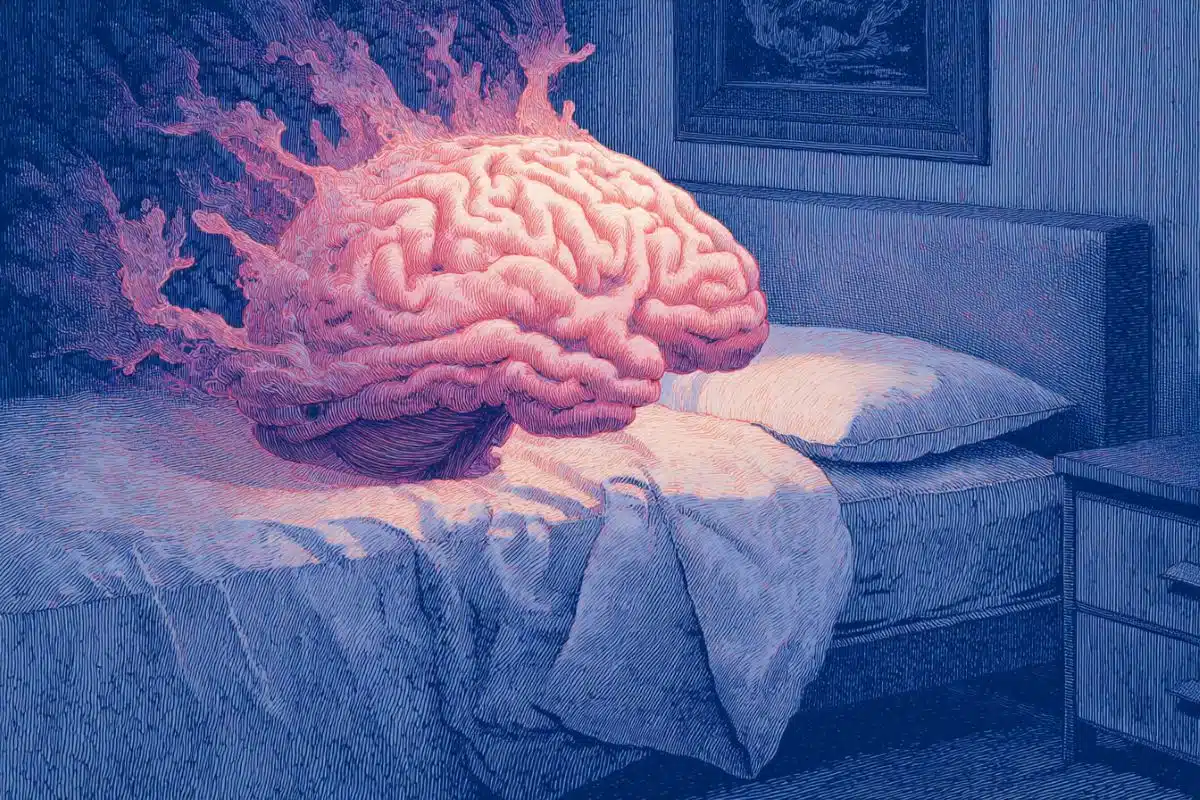
Summary: A new study proposes that chronic stress, depression, cardiovascular disease, poor sleep, and aging all increase dementia risk because they converge on a single biological bottleneck: the disruption of a sleep-dependent brain rhythm that clears metabolic waste.
The study argues that sleep is a highly organized fluid-transport state. When its synchronized rhythms are disrupted, the brain’s glymphatic system fails to efficiently flush out toxic amyloid-beta and tau proteins, paving the way for cognitive decline.
Key Facts
- The Unified Blueprint: Seemingly unrelated conditions like stress, depression, aging, and heart disease may all drive dementia through the same mechanism: crippling the brain’s nightly cleaning process.
- The Glymphatic Engine: Discovered by Nedergaard’s lab in 2012, the glymphatic system circulates cerebrospinal fluid (CSF) through brain tissue to clear out metabolic waste. This system is highly active during sleep.
- Synchronized Neuromodulators: During non-REM sleep, brain chemicals like norepinephrine, serotonin, dopamine, and acetylcholine synchronize into slow, repeating waves that ripple through the brain roughly once a minute.
- Vasomotion Power: These chemical waves drive slow, rhythmic changes in blood vessel size called vasomotion. Independent of the heart’s pumping action, these vascular movements physically push CSF through the brain to flush toxic proteins.
- The Wearable Biomarker: The review highlights heart rate variability (HRV), the subtle timing changes between heartbeats, as a potential biomarker for brain cleaning efficiency. Because HRV during sleep tracks the brain’s chemical rhythms, consumer wearables could eventually flag dementia risks before symptoms start.
Source: University of Rochester
Why are conditions such as chronic stress, depression, cardiovascular disease, fragmented sleep, and aging all associated with a higher risk of dementia?
In a new review piece in Science, University of Rochester Medicine neuroscientist Maiken Nedergaard, MD, DMSc, proposes that many of these seemingly different conditions may converge on the same biological problem: disruption of a sleep-dependent brain rhythm that helps clear waste from the brain.
The article presents a new way of thinking about sleep, not simply as a period of rest, but as a highly organized biological state that coordinates brain chemistry, blood vessel movement, and cerebrospinal fluid flow to support the brain’s nightly cleaning process.
The piece also points to a potential biomarker, heart rate variability, which can already be tracked with consumer wearables, as a simple, noninvasive way to assess sleep-related brain health and identify people at increased risk for cognitive decline.
“Sleep is not a quiet or inactive state,” Nedergaard said. “During sleep, the brain shifts into a coordinated rhythm that appears to support one of its most important housekeeping functions.”
Nedergaard’s lab at URochester Medicine helped transform neuroscience research in 2012 with the discovery of the glymphatic system, a brain-wide network that circulates cerebrospinal fluid through tissue surrounding blood vessels to help remove metabolic waste. The system is especially active during sleep and has since become central to research into Alzheimer’s disease, Parkinson’s disease, stroke, traumatic brain injury, and other neurological disorders.
A synchronized sleep rhythm
The article focuses on neuromodulators—brain chemicals such as norepinephrine, serotonin, dopamine, and acetylcholine that regulate mood, attention, learning, and behavior during wakefulness.
These systems behave differently during non-REM sleep, becoming synchronized into slow, repeating oscillations that occur roughly every minute. These rhythms are linked to changes in brain activity, heart rate, breathing, blood vessel movement, and cerebrospinal fluid flow.
“For decades, we thought about sleep primarily in terms of memory and restoration,” Nedergaard said. “What is emerging now is the idea that sleep is also a highly organized fluid-transport state that helps maintain brain health.”
Sleep and the brain’s cleaning system
These synchronized oscillations help power the glymphatic system by driving slow rhythmic changes in blood vessel size known as vasomotion. Those vascular movements, which are independent of the heart’s pumping action, help push cerebrospinal fluid through the brain and remove waste products, including amyloid-beta and tau proteins associated with Alzheimer’s disease and other dementias.
Nedergaard argues that when these rhythms are disrupted by aging, stress, psychiatric illness, cardiovascular disease, poor sleep, or certain medications, the brain becomes less efficient at clearing toxic proteins.
“Many disorders that increase dementia risk also disrupt the brain’s sleep rhythms,” Nedergaard said. “Our work suggests these may not be separate phenomena. They may be connected through the brain’s ability to clear waste during sleep.”
A potential new biomarker
The article also highlights heart rate variability, subtle changes in the timing between heartbeats, as a possible biomarker of sleep-related brain health. Researchers found that heart rate fluctuations during sleep appear closely tied to the same neuromodulator rhythms occurring in the brain.
Nedergaard believes this could eventually provide a noninvasive way to monitor the health of the brain’s nighttime clearance system and potentially identify people at increased risk for cognitive decline before symptoms appear.
Key Questions Answered:
A: Through heart rate variability (HRV). The same chemical waves that control your brain’s nighttime cleaning cycles also control the subtle fluctuations in your heart rate while you sleep. Because consumer wearables can already track HRV, this metric could serve as a simple, noninvasive dashboard to check your brain’s nightly waste disposal efficiency.
A: Your heart pumps blood continuously, but the brain’s waste-clearing glymphatic system relies on a gentler, slower mechanism. Vasomotion is the rhythmic expanding and contracting of blood vessels driven by sleep chemicals, completely independent of your pulse. It acts like a slow pump that pushes fluid through tissue to wash away toxic proteins.
A: While it isn’t a guaranteed cure, the science shows that deep, uninterrupted sleep is a mandatory baseline for defense. Disrupted sleep rhythms leave toxic waste behind. Protecting your sleep health helps keep this vital plumbing network running smoothly as you age.
Editorial Notes:
- This article was edited by a Neuroscience News editor.
- Journal paper reviewed in full.
- Additional context added by our staff.
About this neuroscience and dementia research news
Author: Mark Michaud
Source: University of Rochester
Contact: Mark Michaud – University of Rochester
Image: The image is credited to Neuroscience News
Original Research: Closed access.
“The oscillatory biology of sleep: Linkage to dementia” by Maiken Nedergaard. Science
DOI:10.1126/science.aeg2276
Abstract
The oscillatory biology of sleep: Linkage to dementia
During wakefulness, neuromodulators operate largely independently to support behavior and cognition. By contrast, sleep reorganizes their activity into a coordinated brain rhythm.
During sleep, the major neuromodulators—norepinephrine, acetylcholine, serotonin, and dopamine—exhibit synchronized fluctuations with a periodicity of ~50 seconds.
These oscillations appear as recurrent bursts of fast (10 to 30 hertz) electroencephalography activity and are phase-coupled to cerebrospinal fluid flow. Neuromodulators are vasoactive agents and drive slow vasomotion, which provide the mechanical force that supports glymphatic clearance of metabolic waste.
Disruption of neuromodulator signaling, as seen in psychiatric disorders, cardiovascular disease, aging, or with commonly prescribed drugs, impairs clearance of neurotoxic proteins, including amyloid-β and tau.
Failure of this evolutionarily conserved brain rhythm may therefore represent a previously unrecognized mechanistic pathway linking diverse disorders with sleep disturbances to increased dementia risk.


