Summary: Researchers identified a specific “long non-coding” RNA gene, PTCHD1-AS, that influences the core behavioral traits of Autism Spectrum Disorder (ASD).
The study reveals that deletions in this X-linked gene specifically impact social interaction and repetitive behaviors in males without affecting cognitive abilities like learning or memory. This discovery helps isolate the biological mechanisms of autism’s hallmark traits from other developmental functions.
Key Research Findings
- A “Non-Coding” Discovery: PTCHD1-AS belongs to a class of genes called long non-coding RNAs (lncRNAs), which act as regulators that turn other genes on and off. This distinguishes it from the ~100 other ASD-linked genes that primarily encode proteins.
- Behavioral Specificity: Deletions of PTCHD1-AS on the X chromosome were found to increase ASD susceptibility in males. In mouse models, those lacking this gene showed typical attention and memory but exhibited increased repetitive actions and altered social behavior.
- Striatal Circuitry: The team pinpointed the striatum, the brain region responsible for regulating repetitive behaviors, as the primary site of impact.
- Synaptic Plasticity: Disrupting PTCHD1-AS affected the brain’s ability to fine-tune signals (synaptic plasticity) and the process of myelination, which allows electrical signals to travel faster between neurons.
- The Protein Kinase C Link: The behavioral changes were traced to reduced activity of protein kinase C in a specific circuit connecting the cortex to the striatum.
Source: Hospital for Sick Children
A long‑overlooked stretch of the human genome appears to play a distinct role in shaping the social and stereotypic repetitive behaviours that define Autism Spectrum Disorder (ASD), without affecting learning or other cognitive abilities, according to a major new study published in Nature.
A research team led by The Hospital for Sick Children (SickKids) has pinpointed PTCHD1-AS, a long non-coding RNA gene on the X chromosome, as a contributor to increased likelihood of ASD in males. Notably, deletions within PTCHD1-AS influence social interaction and repetitive behaviours, while leaving cognition unaffected.
While there are around 100 genes and copy number variations linked to ASD, most encode proteins and are linked to a wide range of developmental outcomes. These findings help distinguish the biological mechanisms underlying Autism’s hallmark behavioural traits from those involved in other brain functions.
“PTCHD1-AS gives us a new entry point to study the biology of ASD, sharpening our understanding of how specific biological pathways relate to key autism traits. This is essential, because no new therapeutics in clinical trials are designed to modulate the main features of ASD,” says senior author Dr. Stephen Scherer, Senior Scientist, Genetics & Genome Biology and Chief of Research at SickKids, and Director of the McLaughlin Centre at the University of Toronto.
A non-coding gene with a distinct role
Roughly one in 50 children and youth in Canada have ASD. Despite the diverse ways they experience the condition, changes in social interaction and repetitive behaviours are common across the spectrum.
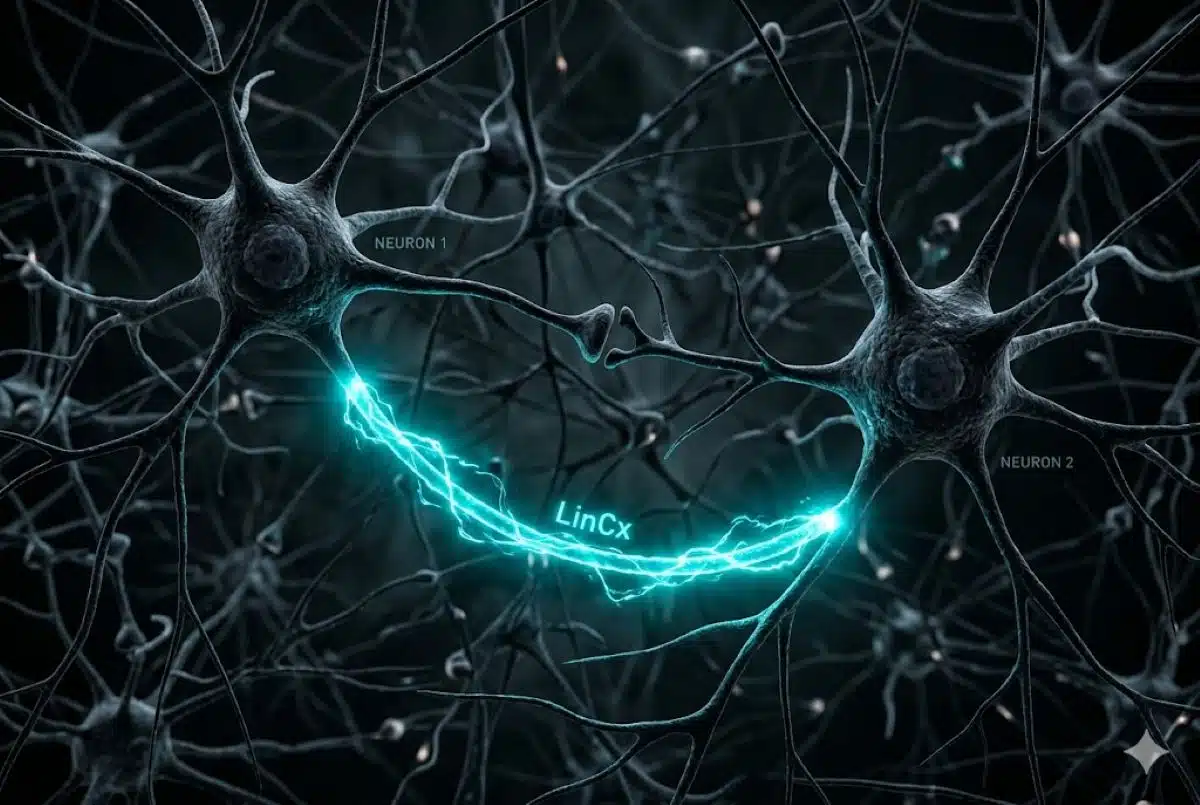
Long non‑coding RNAs (lncRNAs), such as PTCHD1-AS, regulate how other genes become turned on and off and until recently have been largely unexplored. Researchers targeted PTCHD1-AS because it sits in a region close to other protein-coding genes that together have been linked to ASD and intellectual disability.
In studying genomic data from over 9,300 individuals in global databases, they discovered that dozens of deletions of the X-linked PTCHD1‑AS were associated with increased ASD susceptibility in males (females have a backup X chromosome).
Follow‑up studies using mouse models developed by the research team further reinforced these findings. Male mice lacking PTCHD1-AS showed changes only in social behaviour and increased repetitive actions while they behaved typically in learning, memory and attention tasks.
“Our findings suggest there is a different biology involved with our PTCHD1-AS model compared to other ASD protein-coding models,” says Dr. Lisa Bradley, first author and Research Associate in The Centre for Applied Genomics (TCAG) at SickKids.
How PTCHD1-AS influences brain circuitry
What was happening in the brains of these mice? The team found that disrupting PTCHD1‑AS affected “synaptic plasticity,” the brain’s ability to adapt and fine-tune signals in response to activity, inside the striatum, where repetitive behaviours are regulated.
“When we examined gene and protein expression in this area, we saw changes in genes and proteins involved in regulating synaptic plasticity as well as myelination, the process that allows electrical signals to travel faster between neurons. This gives us a molecular pattern we can use for future studies into the biological effect of this non-coding gene in the brain,” adds Bradley.
They traced these changes to reduced activity of protein kinase C in a specific brain circuit connecting the cortex to the striatum, alongside increases in two forms of synaptic plasticity.
“Through a multi-disciplinary approach combining human genetics, mouse models, multi-omics and electrophysiology, we’ve connected a non-coding gene to measurable changes in brain function,” says study co-author Dr. Graham Collingridge, Senior Investigator at Lunenfeld-Tanenbaum Research Institute, Sinai Health and Director of the Tanz Centre for Research in Neurodegenerative Diseases and Professor in the Department of Physiology at Temerty Faculty of Medicine at the University of Toronto.
“Together, our research helps clarify how unique alterations in synaptic plasticity relate to the core features of autism.”
Toward a more precise understanding of ASD biology
The research team notes by linking a specific gene and biological pathway to social and repetitive behaviours, these findings may be relevant across all ASD diagnoses, regardless of clinical complexity.
Next steps for the research include deeper investigation of the molecular, cellular and circuit-level pathways influenced by PTCHD1-AS to identify potential targets driving those core features of ASD and thereby inform future precision therapeutics for those who seek them.
Scherer, who is also a Professor in the Department of Molecular Genetics at Temerty Faculty of Medicine at University of Toronto, adds: “Beyond significantly advancing our understanding of Autism as a human condition, the study shows how small changes in DNA can influence complex human behaviour.”
“It’s amazing to me how much of our disposition is genetically ‘hardwired,’ even in the traits that shape how we connect and interact,” he says.
Funding: The study was funded through support from Autism Speaks, Autism Science Foundation, Canada Foundation for Innovation (CFI), Canadian Institutes of Health Research (CIHR), Genome Canada and Ontario Genomics, the Government of Ontario, Ontario Brain Institute, the Province of Ontario Neurodevelopment Disorders (POND) Network, Simons Foundation Autism Research Initiative, University of Toronto McLaughlin Centre and SickKids Foundation.
Key Questions Answered:
A: PTCHD1-AS is located on the X chromosome. Because males have only one X chromosome, a deletion in this gene has a direct impact. Females have a second “backup” X chromosome that can often compensate for the loss.
A: This is the major breakthrough of the study. Most known autism genes affect a wide range of brain functions, including cognition. PTCHD1-AS is unique because it specifically regulates the brain circuits in the striatum responsible for social and repetitive behaviors, leaving the centers for learning and memory intact.
A: Currently, no clinical trials are designed to modulate the core features of ASD. By identifying the specific molecular pathway involving protein kinase C and synaptic plasticity, researchers have a “new entry point” to develop precision therapeutics that target the core traits of autism directly.
Editorial Notes:
- This article was edited by a Neuroscience News editor.
- Journal paper reviewed in full.
- Additional context added by our staff.
About this genetics and autism research news
Author: Jelena Djurkic
Source: Hospital for Sick Children
Contact: Jelena Djurkic – Hospital for Sick Children
Image: The image is credited to Neuroscience News
Original Research: Open access.
“An X-linked long non-coding RNA, PTCHD1-AS, and the core features of autism” by Clarrisa A. Bradley, Sangyoon Y. Ko, Meng Tian, Liam T. Ralph, Lia D’Abate, Jinyeol Lee, Tianyi Liu, Junhui Wang, Patrick Tidball, Marla Mendes, Xiaolian Fan, Jennifer L. Howe, Roumiana Alexandrova, Giovanna Pellecchia, Guillermo Casallo, Tara Paton, Leanne E. Wybenga-Groot, Worrawat Engchuan, Bhooma Thiruvahindrapuram, Brett Trost, Jill de Rijke, Ashish Kadia, Fuzi Jin, Nelson Bautista Salazar, J. Javier Diaz-Mejia, Jeffrey R. MacDonald, Eric Deneault, P. Joel Ross, James Ellis, Carole Shum, John Georgiou, Olivia Rennie, Miriam S. Reuter, Ny Hoang, Ege Sarikaya, Thanuja Selvanayagam, Aeen Ebrahim Amini, Annabel Rutherford, Natalia Rivera-Alfaro, Christian R. Marshall, Marcello Scala, Cassandra K. Runke, Hutton M. Kearney, John Christodoulou, David I. Francis, Brian H. Y. Chung, Jill Pluciniczak, Alana Iaboni, Kristen M. Wigby, Christine W. Nordahl, David G. Amaral, Melissa L. Hudson, Calvin P. Sjaarda, Andrea Guerin, Mayada Elsabbagh, Rebecca Landa, Seema Mital, Robert Lesurf, Anjali Jain, Michael D. Wilson, Jacob Ellegood, Jason P. Lerch, Leo J. Lee, Brendan J. Frey, Michael W. Salter, Jacob A. S. Vorstman, Evdokia Anagnostou, Paul W. Frankland, Graham L. Collingridge & Stephen W. Scherer. Nature
DOI:10.1038/s41586-026-10515-6
Abstract
An X-linked long non-coding RNA, PTCHD1-AS, and the core features of autism
There are around 100 genes or copy-number variations used in genetic testing for autism spectrum disorder (ASD). The established genes are protein coding, and the associated phenotypes usually extend beyond sociobehavioural traits seen in autism, including cognitive/medical complexities and attention deficit hyperactivity disorder (ADHD).
We examined whole-genome sequencing data in cases of ASD (9,349) and controls (8,332) and identify 27 male individuals with ASD with X-chromosome microdeletions that implicate the long non-coding RNA PTCHD1-AS as an ASD-susceptibility gene (odds ratio = 2.56, P = 0.01).
Two Ptchd1-as-knockout mouse models, which were created by disrupting/deleting the evolutionarily conserved exon 3, show ASD-like features in male mice, including increased repetitive behaviours and impaired social behaviour and communication without cognitive comorbidities or ADHD-like behaviours.
Hippocampus-dependent synaptic function, complex learning and locomotor activity are unaffected in knockout mice. Native nuclear-enriched mouse Ptchd1-as showed sustained expression from postnatal day 7 onwards in the dorsal striatum, a predominantly GABAergic brain region that is implicated in ASD.
Multi-omics analysis revealed transcriptomic alterations in striatal oligodendrocytes, astrocytes and neurons impacting myelination and synaptic plasticity.
Disrupting Ptchd1-as led to reductions in conventional protein kinase C (cPKC) isoforms, altered SRC and GSK-3α/β phosphorylation and enhanced striatal synaptic plasticity (long-term potentiation and long-term depression).
Together, these findings implicate striatal molecular and circuit-level dysregulation through PTCHD1-AS in ASD aetiology.