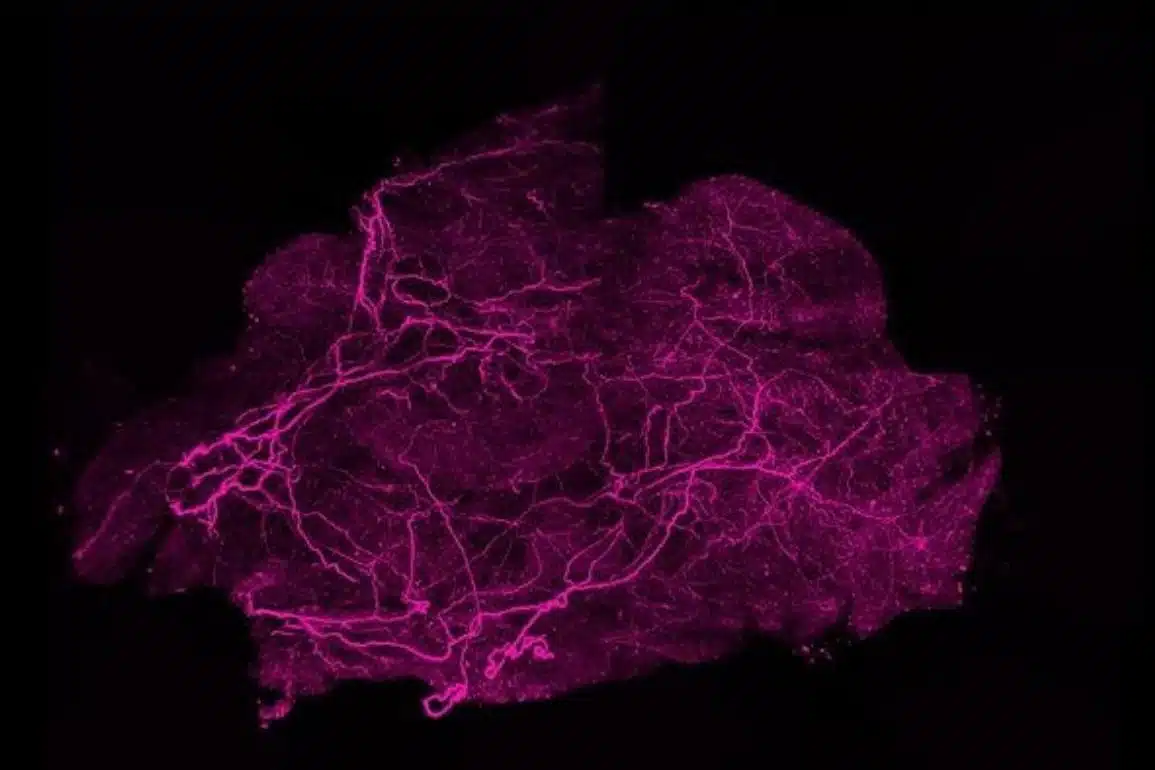
Summary: New research reveals how psychedelic drugs reshape brain communication by suppressing normal visual processing and amplifying memory-linked circuits, which helps explain hallucinations at a neural level.
Using high-resolution imaging in animal models, scientists observed enhanced low-frequency oscillations that activate memory hubs, shifting perception from real-time input to internally generated imagery. This dynamic offers insight into both psychedelic experience and emerging therapeutic uses.
Key Facts:
- 5-HT2A Receptor Activation: Psychedelics bind most strongly to the serotonin 2A receptor, lowering the brain’s responsiveness to external visual stimuli.
- Oscillatory Shift in the Cortex: After psychedelic administration, visual brain areas show stronger low-frequency (5 Hz) oscillations that drive activity in memory-related regions like the retrosplenial cortex.
- Mechanism of Hallucinations: Reduced access to external visual information leads the brain to fill in gaps with memory fragments, explaining hallucination generation.
Source: RUB
Psychedelic substances are increasingly being used under medical supervision to treat anxiety disorders and depression. However, the mechanisms by which these substances influence our perception and consciousness are largely unknown.
A research team from Hong Kong, Singapore, and Ruhr University Bochum, Germany, has now, for the first time, shown high-resolution images of brain activities in an animal model after the administration of psychedelics.
The scientists discovered that visual processes increasingly access brain regions that retrieve memory contents and associations. This could explain how visual hallucinations arise.
The scientists report in Communications Biology on February 11, 2026.
Hallucinations fill the gap
Psychedelics activate a specific serotonin receptor. At least 14 different receptors are known where the neurotransmitter serotonin binds. Psychedelics have the highest affinity for the 2A receptor, which, among other effects, acts suppressive in the visual brain and also influences learning processes.
“We have observed in earlier studies that visual processes in the brain are suppressed by this receptor,” says Callum White, first author of the study.
“This means that visual information about things happening in the outside world becomes less accessible to our consciousness. To fill this gap in the puzzle, our brain inserts fragments from memory – it hallucinates.”
Short-term oscillations trigger communication between brain areas
In their current study, the authors show how this happens. Psychedelics intensify oscillations in visual brain areas. Generally speaking, oscillations are synchronized neural activity waves that modulate communication between brain regions.
After administration of psychedelics the scientist found that visual areas produce increasingly low-frequency (5-Hz) activity waves that activate another brain region, the retrosplenial cortex. This area forms a major hub for the exchange with stored information.
The brain thus switches to a new mode in which access to ongoing events is hindered and instead perceptions are increasingly generated from memory contents, “a bit like partial dreaming,” says Professor Dirk Jancke, leader of the study.
Visualizing the dynamics of brain activity in real-time
To visualize these complex processes, the scientists use an optical method that records neural activity in real-time over the entire brain surface. The mice developed by Professor Thomas Knöpfel from Hong Kong Baptist University are genetically manipulated so that they express fluorescent proteins in defined cell types.
“We therefore know exactly in our experiments that the measured fluorescent signals originate from pyramidal cells of the cortical layers 2/3 and 5, which mediate communication within and between brain regions,” says Jancke.
Developing new therapy approaches
The results support new approaches in psychology that use psychedelics to treat, for example, anxiety disorders or depression.
“When used under medical supervision, such substances can temporarily change the state of the brain to selectively recall positive memory content and restructure learned, excessively negative thought patterns, i.e., to be able to unlearn negative context. It will be exciting to see how such therapies are further personalized in the future,” says Jancke.
Funding: The study was partly funded by the Deutsche Forschungsgemeinschaft through the Research Training Group (RTG 2862/1) “Monoaminergic Neuronal Networks & Disease” (MoNN&Di) and the Collaborative Research Center (CRC) 874.
Key Questions Answered:
A: Psychedelics strongly activate the serotonin 2A receptor, which dampens normal visual processing and promotes new communication patterns between brain regions.
A: Suppressed sensory input forces the brain to draw on stored memories, creating internally generated perceptions that appear as hallucinations.
A: Yes — understanding how psychedelics rewire perception may improve supervised treatments for anxiety and depression by reshaping learned negative thought patterns.
Editorial Notes:
- This article was edited by a Neuroscience News editor.
- Journal paper reviewed in full.
- Additional context added by our staff.
About this psychedelics and neuroscience research news
Author: Meike Driessen
Source: RUB
Contact: Meike Driessen – RUB
Image: The image is credited to Neuroscience News
Original Research: Open access.
“Psychedelic 5-HT2A agonist increases spontaneous and evoked 5-Hz oscillations in visual and retrosplenial cortex” by Callum M. White, Zohre Azimi, Robert Staadt, Chenchen Song, Thomas Knöpfel, Dirk Jancke. Communications Biology
DOI:10.1038/s42003-025-09492-9
Abstract
Psychedelic 5-HT2A agonist increases spontaneous and evoked 5-Hz oscillations in visual and retrosplenial cortex
Visual perception appears largely stable in time. However, psychophysical studies have revealed that low frequency (0.5 – 7 Hz) oscillatory dynamics can modulate perception and have been linked to various cognitive states and functions.
Neither the contribution of waves around 5 Hz (theta or alpha-like) to cortical activity nor their impact during aberrant brain states have been resolved at high spatiotemporal scales.
Here, using cortex-wide population voltage imaging in awake mice, we found that bouts of 5-Hz oscillations in the visual cortex are accompanied by similar oscillations in the retrosplenial cortex, occurring both spontaneously and evoked by visual stimulation.
Injection of psychotropic 5-HT2AR agonist induced a significant increase in spontaneous 5-Hz oscillations, and also increased the power, occurrence probability and temporal persistence of visually evoked 5-Hz oscillations.
This modulation of 5-Hz oscillations in both cortical areas indicates a strengthening of top-down control of perception, supporting an underlying mechanism of perceptual filling and visual hallucinations.