

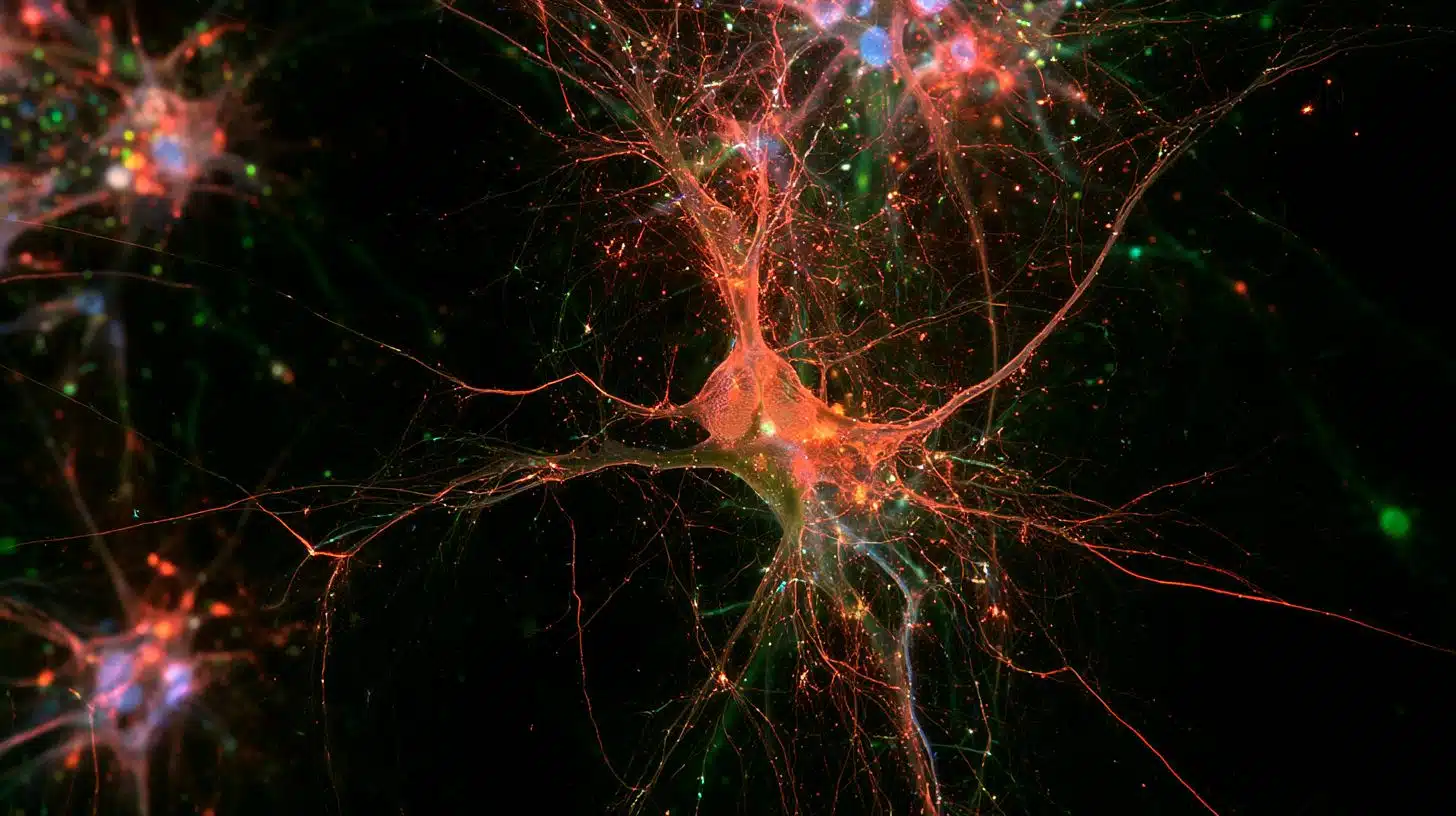
Summary:
Researchers at the University of Birmingham have discovered that targeting the P2X7 receptor in human brain tissue directly suppresses damaging neuroinflammation. Published in the journal Brain, the study utilized living human brain slices from neurosurgery and scalable human monocyte-derived microglia to prove that blocking P2X7 stops the release of pro-inflammatory cytokines. The breakthrough positions existing P2X7 antagonist drugs for rapid repurposing across a spectrum of disorders, from traumatic brain injury and Alzheimer’s to Parkinson’s and severe depression.
Key Facts:
- The P2X7 Inflammatory Gate: The P2X7 receptor acts as a primary trigger for inflammatory signaling in the central nervous system; blocking it with a targeted antagonist sharply halts the release of destructive cytokines in living human brain tissue.
- Breakthrough Human Model: The team successfully converted accessible peripheral blood monocytes into functional microglia-like cells, overcoming the historical obstacle of human microglia rapidly losing their native properties when cultured outside the brain.
- Broad Repurposing Pipeline: Because existing P2X7 antagonists have already undergone clinical testing, this discovery provides a direct, accelerated bridge to clinical trials for conditions lacking targeted anti-inflammatory drugs, including traumatic brain injury (TBI), multiple sclerosis, and treatment-resistant psychosis.
Source: University of Birmingham
Halting the Destructive Cascade of Neuroinflammation
Neuroinflammation is recognized as a shared, insidious driver across virtually all major brain disorders. Whether initiated acutely by physical mechanical impact, such as traumatic brain injury (TBI) and concussions, or brewing chronically over decades in neurodegenerative conditions like Alzheimer’s disease, Parkinson’s disease, and multiple sclerosis, runaway inflammation destroys synapses, impairs neuronal firing, and accelerates cell death. Mounting evidence also implicates neuroinflammatory cascades in psychiatric conditions, including major depressive disorder and schizophrenia.
Despite its catastrophic impact, modern medicine lacks targeted pharmacological treatments capable of shutting down neuroinflammation once it takes hold in the central nervous system.
Now, a team of researchers led by the University of Birmingham has identified a precise molecular target capable of stopping this inflammatory cascade at its source.
Published in the journal Brain, the first-of-its-kind study demonstrated in living human brain tissue that inhibiting the P2X7 receptor cuts off inflammatory cytokine cascades. Crucially, because compounds targeting the P2X7 receptor already exist and have been evaluated in human clinical settings, the discovery offers a rapid pathway to repurpose available pharmaceuticals.
“This exciting discovery marks a major step toward repurposing existing therapeutics to combat neuroinflammation at its source,” said corresponding author Nicholas Barnes, Ph.D., Professor of Neuropharmacology at the College of Medicine and Health at the University of Birmingham.
“The identification of this receptor could have far-reaching implications for some of the most debilitating and widespread brain disorders such as Alzheimer’s Disease, Parkinson’s and Multiple Sclerosis, or inflammation-linked psychiatric conditions like schizophrenia and depression.”
Overcoming the Microglial Research Hurdle
To decipher neuroinflammatory pathways in living human tissue, the research team had to solve a longstanding methodology bottleneck. Microglia, the resident immune sentinels of the central nervous system, play a primary role in sensing damage, clearing cellular debris, and releasing signaling cytokines.
However, primary human microglia are notoriously difficult to study. Once extracted from their native microenvironment, they rapidly alter their gene expression, shed their cellular branching, and lose their physiological identity.
To bypass this barrier, Professor Barnes and his team engineered a method to differentiate human peripheral blood monocytes into microglia-like cells. This technique mimics a natural transformation that occurs in the aging human brain, where blood-derived monocytes migrate across the blood-brain barrier to reinforce the resident microglial population.
“Studying human microglia has long been a major challenge: once removed from their native brain environment, they rapidly lose their defining characteristics, likely due to the absence of critical regulatory signals,” explained Professor Barnes.
“Our approach involved the use of monocyte-derived microglia which provide a powerful, scalable, and virtually unlimited platform for studying human microglial biology with unprecedented precision.”
Validating the P2X7 Switch in Living Neurosurgical Tissue
Equipped with this human microglial platform, the researchers exposed the cells to inflammatory triggers and evaluated the molecular mechanisms driving their immune response.
The experiments isolated the P2X7 receptor as the central engine driving microglial cytokine storms. Activated by extracellular ATP released by injured or dying cells, P2X7 acts as a danger-sensing ion channel that ignites the cellular machinery responsible for churning out pro-inflammatory cytokines.
When the team applied a specific P2X7 antagonist, the inflammatory response collapsed. The drug interrupted the distress signals that microglia release as they become damaged, preserving surrounding cellular health.
To ensure the finding was not an artifact of cultured cells, the researchers confirmed the mechanism in living human brain tissue slices obtained from patients undergoing neurosurgical procedures. Applying the P2X7 antagonist to actual human cerebral tissue successfully replicated the anti-inflammatory effect, validating the receptor as an authentic target in the intact human brain architecture.
Accelerated Path to Human Clinical Trials
Because developing a novel central nervous system drug from scratch frequently requires 10 to 15 years and billions of dollars, repurposing existing P2X7 antagonists bypasses standard safety and toxicology delays.
The research team is now organizing clinical trial protocols to evaluate these antagonists in patient cohorts who currently possess zero disease-modifying treatment options.
“Having identified the response in the human monocyte-derived microglia, this provided the impetus to translate these findings with human brain obtained following neurosurgical procedures,” noted Professor Barnes. “This successful translation means the next stage for this research is the development of clinical trials in patients with neurodegenerative conditions and patients with TBI where there are no effective pharmacological treatments to reduce the neuroinflammation and arising damage.”
Editorial Notes:
- This article was edited by a Neuroscience News editor.
- Journal paper reviewed in full.
- Additional context added by our staff.
About this Neurology and Neuropharmacology Research:
- Media Contact: Tim Mayo
- Source: University of Birmingham
- Image Credit: Image credited to Neuroscience News
- Original Research is Open Access: Brain (Oct 1, 2026). “P2X7 receptor-mediated IL-1β release by human brain tissue: the impact of CNS-penetrant potential therapeutics.” Authors: Jamie Cowley , Neale Harrison , Ashley Pegg , Hujo Chan , Zhi Li , Arshpreet Kaur , Emma Welsh , Alex Brewin , Juan Carlos Yam-Puc , Grace Fensome , Edward Broome , Ines M Morano , Elizabeth Jinks , Gillian Grafton , Alison J Cooper , Zubair Ahmed , Andrew R Stevens , Freya G Anderson , Victoria Wykes , Ramesh Chelvarajah , Georgios Tsermoulas , Ismail Ughratdar , Athanasios Zisakis , Philip J O’Halloran , David J Davies , Thomas Land , Yasir A Chowdhury , Zenab Sher , Kamal M Yakoub , Colin Bergin , Luke Galloway , Rachel Upthegrove , Catherine A Brady , John Gordon , Omar Qureshi , Antonio Belli , Nicholas M Barnes.
- DOI: 10.1093/brain/awag068
Abstract
P2X7 receptor-mediated IL-1β release by human brain tissue: the impact of CNS-penetrant potential therapeutics
Traumatic brain injury is a major cause of death throughout the world, and currently there are no approved drugs to treat this debilitating condition, emphasizing the clear unmet substantial clinical need. It is well recognized that microglial activation and the hostile neuroinflammatory response arising after the initial insult provide a therapeutic window for pharmacological intervention. The purinergic P2X7 receptor (P2X7R) is a key driver of neuroinflammation in a range of animal models of traumatic brain injury.
To generate translational evidence for the role of the P2X7R, we optimized two human inflammatory models, human cells (monocyte-derived microglia) in vitro and human brain tissue ex vivo, to test the impact of clinical-stage brain-penetrant P2X7R antagonists.
Using lipopolysaccharide-primed human monocyte-derived microglia, the P2X7R agonist 2′(3′)-O-(4-benzoylbenzoyl) ATP (BzATP), evoked a concentration-dependent increase in pro-inflammatory interleukin (IL)-1β and IL-18 release, which was antagonized in a concentration-dependent manner by selective P2X7R antagonists and also by inhibitors of either the NLRP3 complex or caspase-1, implicating a role for the inflammasome in P2X7R-mediated cytokine release.
Using slices of human brain tissue, BzATP similarly evoked cytokine release in a concentration-dependent manner that was also antagonized by selective P2X7R antagonists at pharmacologically relevant concentrations.
The present study demonstrates the ability of P2X7R antagonists to suppress the neuroinflammatory response from primed human monocyte-derived microglia and human brain slices to offer direct translational data that central P2X7R antagonism might limit pathology-driven pro-inflammatory responses in the brain. This is predicted to improve the clinical outcomes for patients with traumatic brain injury and other neuroinflammatory pathologies.


