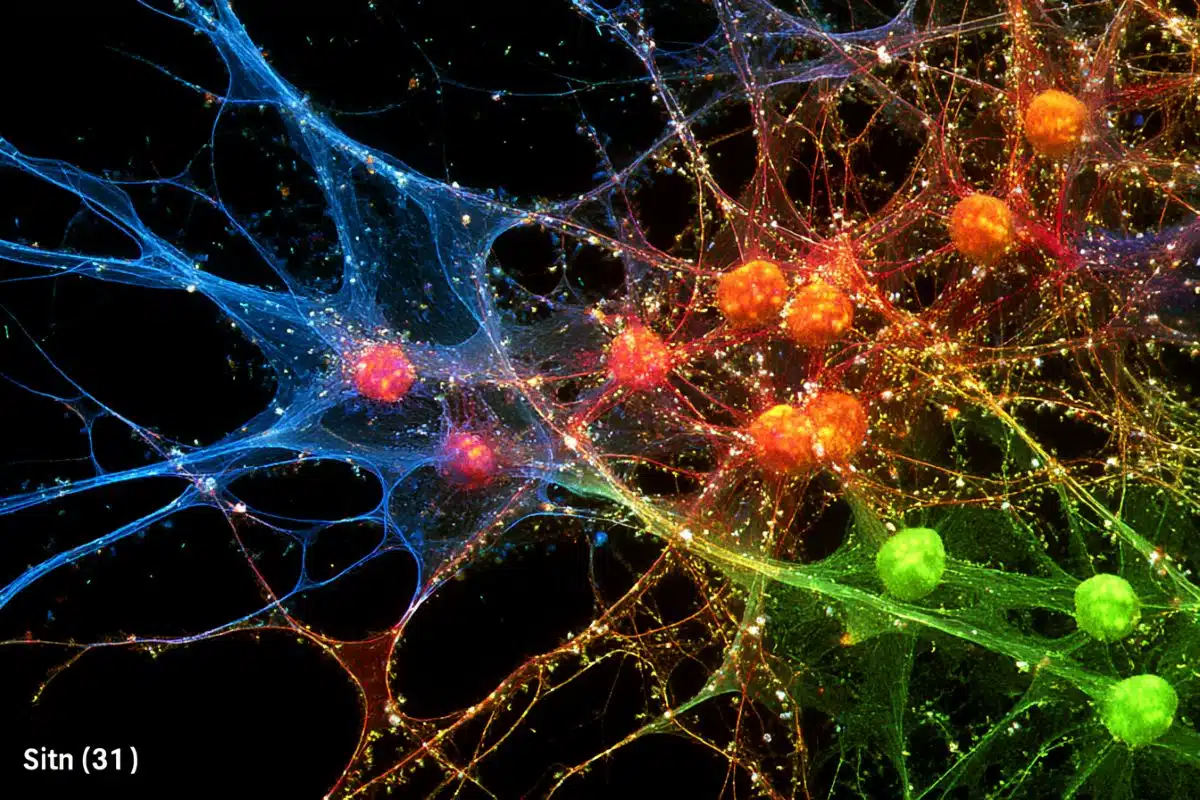
Summary: How does a single cell transform into a complex network of 170 billion cells without a central “general” to direct the process? Neuroscientists have proposed a new theory that challenges the long-held belief that brain development relies solely on long-range chemical signaling.
Instead, they argue that the brain organizes itself through lineage-based positional information. Much like human populations settle and spread geographically over generations, brain cells inherit their “location and identity” from their parents and stay near their relatives. This lineage-based model explains how the brain scales its incredible complexity across different species, from zebrafish to mice, using only local cellular interactions.
Key Facts
- The Command Gap: Traditional theories rely on chemical gradients to tell cells where to go, but these signals fade over long distances in a growing brain.
- Lineage-Based Modeling: CSHL researchers propose that cells “know” their location because they stay near their “ancestors” (progenitor cells), inheriting their positional state.
- Fracturing Subunits: As tissue grows, local groups of cells fracture into smaller subunits. These subunits maintain the identity of their progenitors, creating large-scale structures without needing long-range communication.
- Cross-Species Validation: The theory was successfully tested using gene expression data in both mouse and zebrafish brains, showing it works regardless of brain size.
- AI and Oncology Links: This model of “self-replicating” information could influence the development of next-generation AI and help scientists understand how tumors spread through similar lineage patterns.
Source: CSHL
Your brain begins as a single cell. When all is said and done, it will house an incredibly complex and powerful network of some 170 billion cells. How does it organize itself along the way?
Cold Spring Harbor Laboratory neuroscientists have come up with a surprisingly simple answer that could have far-reaching implications for biology and artificial intelligence.
Stan Kerstjens, a postdoc in Professor Anthony Zador’s lab, frames the question in terms of positional information.
“The only thing a cell ‘sees’ is itself and its neighbors,” he explains. “But its fate depends on where it sits. A cell in the wrong place becomes the wrong thing, and the brain doesn’t develop right. So, every cell must solve two questions: Where am I? And who do I need to become?”
In a study published in Neuron, Kerstjens, Zador, and colleagues at Harvard University and ETH Zürich put forward a new theory for how the brain organizes itself during development.
For a long time, researchers thought that cells exchanged positional information mainly through chemical signaling. This works well when dealing with just a few cells, Kerstjens explains.
But the brain isn’t a few cells. It’s billions of neurons, each needing to land in exactly the right place. Chemical signals can only travel so far before fading. So, how do cells deep in a growing brain automatically ‘know’ where they are?
The answer, Kerstjens proposes, hits close to home. “Consider how human populations spread across a country over generations,” he says.
“Descendants settle near their parents, so people who share ancestry end up in neighboring regions, producing large-scale geographic structures without long-range communication. We argue that a similar principle operates in the developing brain. Cells that descend from the same progenitor tend to remain near one another.”
To test this theory, Kerstjens and colleagues built what they call a “lineage-based model of scalable positional information.” They started with theoretical computations. Then they tested their hypothesis at scale by looking at individual and group gene expression in developing mouse brains. Finally, they confirmed their results in zebrafish, showing that the model can be used across brains of different sizes.
Kerstjens says the model supports the notion that chemical signaling works in conjunction with a lineage-based mechanism to convey positional information. And while his work focuses on the brain, the theory could apply to many other types of developing tissue, including tumors.
There may even be implications for self-replicating AI models that pass information from one generation to the next, just as our own brain cells do.
Perhaps most importantly, showing how a single cell grows into a complex organ could help scientists solve fundamental mysteries of the mind.
“The brain somehow makes us intelligent,” Kerstjens says. “How did it manage to accumulate this capability, not just over its developmental time, but over evolutionary time? This is one piece in that big puzzle.”
Key Questions Answered:
A: No, chemical signals still play a role. However, the study suggests that lineage—who your “parent” cell was—provides the fundamental map. Chemicals act more like local fine-tuning once the lineage has established the general neighborhood.
A: Current AI is often built using top-down architecture. This research provides a blueprint for “bottom-up” self-organization. If we can create AI models that pass information through generations like biological lineages, we might create more scalable and efficient artificial intelligences.
A: Yes. If a cell “misunderstands” its lineage or ends up in the wrong “neighborhood,” it can become the wrong type of neuron. This theory provides a new way to look at developmental disorders as “mapping errors” in the cell’s family tree.
Editorial Notes:
- This article was edited by a Neuroscience News editor.
- Journal paper reviewed in full.
- Additional context added by our staff.
About this neurodevelopment research news
Author: Samuel Diamond
Source: CSHL
Contact: Samuel Diamond – CSHL
Image: The image is credited to Neuroscience News
Original Research: Open access.
“A lineage-based model of scalable positional information in vertebrate brain development” by Stan Kerstjens, Florian Engert, Rodney J. Douglas, and Anthony M. Zador. Neuron
DOI:10.1016/j.neuron.2025.12.043
Abstract
A lineage-based model of scalable positional information in vertebrate brain development
The development of an adult brain from a single zygote requires cells and axons to organize in precise spatial patterns over long distances. Most mechanisms for positional information rely on diffusible molecular cues that move through the tissue, fundamentally limiting the pattern’s ability to scale over the requisite orders of magnitude.
Here, we propose a complementary mechanism in which positional information is inherited through the cell lineage, rather than transmitted through extracellular signals, thereby avoiding these scaling constraints.
Analyzing brain-wide developmental expression in mouse and larval zebrafish, we find that principal eigengenes—co-expression patterns across thousands of genes—span multiple spatial scales, remain stable over development, and are conserved across species. Moreover, small subsets of genes can decode eigengenes, yielding multi-scale positional information.
Together, these findings suggest a lineage-based mechanism for scalable positional information that complements diffusion-based mechanisms and offers a general framework for tissue patterning.