

Summary: For decades, scientists have known that the toxic accumulation of protein aggregates drives neurodegenerative diseases like Alzheimer’s, frontotemporal dementia (FTD), and amyotrophic lateral sclerosis (ALS). However, the precise molecular mechanism translating this protein buildup into actual brain cell loss has remained an elusive mystery. Traditional forms of programmed cell death, such as apoptosis, fail to account for the massive wave of neuronal destruction seen in clinical dementia.
A new study unmasked a brand-new, distinct mechanism for cellular suicide named karyoptosis.
The team discovered that toxic protein clumping triggers a destructive chemical cascade that causes the neuron’s nucleus to warp, shrivel, and ultimately disintegrate. By analyzing over 3,000 individual brain cells from deceased patients, researchers found this newly identified pathway actively destroying vast populations of neurons, offering a revolutionary roadmap for developing targeted therapies to slow or stop dementia at its structural source.
Key Facts
- The Karyoptosis Signature: Karyoptosis is defined by a unique sequence of chemical reactions where toxic protein accumulation causes the nuclear envelope to become unstable, leading to the nuclear shriveling and complete disintegration of the cell’s genetic core.
- Widespread Presence in Dementia: Using computational single-cell algorithms, researchers found that 35% of neurons in the frontal cortex of Alzheimer’s patients exhibited active markers of karyoptosis, compared to just 15% in healthy aged controls.
- The Kinase Molecular Switch: The study pinpointed a specific biochemical pathway controlled by specialized signaling enzymes (kinases) that can be triggered directly by the clumping of intracellular proteins.
- The p38 – LaminB1 Target: Scientists successfully mapped a critical molecular intersection where an enzyme called p38 MAP kinase interacts with a nuclear structural protein called LaminB1.
- Halting Cellular Decay: By introducing targeted compounds to block the p38-LaminB1 interaction in rat models, researchers successfully prevented nuclear breakdown and reduced karyoptosis markers in living neurons.
- Therapeutic Window Expansion: Selectively inhibiting this pathway does not just protect individual cells; it potentially “buys time” for patients, significantly widening the clinical window for doctors to deploy pinpointed treatments against underlying neurodegenerative diseases.
Source: King’s College London
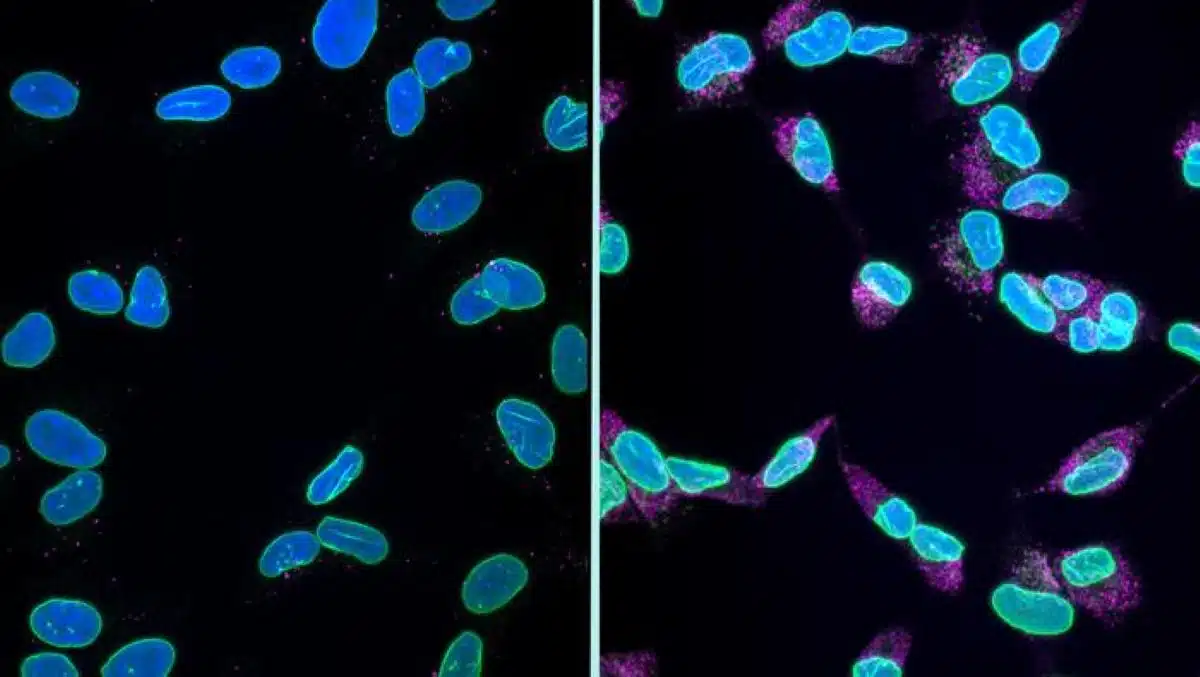
Markers of a new mechanism for cell death, called karyoptosis, have been found in brains of patients with Alzheimer’s disease and frontotemporal dementia (FTD).
In many neurodegenerative diseases such as amyotrophic lateral sclerosis (ALS), Alzheimer’s and FTD, toxic levels of proteins accumulate inside neurons, which subsequently die. While there are other known forms of cell death, such as apoptosis, they do not account for all neuronal loss in neurodegenerative disease.
New research from King’s College London in collaboration with the UK Dementia Research Institute, and funded in part by Alzheimer’s Research UK, reveals that karyoptosis may provide a key link between toxic protein accumulation and neuron death.
Karyoptosis is the set of chemical reactions triggered by toxic protein accumulation, which ultimately cause cell death. When a cell dies by karyoptosis, the nucleus – the part of the cell that contains the genetic information – shrivels before disintegrating.
The study, published in Nature Communications, used computational algorithms to identify key types of cell death in 3000 cells from brains of 28 patients with either FTD or terminal stage Alzheimer’s disease. 35 per cent of cells from the frontal cortex of patients with Alzheimer’s showed signs of karyoptosis, compared to only 15 per cent in healthy aged controls.
“This study is the culmination of a 10-year journey at King’s, from when we first identified karyoptosis in a relatively rare disease to discovering that it is a common feature of dementias which affect millions of people.”
The study identified a key mechanism controlling karyoptosis, that could be triggered by causing proteins in neurons to clump together, a common feature of neurodegenerative disease. In this pathway, the toxic levels of protein accumulation cause the outside of the nucleus to become unstable, leading to it shrivelling and disintegrating. By targeting proteins that act as ‘switches’ in this pathway, called kinases, researchers were able to reduce levels of karyoptosis markers in rat neurons in a dish. Specifically, they showed that the interaction between one particular kinase called p38 MAP kinase and another protein LaminB1 is a key target for blocking or slowing nuclear disintegration.
This pathway has potential to provide new therapeutic targets for slowing or preventing cell death by karyoptosis in dementia. Future work will focus on selectively targeting this protein-kinase interaction to produce viable treatment targets in humans.
“By specifically targeting the interaction between p38 MAP kinase and LaminB1 we may slow down the process of cell death, buying time for more pinpointed therapies against specific neurodegenerative diseases.” – Dr Manolis Fanto, Reader in Functional Genomics, Institute of Psychiatry, Psychology and Neuroscience, King’s College London.
“The death and loss of cells in the brain drives many symptoms experienced by people living with dementia. Our study uncovers a new series of chemical events which can coordinate cell death in brain cells. We have started to lay out the road map of how karyoptosis works, and I’m excited to see future breakthroughs this may drive in the dementia research community and beyond.” – Dr Rebecca Casterton, Senior Researcher at the UK Dementia Research Institute at King’s and first author on the paper.
“For decades, we’ve known that toxic proteins build up in Alzheimer’s disease and frontotemporal dementia, but exactly how they lead to the loss of brain cells has remained unclear.
“The identification of karyoptosis is a crucial step towards finding targets for treatments that could stop or slow cell loss. It could help widen the window for therapies that tackle the underlying causes of disease, bringing us closer to a cure for dementia. This is why Alzheimer’s Research UK funds and supports research.” – Dr Sara Rodrigues, Senior Research Manager at Alzheimer’s Research UK.
Funding: This work was primarily funded by Alzheimer’s Research UK and the Biotechnology and Biological Sciences Research Council International Partnership. It was additionally funded by a studentship from the UK Medical Research Council and the UK Dementia Research Institute.
Key Questions Answered:
A: Karyoptosis is a newly defined form of programmed cell death characterized by the systematic destruction of the cell’s command center—the nucleus. When toxic proteins aggregate to dangerous levels inside a neuron, they trigger a cascade of chemical reactions that destabilize the physical membrane protecting the nucleus. This causes the nucleus to rapidly warp, shrink, and completely fall apart. Because the nucleus houses the cell’s essential genetic information, its disintegration instantly renders the neuron non-viable, leading to its death and subsequent clearance from the brain.
A: The team achieved this by using advanced single-cell computational algorithms to audit individual cells harvested from post-mortem brain tissue. They analyzed more than 3,000 distinct cells from the frontal cortices of 28 patients who had terminal-stage Alzheimer’s disease or frontotemporal dementia. By scanning the distinct genetic and structural profiles of these cells, the algorithms revealed a massive subpopulation of neurons undergoing this specific nuclear-shriveling process, proving that karyoptosis is a widespread, driving force behind global dementia tissue loss.
A: Think of the interaction between the enzyme p38 MAP kinase and the structural protein LaminB1 as a biological self-destruct switch. When toxic proteins trip this switch, the nuclear walls dissolve. In laboratory experiments on rat neurons, researchers demonstrated that breaking the bond between these two specific proteins safely halts the nuclear disintegration pipeline. If translated into human pharmaceuticals, a drug mimicking this effect could act as a neuroprotective shield, slowing down brain cell loss, preserving cognitive function, and extending the timeline for other disease-modifying therapies to work.
Editorial Notes:
- This article was edited by a Neuroscience News editor.
- Journal paper reviewed in full.
- Additional context added by our staff.
About this Alzheimer’s disease research news
Author: Francesca Greenstreet
Source: King’s College London
Contact: Francesca Greenstreet – King’s College London
Image: The image is credited to Casterton et al
Original Research: Open access.
“Karyoptosis mediates cell death and neurodegeneration upon proteotoxic stress” by Rebecca Casterton, Aitana Martinez-Cotrina, Jodi Barnard, Eleanor Wycherley, Yanling Hu, Rhys Anderson, Sebastien Janel, Jiin Byun, Olivia Houghton, Daniel A. Solomon, Juan Alcalde, Frank Lafont, Marc-David Ruepp, Frank Hirth, Bart Tummers, Yong-Yeon Cho, Gian De Nicola, Sarah Mizielinska & Manolis Fanto. Nature Communications
DOI:10.1038/s41467-026-73802-w
Abstract
Karyoptosis mediates cell death and neurodegeneration upon proteotoxic stress
Neurodegenerative diseases are frequently associated with proteotoxic stress linked to disease specific proteins. The autophagy-lysosome system provides essential control of proteotoxic stress and its failure can lead to initiation of apoptosis.
However, in aging and neurodegenerative diseases apoptosis is insufficient to account for all neuronal death, and several different cell death types have been reported in these contexts. Here we show that karyoptosis, a distinct form of cell death, can be induced by proteotoxic stress and then develops through nuclear degeneration and cellular expulsion of nuclear material.
We establish that karyoptosis is regulated by the p38 kinase signalling pathway, which controls stability of the nuclear lamina protein LaminB1 via direct phosphorylation. We demonstrate that karyoptosis affects neurons in models of amyotrophic lateral sclerosis/frontotemporal dementia (ALS/FTD) pathology.
Finally, we identify karyoptotic features in post-mortem frontal cortex of FTD and Alzheimer’s disease (AD) patients. Together these findings characterise a form of cell death directly linked to proteotoxic stress and nuclear lamina stability that is associated with neurodegeneration.


