

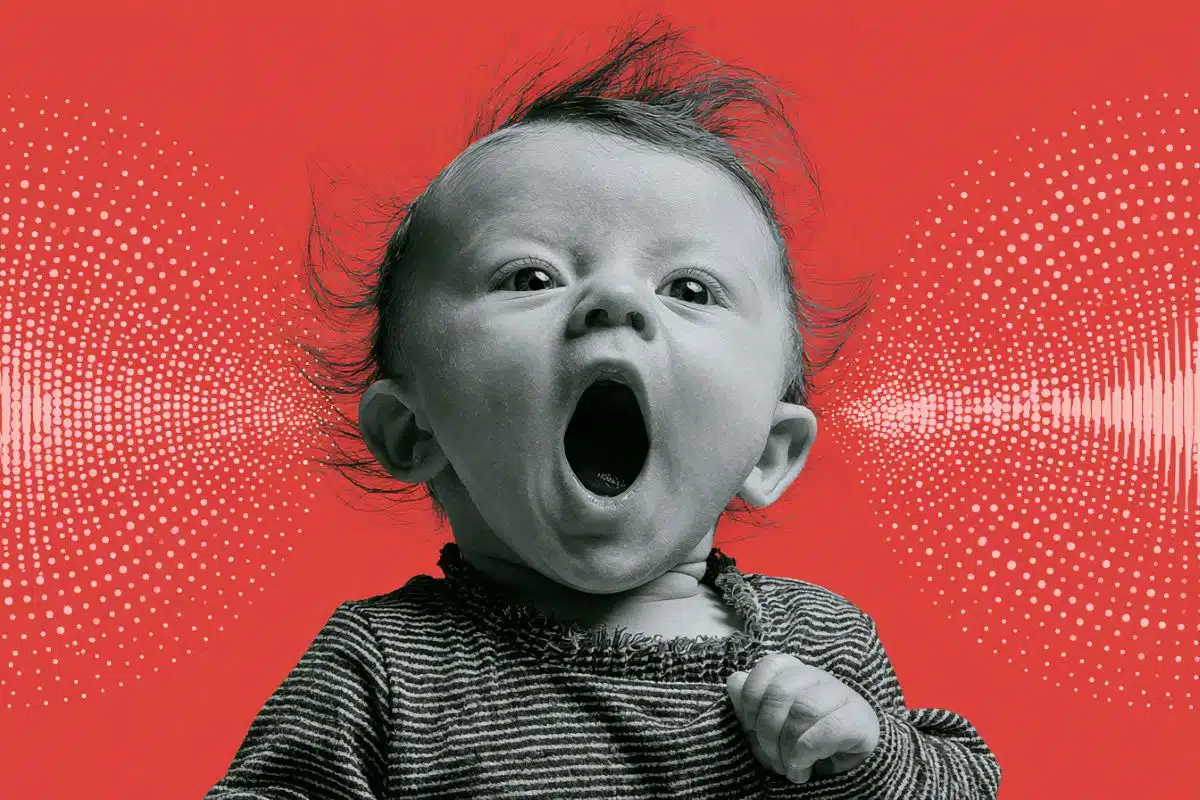
Summary: A new investigation recorded real-time brain activity in infants and adults exposed to varying spatial noise fields. The team discovered that despite possessing an underdeveloped cerebral cortex, human infants are fully capable of utilizing spatial separation cues early in life to isolate and track a single relevant speaker within a noisy room.
Key Facts
- Early Spatial Competence: The study demonstrates that human infants can actively exploit physical spatial cues (the location of a sound source) to filter out background racket and tune into a target voice, proving this sensory defense operates early in development.
- Adult vs. Infant Cortical Footprints: While both demographics successfully deployed spatial separation to track the target speaker, their underlying neurological mechanics were vastly different:
- The Adult Matrix: Exhibited widespread, cross-network activation across the cerebral cortex, pulling from multiple high-level executive and auditory focus loops.
- The Infant Matrix: Displayed a highly localized, confined pocket of cortical activity, showing that the infant brain achieves the same selective focus using a far more streamlined neural footprint.
- Evolutionary Conservation: This early-emerging capacity highlights that filtering noise through spatial sound locations is a foundational, hardwired biological survival mechanism built to optimize vocal communication and social learning during infancy.
- An Architectural Triumph Over Immaturity: Lead researcher Farhin Ahmed notes that the major takeaway is that infants do not need a fully matured, deeply connected adult brain to solve complex environmental sound challenges; their young systems are pre-programmed to track relevant human speech amidst everyday chaos.
Source: SfN
In noisy environments, organisms differentiate sounds they want to detect from interfering noise to improve their perception of target sounds. This process is widely conserved across species, including birds, crocodiles, ferrets, and human adults. But how early in life does this ability emerge?
In a new Journal of Neuroscience paper, Farhin Ahmed, Qianxun Zheng, and colleagues at the University of Washington explored whether infants also use this evolutionarily conserved mechanism for detecting sounds in noisy environments.
The researchers recorded the brain activity of 53 infants and 20 adults as participants listened to speakers in different environments: One environment had just a speaker, another environment had surrounding noise coming from the same location as the speaker, and a third environment had noise coming from a different location than the speaker.
Both infants and adults used sound location to track speakers, but their brain responses were different. In adults, there was widespread activation of the cortex whereas infants had more confined activity in the cortex.
Summarizing the major takeaway from this study, says Ahmed, “Despite their immature brains, infants are still able to make use of spatial cues early in life to help them hear the relevant voice in a noisy environment.”
Key Questions Answered:
A: Spatial cues are the physical clues your ears gather about where a sound is coming from in 3D space, based on tiny differences in when a sound reaches your left ear versus your right ear. In this University of Washington study, when background noise came from the exact same spot as the speaker, it completely swallowed the voice. But the moment the noise was moved to a different part of the room, the physical separation created a spatial cue. The infants’ brains instantly used this physical gap to isolate the speaker’s voice, filtering out the background noise.
A: It highlights the profound difference between a fully mature brain and an early-stage developing brain. When an adult filters out noise, their brain lights up across broad, highly connected networks in the cerebral cortex, drawing on years of learned language patterns, attention control, and cognitive prediction. An infant’s brain lacks these massive, long-range cellular highways. Instead, the infant brain relies on a highly efficient, deeply confined pocket of localized cortical activity, proving that nature has built a streamlined shortcut for babies to track language before their brains are fully wired.
A: For a long time, scientists weren’t sure if babies simply experienced a chaotic “wall of sound” in noisy environments, unable to isolate their parents’ voices from background chatter. Showing that this ability is active early in infancy, and knowing it is shared by birds, crocodiles, and ferrets, proves that spatial hearing isn’t an advanced trick we learn as we grow up. It is an ancient, deeply rooted biological shield designed to protect a young organism’s ability to hear, learn language, and stay connected to its caretakers, no matter how loud or chaotic the world around them becomes.
Editorial Notes:
- This article was edited by a Neuroscience News editor.
- Journal paper reviewed in full.
- Additional context added by our staff.
About this neuroscience research news
Author: SfN Media
Source: SfN
Contact: SfN Media – SfN
Image: The image is credited to Neuroscience News
Original Research: The study will appear in Journal of Neuroscience


