

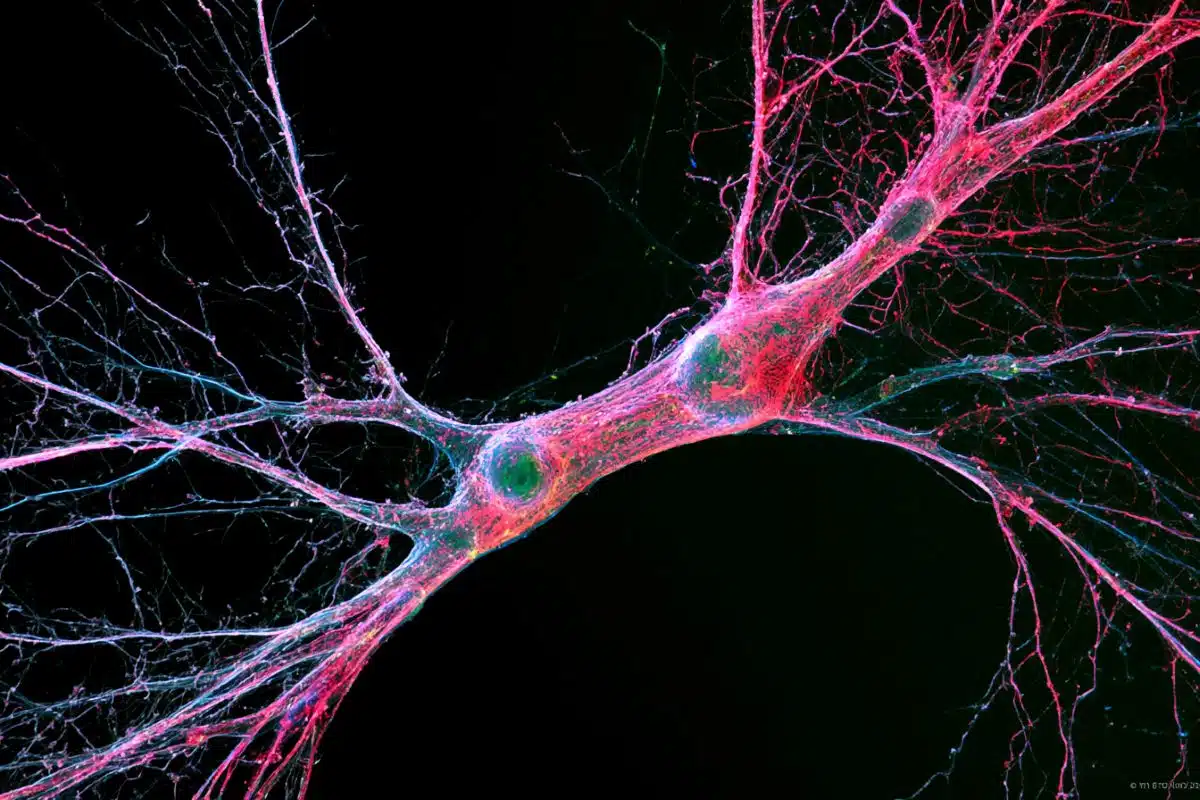
Summary: A study shows that G Protein-Coupled Receptor 3 (GPR3) acts as a unique immediate-early molecule that helps trigger the differentiation of stem cells into neurons. The research found that GPR3 activates within 30 minutes of growth factor exposure, acting as an autonomous signal amplifier that boosts the cAMP-CREB pathway.
This rapid cascade drives the expression of the survival gene NR4A, directly linking early genetic responses to healthy synapse creation and offering a new target for treating neurodevelopmental disorders like autism.
Key Facts
- Unprecedented Receptor Speed: GPR3 disrupts traditional receptor timelines by activating within 30 minutes of growth factor stimulation, mimicking classical immediate-early genes.
- Autonomous Signal Amplification: Unlike most receptors that require a matching molecule to trigger an action, GPR3 can initiate downstream signaling autonomously to lock in cell differentiation.
- cAMP-CREB Pathway Boost: Early expression of GPR3 heavily amplifies the internal cAMP-CREB pathway, effectively transforming temporary external triggers into permanent structural cell programs.
- Synaptic Development Link: The GPR3 cascade directly drives the expression of NR4A, an essential gene that governs the growth of synapses and ensures the survival of newborn neurons.
- New Clinical Targets: By mapping how early gene expression dictates brain plasticity, researchers aim to uncover therapeutic pathways for neurodevelopmental conditions like autism.
Source: Hiroshima University
Cells have surface receptors that couple to proteins and other molecules to initiate or inhibit certain behaviors. Typically, the number of these receptors increases as the cell matures, but researchers have now identified that one receptor influences cell behavior much earlier than previously thought and appears to help trigger the cell differentiation process to form neurons.
The Hiroshima University-based team published their work, which they said has implications for better understanding neuronal development and brain plasticity — and how those processes become dysregulated — on March 20 in iScience.
They specifically found that G protein-coupled receptor 3 (GPR3) represents a unique molecule in this receptor family, as it behaves like an immediate-early gene that rapidly responds and induces downstream signaling. Other G protein-coupled receptors behave like delayed-response genes that aren’t expressed into much later in the cell maturation process.
“Understanding early transcriptional responses — how genes are expressed in response to upstream signals — is critical because these programs determine neuronal development, synaptic formation and plasticity, and their dysregulation is associated with neurological disorders such as autism and cognitive dysfunction,” said corresponding author Shigeru Tanaka, associate professor of molecular and pharmacological neuroscience in the Graduate School of Biomedical and Health Sciences at Hiroshima University.
Like a baseball player raising a gloved hand to catch a baseball, cell surface receptors extend out, waiting to receive specific molecules. When the baseball hits the mitt, it can trigger a series of reactions, depending on where the baseball originated. It can immediately end the play, or the catcher can use it to tap out an opponent, or throw it to a teammate who might be closer to the player who hit it in the first place.
Just like the game can end or continue depending on how and where the ball moves, so can cell differentiation and behavior. However, many rules of play for cells in development still remain unclear, according to Tanaka. Making the situation even more complex is that GPR3 — the mitt — can exert its function even without a baseball, or a molecule to trigger a specific action.
To better understand how GPR3 works in the process, Tanaka and the research team analyzed rodent PC12 cells, a widely used and well-established scientific model for studying how cells differentiate into neurons. This neuronal differentiation process involves stimulating the cells with nerve growth factor, a signal that tells the cells to become neurons.
Over 48 hours, the cells develop neurites, which are immature branches that may eventually form neuron networks if properly supported. The team then inspected the neuronal protein markers on the cells and found that GPR3 activated within 30 minutes of stimulation.
“That was striking — that GPR3 is one of the very few G protein-coupled receptors showing immediate-early gene-like rapid induction within 30 minutes,” Tanaka said. “That’s comparable to classical immediate-early genes, yet unprecedented for this receptor family.”
Tanaka explained that GPR3 could be considered a “signal amplifier,” meaning it converts early stimuli signaling from other molecules upstream into a sustained program necessary for neuronal maturation. Because GPR3 can act on its own, its early appearance may be especially important in helping this process happen quickly.
Specifically, he said, genetic analysis revealed early induction of GPR3 enhances cAMP-CREB signaling, which makes long-term processes from short-term signaling. That, in turn, drives downstream expression of NR4A, an immediate-early gene critical for neuronal survival and the development of synapses, which are the spaces over which neurons communicate.
“This work establishes a previously unrecognized signaling cascade linking early transcriptional responses to synapse development,” Tanaka said.
Next, the researchers said they plan to investigate how GPR3 contributes to synaptic function, neural circuit formation and neurological disorders.
“Our ultimate goal is to clarify how activity-dependent transcriptional programs regulate brain development and to identify new therapeutic targets for neurodevelopmental and neuropsychiatric diseases,” Tanaka said.
Other contributors to the study are Fumiaki Ikawa, Hiroko Shiraki, Kana Harada, Izumi Hide and Norio Sakai, all of whom are affiliated with the Department of Molecular and Pharmacological Neuroscience in Hiroshima University’s Graduate School of Biomedical and Health Sciences.
Funding: The Japan Society for the Promotion of Science supported this research.
Key Questions Answered:
A: In cell biology, immediate-early genes are the first-responder units of the genome, bursting into action within minutes of an external stimulus to jumpstart foundational cell behaviors. In contrast, G protein-coupled receptors (GPCRs) are almost always late-stage players, slowly populating the cell membrane as it settles into its final role. Finding a GPCR that acts as an immediate-early gene flips the script, showing that a receptor can actively direct the early dawn of neural development rather than just responding to environment signals once mature.
A: GPR3 acts as an internal megaphone for cellular signaling. When a temporary signal like nerve growth factor strikes the developing cell, GPR3 is rapidly produced. Once present, it amplifies the internal cAMP-CREB signaling pathway. This specific biochemical pathway acts as a bridge, taking transient, fleeting biological signals and converting them into a sustained, long-term genetic program that triggers the expression of structural genes needed to construct neurite networks and permanent synapses.
A: Proper brain development and lifetime cognitive flexibility depend heavily on precise, activity-dependent genetic timelines. If the early transcription programs that govern how neurons differentiate, branch out, and form functional communication spaces are altered by even a few minutes, the underlying brain circuits can form incorrectly. By identifying GPR3 as a core master controller of this delicate timeline, scientists can now study how its dysregulation contributes to conditions like autism, opening the door to highly targeted therapies.
Editorial Notes:
- This article was edited by a Neuroscience News editor.
- Journal paper reviewed in full.
- Additional context added by our staff.
About this neuroscience research news
Author: Lika Araki
Source: Hiroshima University
Contact: Lika Araki – Hiroshima University
Image: The image is credited to Neuroscience News
Original Research: Open access.
“GPR3 is an immediate-early gene-like GPCR regulating CREB-dependent neuronal differentiation” by Tanaka S, Ikawa F, Shiraki H, Harada K, Hide I, Sakai N. iScience
DOI:10.1016/j.isci.2026.114944
Abstract
GPR3 is an immediate-early gene-like GPCR regulating CREB-dependent neuronal differentiation
GPR3 is a constitutively active Gs-coupled receptor whose transcriptional regulation during neuronal differentiation has remained unclear.
Here, we identify Gpr3 as an immediate-early gene-like transcript rapidly induced by nerve growth factor (NGF) and cAMP signaling in PC12 cells, exhibiting biphasic activation captured by native elongating transcript-cap analysis of gene expression (NET-CAGE) at a core promoter ∼200 bp upstream of the transcription start site (TSS).
Five cAMP response elements (CREs) within the 1-kb regulatory region cooperatively mediated stimulus-responsive transcription, with p-CREB enrichment selectively occurring at the proximal −34 CRE.
Early Gpr3 induction enhanced delayed Nr4a1–3 expression and promoted Synapsin1 (Syn1) transcription through an Nr4a1-dependent mechanism. In primary cortical neurons, Gpr3 deletion diminished the developmental upregulation of Nr4a1–3 and Syn1 and reduced SYN1-positive vesicle density.
These findings indicate GPR3 as an activity-dependent cAMP amplifier that couples early CREB activation to transcriptional programs governing NR4A signaling and presynaptic maturation during neuronal differentiation.


