

Summary:
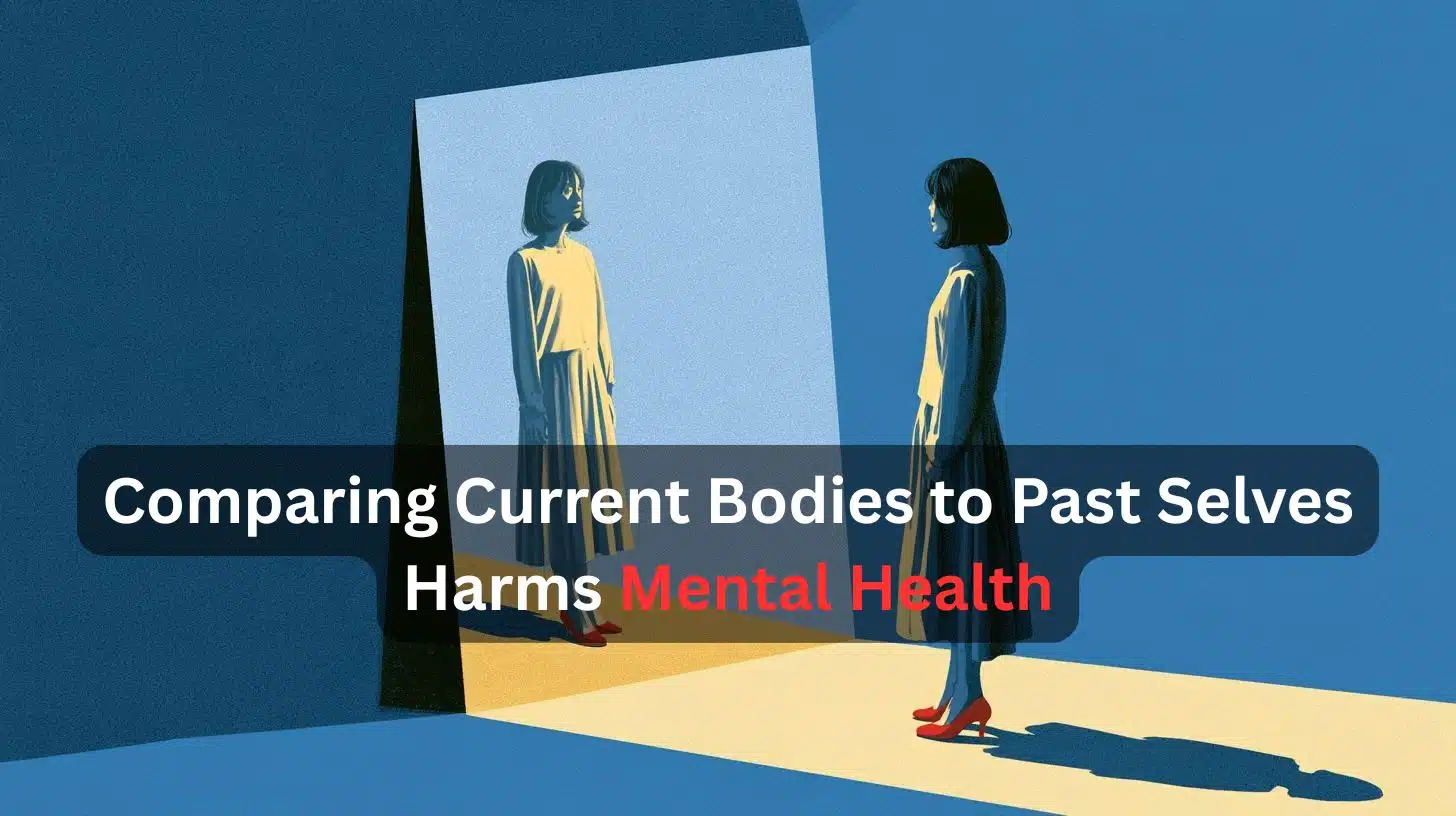
A new psychometric study from The Ohio State University reveals that comparing our current body to former versions of ourselves is just as harmful to mental health as comparing ourselves to other people. Published in Body Image, the research introduces and validates the Self-Oriented Comparison Scale for Appearance (SOCS-A). The authors found that “upward self-comparison,” measuring current appearance against a perceived younger, fitter past, strongly predicts body shame, rumination, and disordered eating, with women being disproportionately affected.
Key Facts:
- The Missing Metric in Body Image: While decades of eating disorder and body image research have focused almost exclusively on social comparison (measuring oneself against peers or media models), this study identifies “self-oriented comparison” as an independent, equally potent driver of body dissatisfaction.
- Upward vs. Downward Temporal Comparison: “Upward self-comparison” (evaluating current appearance unfavorably against a past idealized self) is strongly linked to body shame and disordered eating. Conversely, “downward self-comparison” (remembering a past time when one felt less attractive) is associated with body appreciation and appearance pride.
- Marked Gender Disparity: While the 11-item SOCS-A demonstrated structural validity across genders, women reported significantly higher levels of upward self-comparison, driven by cultural beauty standards that penalize normal female aging and physical transitions.
Source: The Ohio State University
For more than half a century, clinical psychologists and body image researchers have centered their investigations around social comparison theory. Under this dominant framework, body dissatisfaction and disordered eating arise when individuals measure their physical features against unattainable societal ideals showcased by peers, parents, and media representations.
Yet clinicians have increasingly documented that individuals frequently bypass external models altogether, instead judging their reflection against an internalized ghost: a younger, leaner, or firmer version of themselves captured in old photographs, home videos, and memories.
Now, a study led by researchers at The Ohio State University provides the first rigorous empirical validation of “self-oriented appearance comparison,” demonstrating that looking back at past versions of ourselves exerts a unique, powerful, and often toxic influence on psychological well-being.
The findings, published in the journal Body Image, offer clinicians a validated measurement tool to assess this neglected phenomenon, which frequently intensifies during normal developmental milestones, aging, and metabolic changes.
“There’s so much literature on social comparison, especially in body image and eating disorder literatures, and there’s virtually nothing on self-oriented comparison,” said lead author Tracy Tylka, Ph.D., a professor of clinical psychology at Ohio State’s Marion campus.
“Self-oriented comparison matters. It is uniquely associated with body image and eating behavior. In clinical treatment, we shouldn’t just focus on how clients are comparing themselves to others, but also how they are comparing themselves to previous versions of themselves.”
Overcoming the Field’s Historical Blind Spot
The clinical relevance of self-oriented comparison emerged through observations by co-author Nichole Wood-Barcalow, Ph.D., a clinical psychologist in private practice in Westerville, Ohio. In therapy sessions, clients navigating major life transitions, such as puberty, postpartum changes, menopause, andropause, chronic illness, weight fluctuations, and natural chronological aging, regularly fixated on past photos with distress, lamenting how drastically their bodies had shifted.
Despite its clinical prevalence, Dr. Tylka, an internationally recognized psychometrician who previously developed standard clinical instruments for intuitive eating and body appreciation, discovered that no validated psychological scale existed to measure trait-level temporal appearance comparisons.
Dr. Tylka noted that this absence reflects a systemic limitation in eating disorder research, which has historically prioritized adolescent and young-adult cohorts while overlooking the psychological toll of ageism.
“The body image field has been late to notice ageism and the lack of research on the aging process as it relates to body image,” Dr. Tylka explained. “As we age, we move further away from what society tells us we should look like, and we compare ourselves to previous versions, photos or videos from decades ago.”
Validating the SOCS-A: Upward Distress vs. Downward Pride
To fill this diagnostic void, Tylka, Wood-Barcalow, and their colleagues developed and validated the Self-Oriented Comparison Scale for Appearance (SOCS-A). The 11-item instrument was psychometrically evaluated across two distinct, non-clinical community cohorts of U.S. adults.
Statistical modeling confirmed that self-oriented appearance comparison splits into two robust subscales with diverging psychological outcomes:
- Upward Self-Oriented Comparison: Occurs when an individual measures their present appearance against a previous self perceived as more attractive, youthful, or fit. This trajectory showed powerful correlations with negative body image, cognitive rumination, body shame, and disordered eating patterns.
- Downward Self-Oriented Comparison: Occurs when an individual contrasts their current self with a past period when they felt less healthy or less attractive. Unlike downward social comparison (which often breeds guilt, shame, and psychological rigidity), downward self-oriented comparison was linked to higher body appreciation, appearance pride, and body image flexibility.
“What surprised us was that downward comparison was viewed more favorably. We were expecting a pattern more similar to social comparison, where downward comparison is also maladaptive,” Dr. Tylka said.
“People think comparing themselves to others they view as less attractive would make them feel good, but downward social comparison is linked to body-focused shame, guilt and less body image flexibility. Downward self-oriented comparison, however, often means you worked to change or overcome something you didn’t like about your appearance, so you’re more likely to report feeling a sense of pride and accomplishment.”
Gender Disparities and Future Applications in GLP-1 Therapies
The study highlighted pronounced gender differences. While the SOCS-A proved psychometrically robust across the gender spectrum, women reported substantially higher rates of upward self-oriented comparison than men. Men, conversely, engaged more frequently in downward self-oriented comparison.
Dr. Tylka attributed this divide to cultural conditioning that tightly links a woman’s social worth to youthful aesthetics, turning normal bodily evolution into a source of psychological distress.
Looking ahead, the authors emphasize that the SOCS-A will be instrumental in tracking therapeutic outcomes, particularly in acceptance-based therapies and cognitive interventions designed to cultivate self-compassion across the lifespan.
Moreover, the researchers note the scale has immediate clinical relevance for investigating the psychological impacts of newer metabolic medications.
“Beyond age, I think the SOCS-A has relevance to be explored in the context of GLP-1 use,” Dr. Tylka added. “I am starting to do research with colleagues on GLP-1s, body image and eating behavior. We haven’t analyzed the data yet, but I think the intersection with self-oriented comparison will be really interesting.”
Funding: This work was funded by an Ohio State Joan Huber Fellowship Grant.
Editorial Notes:
- This article was edited by a Neuroscience News editor.
- Journal paper reviewed in full.
- Additional context added by our staff.
About this Psychology Research:
- Media Contact: Elizabeth Weinstein
- Source: Ohio State University
- Image Credit: Image credited to Neuroscience News
- Original Research is Open Access: Body Image (Sept 22, 2026). “Self-Oriented Comparison Scale for Appearance (SOCS-A): Development and psychometric evaluation.” Authors: Tracy L. Tylka and Nichole L. Wood-Barcalow.
- DOI: 10.1016/j.bodyim.2026.102159
Abstract
Self-Oriented Comparison Scale for Appearance (SOCS-A): Development and psychometric evaluation
Appearance-related social comparison, or comparing one’s body to another’s body, is a risk factor for negative body image and disordered eating. People also compare their current body to their former appearance (i.e., self-oriented appearance comparison), which could also serve as a potential risk, maintenance, or protective factor for negative body image and disordered eating.
Yet, there is no existing multi-item measure of self-oriented comparison directions (upward, downward) applicable across diverse appearance-related changes. Therefore, we developed the Self-Oriented Comparison Scale for Appearance (SOCS-A) and investigated its psychometric properties with U.S. community adults in two online studies (Study 1: N = 973; 49.0% women, 48.5% men, 2.5% nonbinary; Mage=39.60; Study 2: N = 885; 49.8% women, 48.2% men, 1.9% nonbinary; Mage=38.54).
Study 1 supported a 2-factor model (upward, downward); Study 2 confirmed this 2-factor structure. Gender invariance, composite reliability, and test-retest reliability were upheld. Convergent, discriminant validity, and incremental validity were supported.
Upward self-oriented appearance comparison aligned with maladaptive characteristics (e.g., related positively to upward social comparison, disordered eating, and negative body image and negatively to positive body image, intuitive eating, and well-being), while downward self-oriented appearance comparison was neutral or aligned with positive characteristics.
Upward and downward self-oriented appearance comparison accounted for unique variance in body shame, and upward self-oriented appearance comparison accounted for unique variance in disordered eating, beyond appearance-related social comparison and brooding.
The 11-item SOCS-A demonstrates strong psychometric properties in U.S. community adults. Continued psychometric and longitudinal research on the SOCS-A is needed in other countries, cultures, and social identity and life experience groups.


