

Summary:
Researchers at USC examining living human brain tissue surgically resected from epilepsy patients discovered that higher numbers of abnormal, immature astroglia in the hippocampus correlate directly with poorer fluid intelligence, the ability to reason, solve novel problems, and adapt. The finding provides rare direct human cellular evidence that non-neuronal glial cells actively influence complex human cognition, identifying a potential cellular target to treat accelerated cognitive aging.
Key Facts:
- Direct Human Tissue Quantification: Unlike studies reliant on animal models or post-mortem gene arrays, researchers quantified individual immature astroglial cells in surgically removed hippocampal tissue from 29 living patients with drug-resistant mesial temporal lobe epilepsy.
- Specific Cognitive Correlation: An increased density of abnormal immature astroglia correlated specifically with lower scores on tests of fluid intelligence, while showing no identical degradation across all generalized cognitive domains.
- Novel Glial Target for Aging: Because fluid intelligence naturally deteriorates during normal aging and falters in conditions such as Parkinson’s disease, frontotemporal dementia, and multiple sclerosis, targeting astroglial maturation may offer a path to protect reasoning faculties.
Source: Keck School of Medicine of USC
Fluid intelligence, the fundamental capacity to think logically, solve unfamiliar problems, identify patterns, and adapt to novel circumstances independent of acquired knowledge, inevitably declines with advancing age. It is also among the first cognitive domains to disintegrate in neurodegenerative conditions such as frontotemporal dementia, Parkinson’s disease, and multiple sclerosis.
While neuroscientists have conventionally attributed cognitive reasoning deficits to synaptic dysfunction and neuronal death, the potential contribution of glial support cells has remained difficult to evaluate directly in living human tissue.
Now, a team led by researchers from the USC Stem Cell laboratory of Michael Bonaguidi, PhD, and the USC Neurorestoration Center has revealed that non-neuronal support cells play an active role in human problem-solving capacity.
Publishing in the journal Frontiers in Cellular Neuroscience, the investigators established that older adults harboring an increased abundance of abnormal, immature astroglia in the hippocampus perform significantly worse on clinical evaluations of fluid intelligence.
Rare Access to Living Hippocampal Tissue
Studying cellular dynamics in the living human brain presents severe technical barriers. Standard non-invasive neuroimaging tools like magnetic resonance imaging (MRI) and electroencephalography (EEG) lack the cellular resolution necessary to differentiate distinct glial phenotypes. Conversely, post-mortem brain donations often suffer from tissue degradation and lack recent, standardized cognitive testing prior to death.
The USC team overcame these limitations through a rare clinical opportunity: examining hippocampal tissue surgically removed from 29 patients undergoing therapeutic resections for drug-resistant mesial temporal lobe epilepsy.
Prior to surgery, each patient completed comprehensive neuropsychological batteries measuring reasoning, working memory, attention, language, and fine motor skills. Immediately following resection, the researchers microscopically examined and quantified the exact distribution of immature astroglia within targeted anatomical zones of the hippocampus.
The Link Between Immature Glia and Cognitive Decline
Astroglia—the star-shaped cells of the central nervous system, have long been viewed primarily as metabolic and structural caretakers that nourish neurons, regulate the blood-brain barrier, and recycle neurotransmitters.
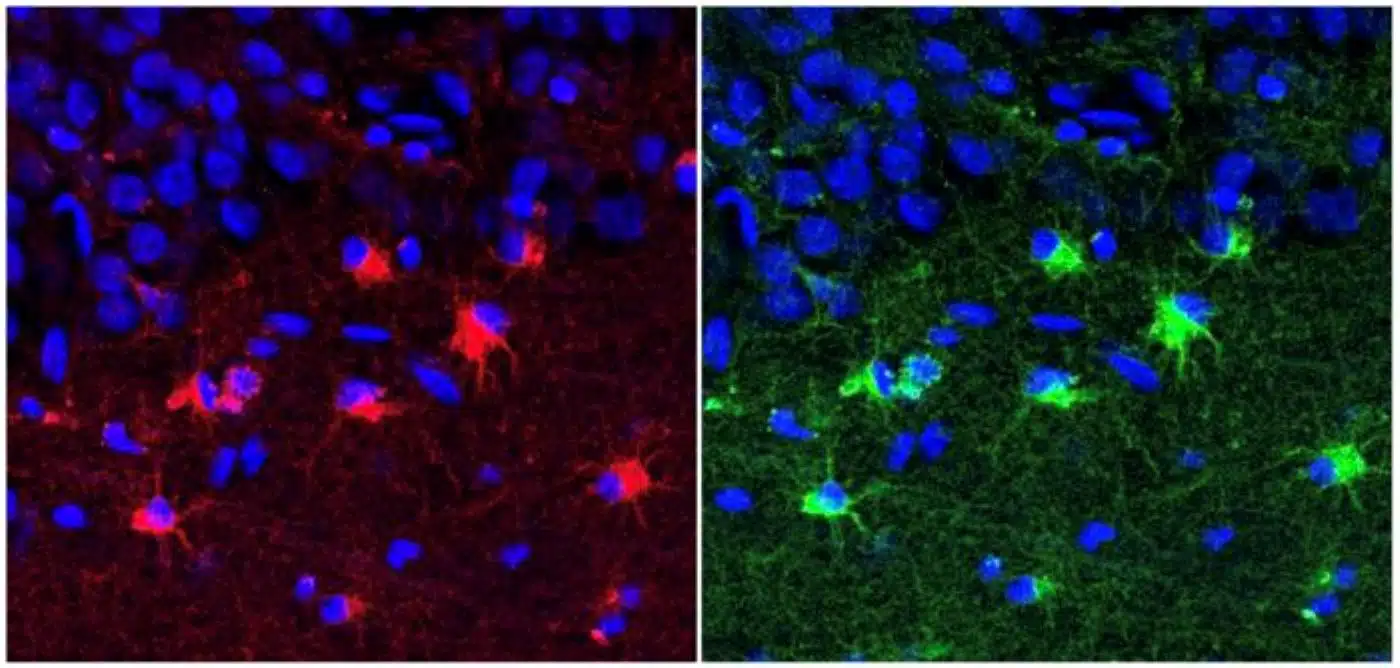
However, the tissue analysis revealed that older patients had a disproportionate burden of abnormal, arrested immature astroglia. When cross-referenced with pre-surgical cognitive performance, a distinct relationship emerged: greater numbers of these immature cells tracked directly with lower fluid intelligence scores.
“We found that older patients tended to have more abnormal immature astroglia, and that higher numbers of these cells were also associated with poorer performance on tests of fluid intelligence,” said first author Aswathy Ammothumkandy, PhD, assistant professor of research in the Department of Stem Cell Biology and Regenerative Medicine at the Keck School of Medicine of USC. “These findings suggest that astroglia could be a shared therapeutic target for accelerated age-related cognitive decline in people with epilepsy, as well as for seizure control, as indicated by our previous research.”
Opening a New Glial Frontier for Drug Discovery
Because the cells were arrested in an abnormal, immature functional state, they may fail to properly support local synaptic plasticity within the hippocampus, impairing the dynamic network synchronization required for complex problem-solving.
“Aging is something we’re all familiar with and all impacted by, it’s a matter of when, not if,” said co-corresponding author Michael Bonaguidi, PhD, associate professor of stem cell biology and regenerative medicine, gerontology, biomedical engineering, and neurological surgery, and assistant director of the USC Neurorestoration Center. “What this study provides is a new therapeutic target that could someday help us slow down or potentially even reverse age-related declines in our ability to solve new problems.”
The research group is currently screening for specific molecular markers that distinguish these abnormal immature astroglia from healthy mature cells. Identifying these transcriptional and metabolic signatures could enable the development of small molecules designed to drive astroglial maturation or selectively eliminate dysfunctional cells.
Additionally, the investigators plan to test whether targeted neuromodulation, using precise electrical or magnetic stimulation to alter hippocampal network states, can encourage healthy astroglial physiology and preserve fluid reasoning across the lifespan.
Funding:
This research was supported by the National Institutes of Health (grant R01AG076956), , the , the Cure Alzheimer’s Fund, The Eli and Edythe Broad Foundation, the USC Neurorestoration Center, the Rudi Schulte Research Institute, the American Epilepsy Society, the California Institute for Regenerative Medicine (grant EDUC4-12756), and CURE Epilepsy Taking Flight.
Editorial Notes:
- This article was edited by a Neuroscience News editor.
- Journal paper reviewed in full.
- Additional context added by our staff.
About this neuroscience Research:
- Media Contact: Laura LeBlanc
- Source: USC
- Image Credit: Image credited to Aswathy Ammothumkandy/Bonaguidi Lab/USC Stem Cell
- Original Research is Open Access: Frontiers in Cellular Neuroscience (Oct 19, 2026). “An age-related decline in human fluid intelligence corresponds with immature astroglia prevalence.” Authors: Aswathy Ammothumkandy, Luis Corona, Nadia A. Atai, Aidin Abedi, Nora Jimenez, Michelle Armacost, Lina M. D’Orazio, Virginia Zuverza-Chavarria, Alisha Cayce, Mohammad Shariq, Ryan McGinn, Darrin Lee, Brian Lee, Christianne Heck, Jonathan J. Russin, Charles Y. Liu, and Jason A. D. Smith.
- DOI: 10.3389/fncel.2026.1926804
Abstract
An age-related decline in human fluid intelligence corresponds with immature astroglia prevalence
Age-related cognitive decline remains a daunting health challenge, and targeting neuronal cells alone has been insufficient to halt its progression. Astroglia are emerging as key players in cognitive function and dysfunction, yet their relevance to age-associated cognitive decline in humans remains unclear. Epilepsy patients undergo age-amplified progressive cognitive decline.
Our prior research in Mesial Temporal Lobe Epilepsy (MTLE) patients identified pathological stellar Dcx + immature astroglia in epileptic, but not healthy hippocampus. In this study, we combined histology data with pre-surgical neuropsychology tests to assess (1) age-associated cognitive decline in MTLE patients (N = 40), (2) age-related changes in Dcx + immature astroglia (N = 29), and (3) the association between Dcx + immature astroglia and cognitive decline (N = 19).
We observed a strong decline in fluid intelligence, visuospatial reconstruction, and memory with age. An increase in Dcx + immature astroglia positively correlated with age, whereas negatively associated with nonverbal abstract reasoning and fluid intelligence as measured by the Raven’s Progressive Matrices test.
These findings reveal an interplay among aging, fluid intelligence decline, and immature astroglia prevalence in epilepsy patients. Our study suggests immature astroglia represent a new cellular target to consider for altering age-associated cognitive decline.


