Summary:
Proteins best known for driving neurodegenerative diseases like Alzheimer’s and Parkinson’s play an unexpected physiological role in human reproduction. Researchers at Columbia University’s Mortimer B. Zuckerman Mind Brain Behavior Institute discovered that amyloid fibrils in semen bind negatively charged RNA, protect it from degradation, and shepherd it directly into sperm cells. Published in Molecular Cell, the findings reveal a key biological vehicle for paternal epigenetic inheritance and introduce a human-derived delivery scaffold capable of enhancing CRISPR gene-editing technologies.
Key Facts:
- Functional Reproductive Amyloids: Positively charged amyloid fibrils naturally present in seminal fluid bind fragile, negatively charged RNA molecules, shielding them from degradation and transporting them directly into the interior of sperm cells.
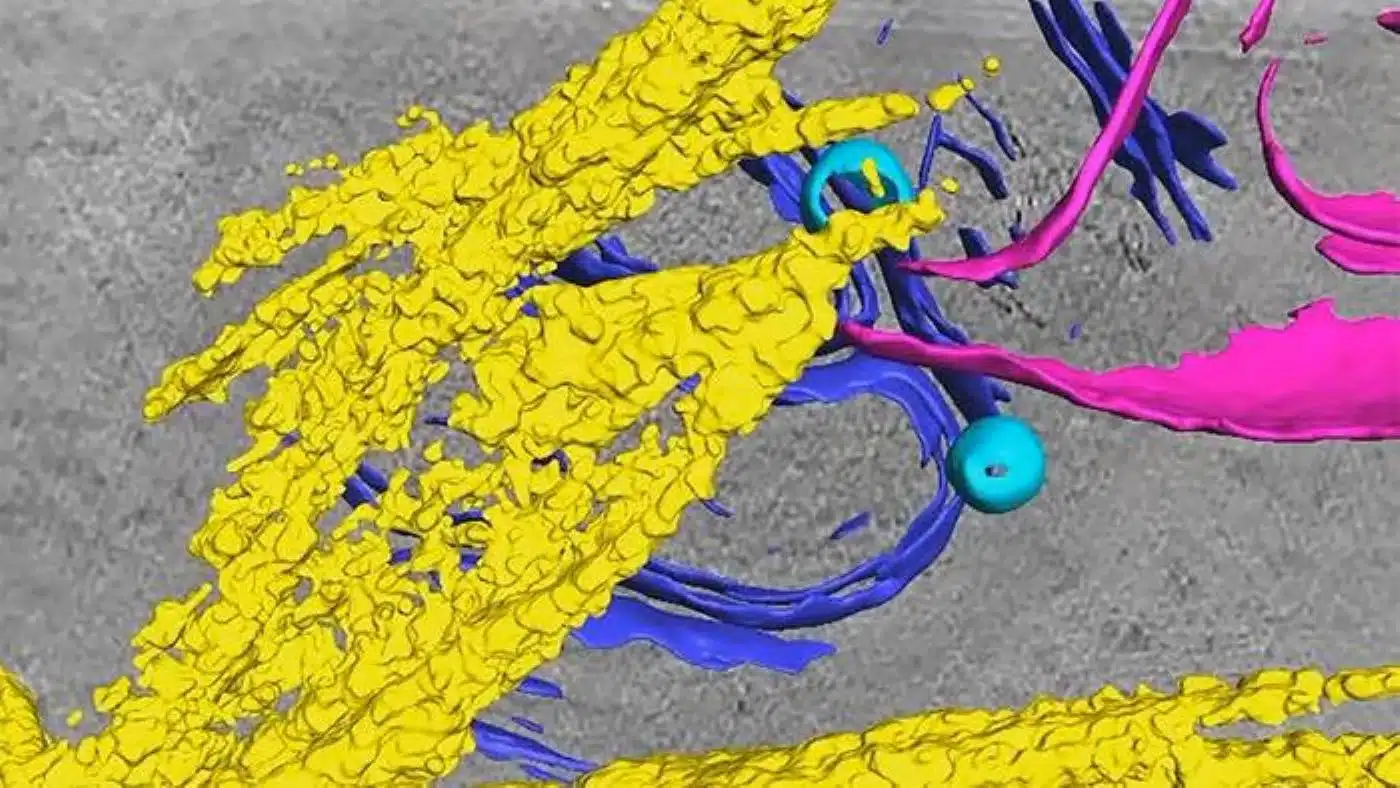
- Direct Cryo-ET Visualization: Using near-atomic-resolution cryo-electron tomography with gold-labeled markers, researchers confirmed that amyloid fibrils fully penetrate sperm cells rather than merely adhering to the outer membrane.
- CRISPR & Gene Delivery Platform: Amyloid fibrils shuttled large RNA transcripts encoding green fluorescent protein into sperm, resulting in fertilized embryos expressing over ten times more target protein than controls, highlighting a non-viral, human-based vector for genetic therapies.
Source: Columbia University Zuckerman Institute
In neurobiology, amyloid proteins are notorious as the pathological hallmarks of debilitating neurodegenerative disorders, aggregating into neurotoxic plaques and tangles that destroy synapses in Alzheimer’s, Parkinson’s, and related dementias. Yet across the human body, functional amyloids perform diverse, non-pathological tasks that are only beginning to come to light.
Now, a study led by structural biologists and neuroscientists at Columbia University’s Mortimer B. Zuckerman Mind Brain Behavior Institute reveals that seminal fluid relies on amyloid fibrils to perform an essential reproductive feat: shepherding genetic material directly into sperm cells to influence the next generation.
Publishing October 26 in the journal Molecular Cell, the team demonstrated that amyloid fibrils serve as molecular escorts for delicate ribonucleic acid (RNA) molecules, solving a long-standing mystery regarding how paternal epigenetic information travels from seminal plasma into mature spermatozoa.
From HIV Infection Mechanics to Epigenetic Inheritance
The investigation originated from an unexpected intersection between neurodegeneration and virology. Prior infectious disease research showed that amyloid fibrils present in human semen facilitate the transmission of HIV by binding viral particles and aiding their entry into host cells within the reproductive tract.
Senior author Anthony W.P. Fitzpatrick, PhD, an expert on neurodegenerative amyloid structures and principal investigator at Columbia’s Zuckerman Institute, questioned whether the reproductive tract harnessed these durable fibrils for normal physiological cargo. Specifically, scientists have long known that seminal fluid is enriched with small non-coding RNAs that regulate embryonic development and paternal epigenetic inheritance, transmitting traits like diet-induced metabolic disorders and stress responses across generations. However, the precise physical chaperone transporting fragile RNA across the sperm membrane remained unknown.
“This is wild biology,” said Dr. Fitzpatrick. “Amyloids are most often thought of as a hallmark of Alzheimer’s, Parkinson’s and other neurodegenerative diseases in the brain, but they also have functional roles throughout the body, and keep turning up in unexpected places.”
Because seminal amyloid fibrils carry a positive electrostatic charge, they naturally attract the negatively charged phosphate backbone of RNA molecules. William S. Mallen, PhD, the study’s lead author, used fluorescent tags to confirm that amyloids bind RNA tightly into stable complexes, providing a protective structural scaffold that shields fragile genetic sequences from enzymatic degradation.
Visualizing Amyloid Entry via Cryo-Electron Tomography
To verify whether these protein-RNA complexes actually enter the sperm or merely coat the exterior, the researchers turned to cryo-electron tomography (cryo-ET), an advanced imaging modality that uses electron beams on vitrified samples to reconstruct three-dimensional macromolecular architectures at near-atomic resolution.
Using gold-nanoparticle-labeled amyloid proteins, the cryo-ET reconstructions provided unambiguous proof: intact amyloid fibrils successfully breached the sperm cell membrane and lodged within the cytoplasm.
“Seeing those amyloid fibers inside sperm cells was just so extraordinary to me,” said Dr. Mallen. “There were hints of this happening earlier in our other experiments, but actually seeing this just totally blew us away.”
Subsequent functional assays showed that once the amyloid-RNA payload enters the intracellular environment, clusterin, a known molecular chaperone abundant in reproductive tissues, acts as an uncoating agent, dissociating the RNA from its amyloid scaffold so the genetic cargo can participate in cellular processes.
Transforming Non-Viral CRISPR and RNA Delivery
The discovery provides a direct mechanistic explanation for paternal epigenetics, illuminating how paternal lifestyle factors, such as diet-induced insulin resistance or chronic stress, can package regulatory RNAs into sperm to alter embryonic gene expression programs.
Beyond basic biology, the findings point toward practical biotechnological applications. Standard gene-editing tools like CRISPR-Cas9 rely heavily on synthetic messenger RNAs and guide RNAs, which are notoriously delicate and often require modified viral vectors or synthetic lipid nanoparticles for delivery. Viral vectors can trigger severe host immune responses, while synthetic lipids often exhibit off-target cytotoxicity.
The Columbia team demonstrated that seminal amyloid fibrils can transport large, functional mRNA transcripts, specifically those encoding green fluorescent protein (GFP), into sperm cells. Embryos fertilized with sperm treated with amyloid-RNA complexes generated at least ten times more GFP than those exposed to naked RNA.
Because these amyloid fibrils are naturally occurring, human-derived protein structures, they represent a biocompatible, low-immunogenicity delivery vehicle capable of transporting gene-editing machinery and therapeutic RNA payloads into embryos and cells without viral vectors.
Funding: This work was funded by the Hevolution Foundation, the ERC-CFAR Center for AIDS research, the Einstein-Mount Sinai Diabetes center, the NIH Office of the Director (S10OD030286), the Vagelos Precision Medicine Fund, and the NYU Langone Health Microscopy Laboratory (RRID: SCR_017934), which is partially funded by NYU Cancer Center Support Grant NCI P30CA016087.
The authors report no conflicts of interest.
Editorial Notes:
- This article was edited by a Neuroscience News editor.
- Journal paper reviewed in full.
- Additional context added by our staff.
About this neurotech and schizophrenia Research:
- Media Contact: Media Relations
- Source: Zuckerman Institute
- Image Credit: Image credited to William Mallen / Fitzpatrick lab / Columbia’s Zuckerman Institute
- Original Research is Open Access: Molecular Cell (Oct 1, 2026). “Amyloid-mediated RNA uptake by sperm for embryonic delivery.” Authors: William S. Mallen, Nataliya Zabello, Susan Brenner-Morton, Simone Sidoli, Feng-Xia Liang, Joseph Sall, Jason Yin, Priyanka Mathews, Mengmeng Zhu, Guoan Zhang, Carolyn L. Lee, Ya-Cheng Liao, and Anthony W.P. Fitzpatrick.
- DOI: 10.1016/j.molcel.2026.10.004
Abstract
Amyloid-mediated RNA uptake by sperm for embryonic delivery
Seminal fluid (SF) RNA is essential for embryonic development, but the mechanism by which extracellular RNA is transferred from SF to sperm remains unclear.
Here, we identify a role for functional amyloid fibrils in SF that bind and traffic RNA to mammalian sperm and, upon fertilization, to the zygote. We show that highly cationic peptides in SF phase separate with RNA to form amyloid fibrils.
Cryo-electron tomography (cryo-ET), volume electron microscopy (volume EM), and fluorescence live-cell imaging reveal that these amyloid fibrils are internalized by mammalian sperm.
Furthermore, biophysical and in vitro fertilization (IVF) experiments show that amyloid-bound RNA reaches the zygote, where molecular chaperones can control RNA dissociation from amyloid fibrils.
Our work uncovers a mechanism for RNA trafficking from SF to the zygote, establishing amyloid fibrils as potential tools for RNA delivery during fertilization.