

Summary:
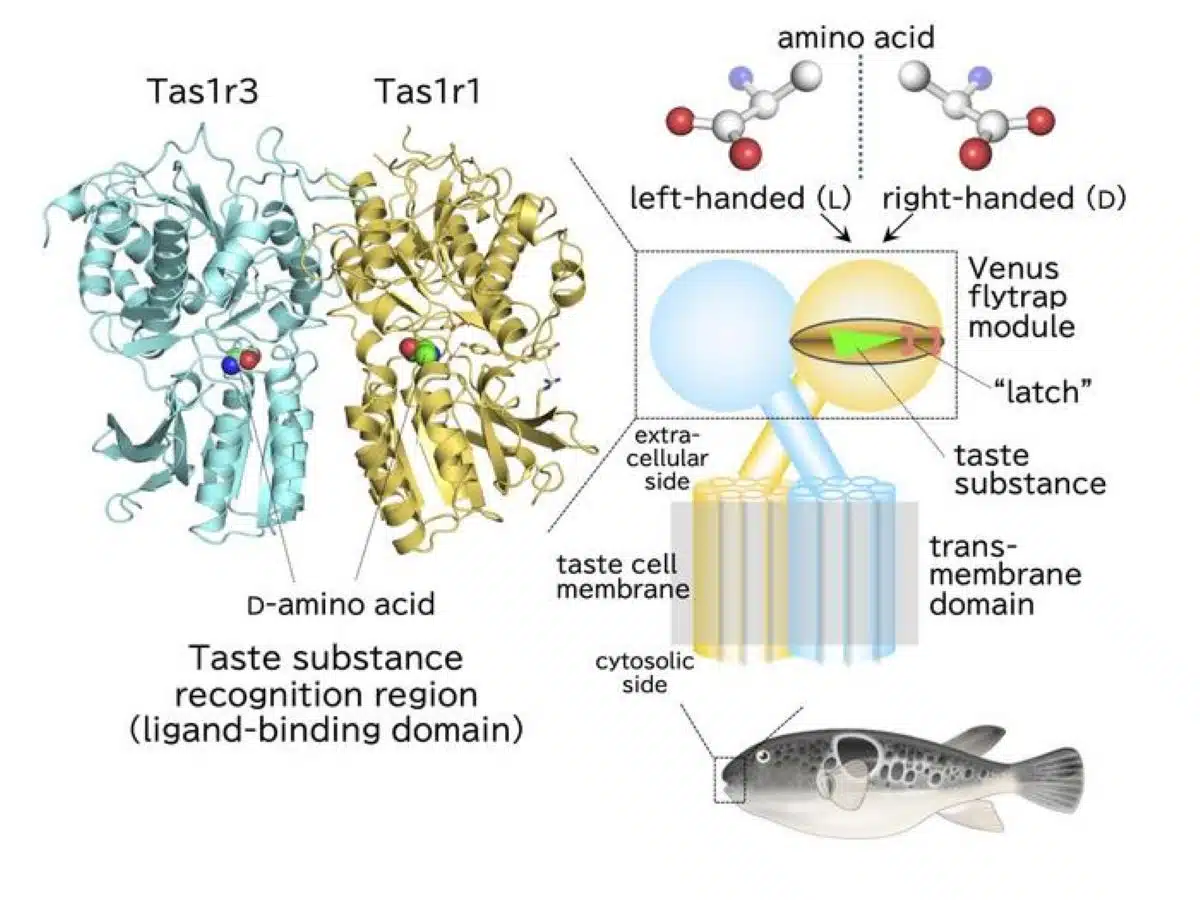
Researchers have solved the first 3D crystal structure of an umami taste receptor ortholog in pufferfish, revealing a unique molecular latch that enables it to recognize both savory L- and sweet D-amino acids. The structural finding shows how sensory receptors can evolve flexible internal connections to broaden taste perception, offering new avenues for designing next-generation flavor compounds and specialized feeds.
Key Facts:
- Unprecedented Stereochemical Flexibility: While mammalian taste receptors strictly discriminate between mirror-image enantiomers, the pufferfish Tas1r1/Tas1r3 receptor binds and responds to both L-amino acids (typically savory) and D-amino acids (typically sweet).
- Molecular “Latch” Mechanism: Structural analysis demonstrated that intersubdomain interactions hold the receptor’s clamshell-like binding cleft shut even when the molecular fit is imperfect, stabilizing the active signaling state.
- Diet-Driven Evolution: The adaptation is thought to stem from the pufferfish’s dietary intake of mollusks and crustaceans, which naturally accumulate high concentrations of D-amino acids.
Source: The University of Osaka
How Animals Sense the Chemistry of Food
The sense of taste is a biological sentinel, alerting vertebrates to calorie-rich, lifesaving nutrients while warning against toxic compounds. At the molecular frontline of this sensory system is the taste receptor type 1 (TAS1R) family, class C G protein–coupled receptors (GPCRs) that detect sugars, amino acids, and nucleotides across diverse species.
In humans and other mammals, taste discrimination is notoriously enantioselective: the umami receptor (TAS1R1/TAS1R3) selectively identifies L-amino acids, while the sweet receptor (TAS1R2/TAS1R3) detects sugars and D-amino acids. Because purifying and stabilizing these fragile receptor complexes in vitro has proved difficult, the structural mechanisms governing how taste receptors recognize target ligands have largely remained elusive.
Now, a research team led by The University of Osaka has cracked this structural enigma by determining the 3D crystal structure of the ligand-binding domain of Tas1r1/Tas1r3 from the pufferfish (Takifugu rubripes). The team’s findings, published in the Proceedings of the National Academy of Sciences (PNAS), uncover a surprising degree of stereochemical flexibility that overturns classical models of taste receptor specificity.
A Molecular Clamp with a Built-In Latch
Like other class C GPCRs, TAS1R receptors feature a large extracellular ligand-binding domain configured like a clamshell or clamp. Normally, a matching nutrient binds inside the cleft, causing the clamp to close tightly and trigger intracellular signaling. If a molecule possesses the wrong 3D shape or mirror-image chirality, the clamp fails to lock shut, and the signaling cascade remains silent.
However, the pufferfish Tas1r1/Tas1r3 receptor behaves very differently. Through crystallographic and mutational analyses, the researchers identified distinct intersubdomain interactions acting as internal molecular “latches”. These bridges brace the binding cleft shut even when interacting with atypical ligands, maintaining an active receptor conformation across a wide spectrum of amino acids.
“Normally, a receptor is unable to bind onto a molecule that is the wrong shape,” explained senior author Atsuko Yamashita. “Discovering how the Tas1r1/Tas1r3 receptor structure acts like a latch, holding either an L- or D-amino acid molecule in place, is an exciting breakthrough in understanding how receptors can evolve to be more flexible.”
Driven by Marine Diets
This stereochemical promiscuity appears to be an evolutionary adaptation directly shaped by the animal’s ecological niche.
“We believe that the pufferfish’s diet drives this molecular evolution,” Yamashita noted. “They eat a lot of mollusks and crustaceans, which contain high amounts of D-amino acids. Generally, TAS1Rs are considered to discriminate L- and D-amino acids and sense only one of them. The ability to taste both forms may help the fish detect a wider range of savory amino acids in their foods.”
By acquiring intramolecular interactions that shift the conformational equilibrium toward the active state, pufferfish taste receptors expanded their culinary repertoire without needing an entirely new family of receptor genes.
From Evolutionary Biology to Flavor Engineering
Unveiling the atomic framework of Tas1r1/Tas1r3 delivers practical implications far beyond evolutionary sensory biology. Because vertebrate taste receptors share a conserved structural core architecture, understanding how intramolecular latches modulate ligand binding could inspire rational drug and flavor design.
Food scientists could leverage these structural blueprints to engineer novel umami enhancers for human nutrition or formulate targeted feed additives to improve palatability in aquaculture and livestock industries.
Editorial Notes:
- This article was edited by a Neuroscience News editor.
- Journal paper reviewed in full.
- Additional context added by our staff.
About this Genetics and Neurology Research:
- Media Contact: Saori Obayashi
- Source: University of Osaka
- Image Credit: Image credited to Atsuko Yamashita
- Original Research is Closed Access: PNAS (September 15, 2026). “Identification and structural characterization of stereochemical promiscuity in a taste receptor” Authors: Rakuto Mizoguchi, Yasuka Toda, Mana Nagae, Takashi Yoshida, Hiroaki Matsuura, Kunio Hirata, Vi Toan Lam, Duy Phuoc Tran, Akio Kitao, Yohei Miyanoiri, Maiko Hosotani, Yuji Ashikawa, Chiaki Ito, Naotaka Tsutsumi, Norihisa Yasui, Yoshiro Ishimaru, and Atsuko Yamashita.
- DOI: 10.1073/pnas.2534924123
Abstract
Identification and structural characterization of stereochemical promiscuity in a taste receptor
Taste receptor type 1 (TAS1R), which consists of sweet and umami receptors in humans, senses nutrients (such as sugars and amino acids) with substrate specificity that is often broad and varies among animals and subtypes. However, the structural basis for achieving diverse specificities remains largely elusive.
Here, we present the crystal structure of the ligand-binding domain (LBD) of Tas1r1/Tas1r3 heterodimer from pufferfish, an ortholog of the human umami taste receptor.
The overall structure of Tas1r1/Tas1r3LBD resembles previously reported TAS1R structures, indicating a conserved core architecture within the family. Nevertheless, pufferfish Tas1r1/Tas1r3 was found to bind and respond to both l- and d-amino acids, even though TAS1Rs are considered to respond to either enantiomer.
Structural and mutational analyses revealed that this nonrigorous stereochemical recognition is attributed to intersubdomain interactions that latch the cleft containing the amino acid-binding site. These interactions prevent the cleft from fully opening, thereby stabilizing the active conformation, even if the ligand has a different chirality.
These results suggest that different substrate specificities in TAS1Rs can be acquired not only by the gain or loss of direct interactions with the substrate but also by the gain of intramolecular interactions, which alter the conformational equilibrium of the receptor.


