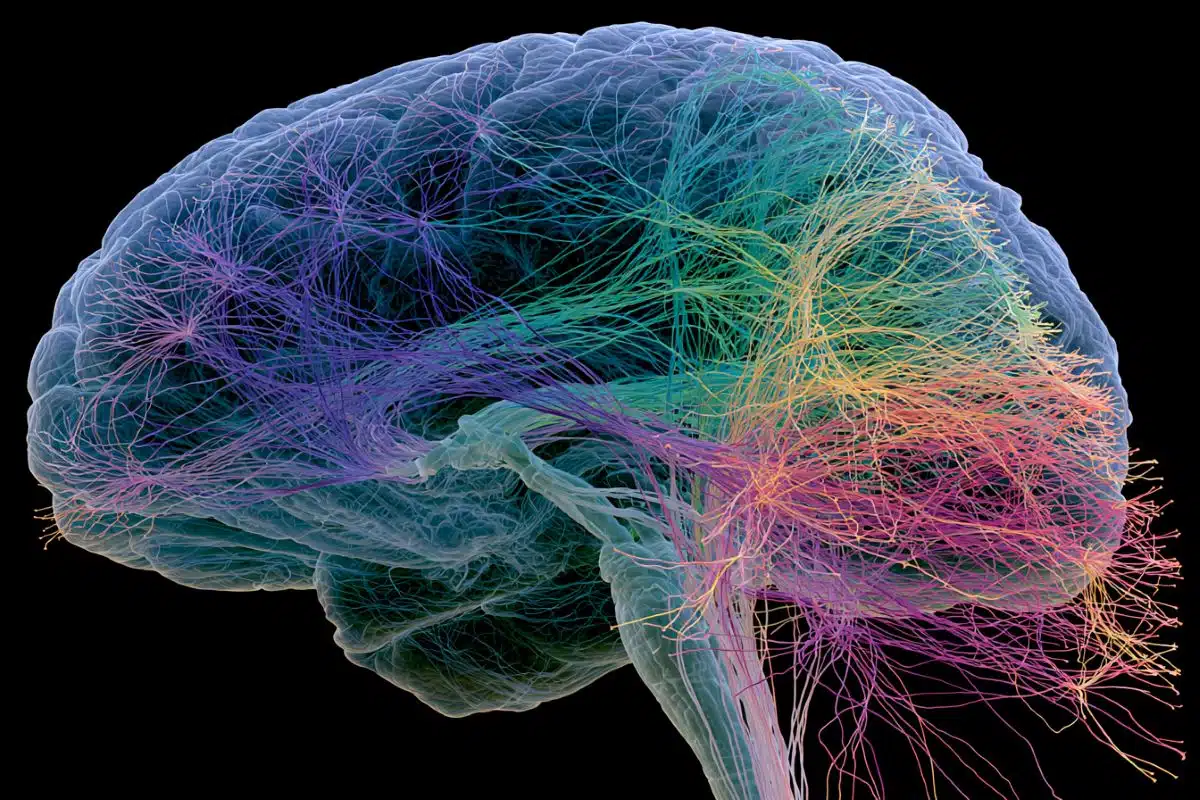
Summary: Researchers analyzed resting-state functional Magnetic Resonance Imaging (fMRI) scans from over 1,300 adults. The team discovered that while poor sleep in college-age adults triggers overconnectivity in physical movement networks, older adults (aged 65 and above) experience a systemic breakdown marked by hyperconnectivity in cognitive networks, a pattern that closely mirrors the earliest, silent stages of Alzheimer’s disease.
Key Facts
- The Lifespan Split: The study revealed that poor sleep triggers entirely opposite neural connection patterns in young vs. older brains:
- College-Age Adults (Ages 18–25): Exhibited hyper-connectivity (over-communication) in motor-control brain regions, suggesting their physical bodies remain in a state of high arousal and are not physically relaxed enough to sleep.
- Older Adults (Ages 65+): Exhibited under-connectivity in motor areas but showed abnormal hyper-connectivity in higher-level cognitive networks.
- The Silent Alzheimer’s Mirror: In older women, poor sleep was directly associated with severe hyperconnectivity between the Default Mode Network (DMN)—which handles internal thoughts, self-reflection, and autobiographical memory—and the Frontal Parietal Network (FPN), which manages active attention and working memory. This specific pattern of “over-communication” matches the preclinical, asymptomatic brain changes observed in early-stage Alzheimer’s disease.
- Cognitive Toll: Rather than representing a helpful compensation mechanism, this DMN-FPN hyperconnectivity in older adults was directly linked to poorer cognitive performance and accelerated memory decline over time.
- The Rumination Loop: Dr. Ian McDonough notes that while young adults are often plagued by physical hyperarousal, older adults’ sleep failures may be driven by active cognitive hyperarousal, such as rumination (obsessive, running thoughts before bed) which prevents the brain from entering a calm state.
- The Directionality Dilemma: A classic chicken-and-egg question remains: does underlying network degradation cause sleep loss, or does chronic poor sleep systematically destroy these network connections? The researchers found that DMN-FPN hyperconnectivity predicted steeper cognitive drops over time, suggesting that long-term cognitive damage directly follows chronic sleep disturbances.
- Tailored Clinical Solutions: Because the biological root causes of poor sleep differ by age, clinical interventions must be targeted. Young adults benefit heavily from physical pre-sleep wind-down routines (such as journaling to quiet running thoughts), whereas older adults require interventions that target deeper network integrity.
Source: Binghamton University
Have trouble sleeping? The reason may depend in part on your age.
A recent study including psychology researchers from Binghamton University, State University of New York investigates how poor sleep alters brain communication across the adult lifespan, specifically examining how these changes vary by age and biological sex.

The article, “Sleep quality is associated with default mode and salience network connectivity differently across age and sex,” appeared in a recent edition of the journal Neurobiology of Aging. Co-authors include psychology graduate student Sepehr Gourabi, and Associate Professor of Psychology Ian McDonough, both at Binghamton; and Selene Tan, Matthew Cribbet, and Jeanne Cundiff of The University of Alabama.
The researchers analyzed brain scans from two large groups totaling more than 1,300 participants to see how brain networks connect at rest in people who report having poor sleep quality.
“We discovered that the poorly slept older brain looks like it is suffering from a general breakdown in its sleep-regulation systems,” McDonough said.
College-age adults with poor sleep quality exhibited overconnected brain regions involved in movement, suggesting that their bodies aren’t physically ready to sleep. In older adults, typically age 65 and above, these same regions were under-connected; instead, they showed hyperconnectivity in brain regions involved in cognition.
In particular, older women with poor sleep showed abnormal hyperconnectivity between the Default Mode Network (DMN), which is involved in internal thoughts and memory, and the Frontal Parietal Network (FPN), which is involved in sustained attention and working memory. This over-communication pattern was directly linked to poorer memory performance and mirrors brain wiring patterns seen in the preclinical, silent stages of Alzheimer’s disease, McDonough said.
The reasons behind these differences are currently unclear. Older adults may become habituated to hyperarousal or develop coping mechanisms, including a willingness to take sleep-related medications. Another possible factor is rumination, a state of overthinking often associated with anxiety or depression, although anyone can experience it, depending on their personal situation.
“One strong possibility is that people who have a lot of running thoughts right before bed are not in a calm state, but rather more of an agitated state,” McDonough said.
Depression has a complicated relationship with dementia, with some studies showing a link between the two conditions. Other research has suggested that depression can resemble cognitive decline, but cognition improves once the individuals are treated for depression, McDonough said.
A chicken-and-egg issue remains: Do abnormal connections in the brain cause sleep dysfunction, or does sleep dysfunction cause those abnormalities? Hyperconnectivity between the DMN and FPN was associated with poorer cognition over time, suggesting that cognitive consequences follow sleep disturbance or increased connectivity between these networks, McDonough said.
Growing evidence suggests that between-network connectivity, especially with the DMN, is an early sign of declining brain health. Because of this, getting enough shut-eye is essential.
For young adults, efforts to reduce arousal before bedtime could help, such as journaling to reduce running thoughts. For older adults, however, the mechanisms are less clear, given that hyperarousal may not be the source. If you’re having problems sleeping, consult your physician, McDonough recommended.
“If connectivity changes do precede sleep loss, then strengthening brain networks could be one solution,” he said.
Key Questions Answered:
A: Think of your brain networks like coworkers in an office. The Default Mode Network (DMN) handles your internal world, daydreaming, memory, and self-reflection, and is usually active when you are resting. The Frontal Parietal Network (FPN) is your task-manager, handling active focus and decision-making when you are doing a chore. Normally, these two networks take turns. In older adults with poor sleep, these networks get stuck in an abnormal, constant loop of “over-talking” (hyperconnectivity). Instead of helping, this chaotic cross-talk causes cognitive interference, directly harming memory performance.
A: It points to a shift in what is keeping the brain awake. In college-age adults, poor sleep correlates with hyperactive motor networks. Their bodies are essentially primed for movement, indicating physical restlessness and difficulty winding down. In older adults, those physical networks are actually under-connected. Instead, their sleep issues are tied to cognitive networks, suggesting their brains are stuck in an active state of thinking, worrying, or ruminating. As Dr. McDonough explains, the older brain appears to suffer from a more general, structural breakdown of its internal sleep-regulation systems.
A: The relationship is deeply intertwined. Chronic sleep loss, depression, and cognitive decline often feed into one another in a toxic loop. The hyperconnectivity pattern seen in poorly slept older adults mirrors the exact, silent changes that occur years before Alzheimer’s symptoms physically manifest. Crucially, while depression can sometimes mimic dementia by temporarily slowing down thinking, treating the underlying sleep and mood issues can dramatically improve an older adult’s cognitive performance, proving that keeping our brain networks healthy is vital to preserving our memory as we age.
Editorial Notes:
- This article was edited by a Neuroscience News editor.
- Journal paper reviewed in full.
- Additional context added by our staff.
About this neuroscience and sleep research news
Author: John Brhel
Source: Binghamton University
Contact: John Brhel – Binghamton University
Image: The image is credited to Neuroscience News
Original Research: Open access.
“Sleep quality is associated with default mode and salience network connectivity differently across age and sex” by Ian M. McDonough, Jeanne M. Cundiff, Matthew R. Cribbet, Selene Tan, Sepehr Gourabi. Neurobiology of Aging
DOI:10.1016/j.neurobiolaging.2026.05.002
Abstract
Sleep quality is associated with default mode and salience network connectivity differently across age and sex
Aging and biological sex are critical moderators of sleep quality, which contributes significantly to age-related cognitive decline and Alzheimer’s disease (AD) risk. This study investigated how age and sex moderated the relationship between subjective sleep quality and resting-state functional connectivity (rsFC) within networks associated with hyperarousal and cognitive processing.
Using an exploratory-confirmatory approach across two datasets (N = 95 and N = 1244), we examined connectivity of the default mode network (DMN), salience network (SN), and amygdala with the rest of the brain. Results revealed distinct age- and sex-dependent patterns: in the DMN, a three-way interaction (Age×Sex×Sleep Quality) showed that poorer sleep quality was associated with reduced DMN–superior parietal lobule (SPL) connectivity in younger women but hyperconnectivity in older women.
This hyperconnectivity correlated with poorer episodic memory performance, consistent with patterns observed in preclinical AD. For the SN, an age-dependent interaction showed that poorer sleep was associated with SN–sensorimotor hyperconnectivity in younger adults—supporting the hyperarousal hypothesis—but lower connectivity in older adults, suggesting a shift toward different mechanisms, such as circadian or homeostatic decline, in late life.
No significant effects were found for the amygdala or blood-based biomarkers of AD pathology, inflammation, or sex hormones. These findings highlight a selective vulnerability of the DMN to sleep impairments in older women and suggest that the neural correlates of poor sleep shift from hyperarousal in youth to neurodegenerative-like patterns in older age.