

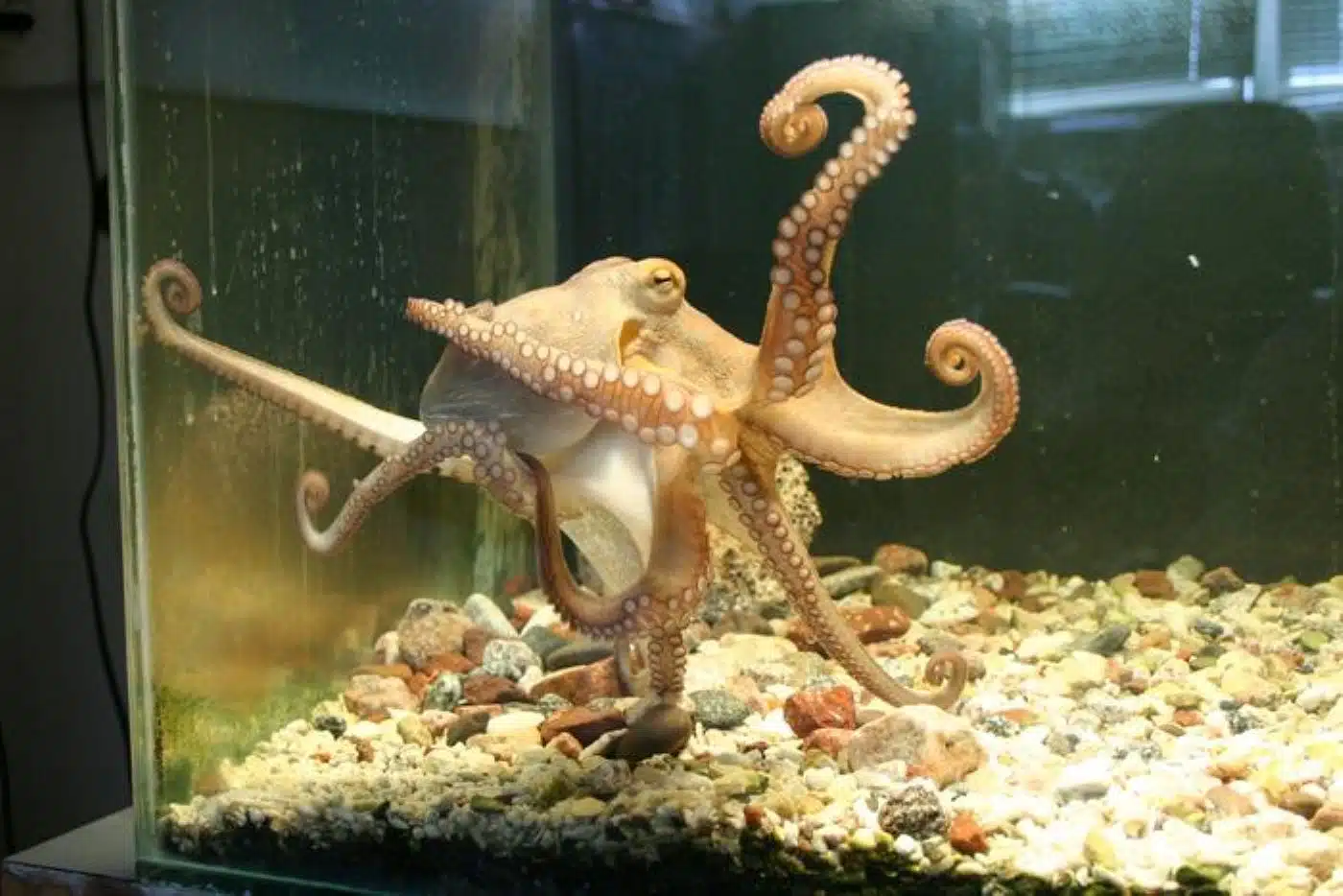
Summary:
A neurobiological investigation published in the Journal of Neuroscience reveals a distinct molecular mechanism underpinning long-term memory in the octopus brain. Led by researchers from the Hebrew University of Jerusalem and Ruppin Academic Center, the study demonstrates that long-term potentiation (LTP) in the octopus vertical lobe is preserved via an autonomous, self-sustaining nitric oxide (NO) feedback loop.
Unlike classical vertebrate memory consolidation, which requires nuclear gene expression and de novo protein synthesis, the octopus system continuously reactivates nitric oxide synthase to maintain enhanced neurotransmitter release, revealing an alternative evolutionary solution for enduring memory storage.
Key Facts:
- Protein-Synthesis Independence: Unlike vertebrate hippocampal synaptic plasticity, which requires newly synthesized proteins to stabilize late-phase long-term potentiation, octopus long-term memory maintenance functions entirely without de novo protein production.
- Nitric Oxide Positive Feedback Loop: Nitric oxide (NO) performs a dual function in the vertical lobe: it facilitates immediate neurotransmitter release and persistently reactivates its own synthetic enzyme, nitric oxide synthase (NOS), locking the synapse into an active, potentiated state.
- Convergent Evolution in Cephalopod Learning: The octopus vertical lobe serves as the functional analog to the vertebrate hippocampus, demonstrating that high-level learning and memory consolidation evolved independently via divergent biochemical pathways.
Source: Hebrew University of Jerusalem
Octopuses are renowned for their problem-solving abilities, associative learning, exploratory navigation, and tool manipulation. Yet their evolutionary lineage diverged from vertebrates over 500 million years ago, leading to a radically decentralized nervous system where two-thirds of their neurons reside within the arms rather than the central brain capsule.
In mammalian neurobiology, stabilizing long-term memories requires long-term potentiation (LTP), the persistent strengthening of chemical synapses following high-frequency activation. A dogma of vertebrate neuroscience is that transforming early, fleeting LTP into late, enduring memory traces requires transcription factors, nuclear signaling, and the translation of new structural proteins to physically remodel synaptic junctions.
In a study published in the Journal of Neuroscience, neurobiologists Dr. Ana Luiza Turchetti-Maia, Dr. Tal Shomrat, and Prof. Binyamin (Benny) Hochner investigated the vertical lobe of the octopus brain—a cerebral structure functionally analogous to the mammalian hippocampus.
Their findings show that octopuses preserve learned synaptic memory through an autonomous gaseous feedback loop that bypasses the need for new protein production.
The Vertical Lobe and Synaptic Potentiation
The octopus vertical lobe acts as the primary sensory-associative hub for visual and tactile learning. When vertical lobe neural circuits receive strong, brief electrical stimulation, the connections between nerve cells undergo robust long-term potentiation, reinforcing the synaptic pathways that register past experience.
However, electrophysiological and biochemical assays revealed that the downstream cascade sustaining this potentiation differs fundamentally from vertebrate models.
The mechanism centers on nitric oxide (NO), a gaseous, membrane-permeable signaling molecule:
- Facilitating Transmitter Release: Upon electrical stimulation, nitric oxide is synthesized and diffuses retrogradely into presynaptic terminals, promoting sustained neurotransmitter exocytosis.
- Self-Reactivating Feedback: Rather than dissipating quickly, the generated NO continuously stimulates nitric oxide synthase (NOS), the enzyme responsible for synthesizing NO.
This reciprocal activation establishes a self-reinforcing, regenerative enzymatic circuit. Once switched “ON” by an initial burst of activity, the loop keeps synaptic transmission enhanced over long time horizons.
Bypassing the Requirement for De Novo Translation
The key divergence from mammalian biology emerged when the team exposed vertical lobe slices to protein synthesis inhibitors.
In the vertebrate hippocampus, blocking ribosomal translation reliably extinguishes late-phase LTP within hours, erasing consolidated memory storage. In the octopus vertical lobe, blocking protein synthesis had no effect on the maintenance of synaptic potentiation.
The self-perpetuating enzymatic cycle of NOS and NO was sufficient to maintain strengthened synaptic transmission independently, challenging long-held assumptions that long-term cellular memories strictly require structural protein synthesis.
“What makes this discovery so exciting is that octopuses have evolved a fundamentally different molecular solution to a challenge shared by all learning systems: how to turn brief experience into a long-lasting change in neural connections,” explains Prof. Benny Hochner of the Hebrew University. “It is a remarkable example of how evolution can give rise to similar principles of learning and memory through very different biological mechanisms.”
Evolutionary Perspectives on Neural Plasticity
The discovery provides insights into evolutionary neurobiology. Because cephalopods developed complex cognition entirely independently of vertebrates, their neural machinery represents an alternative blueprint for computational intelligence.
Understanding non-protein-dependent memory mechanisms broadens the theoretical framework of neurobiology, offering new models for synthetic neural networks, bio-inspired computation, and the study of non-canonical plasticity pathways across diverse animal phyla.
Questions and Answers
How does memory maintenance in the octopus differ from vertebrates?
In vertebrates, long-term memory consolidation in the hippocampus requires new protein synthesis to physically remodel synapses. In the octopus vertical lobe, long-term potentiation is maintained through a self-sustaining nitric oxide feedback loop that operates without synthesizing new proteins.
What role does nitric oxide (NO) play in the octopus brain?
Nitric oxide acts as a dual-function molecular switch. It facilitates neurotransmitter release at the synapse and continuously reactivates its own producing enzyme, nitric oxide synthase (NOS), locking the synapse in a strengthened state over time.
What is the vertical lobe in the octopus brain?
The vertical lobe is the central learning and memory center of the octopus brain. It is the functional analog of the vertebrate hippocampus, responsible for processing sensory experiences and supporting long-term potentiation.
Editorial Notes:
- This article was edited by a Neuroscience News editor.
- Journal paper reviewed in full.
- Additional context added by our staff.
About this neuroscience and memory Research:
- Media Contact: Yarden Mills
- Source: Hebrew University of Jerusalem
- Image Credit: Image credited to Octopus Research Group, The Hebrew University
- Original Research is Open Access: Journal of Neuroscience (Nov 5, 2026). “A novel nitric oxide (NO)-dependent ‘molecular switch’ mediates LTP in the Octopus vulgaris brain through persistent activation of nitric oxide synthase (NOS).” Authors: Ana Luiza Turchetti-Maia, Tal Shomrat, Flavie Bidel, Itamar Koren, Naama Stern-Mentch, Nir Nesher and Binyamin Hochner.
- DOI: 10.1523/JNEUROSCI.1676-25.2026
Abstract
A novel nitric oxide (NO)-dependent ‘molecular switch’ mediates LTP in the Octopus vulgaris brain through persistent activation of nitric oxide synthase (NOS)
Cephalopod mollusks provide a striking example of the independent evolution of advanced cognitive abilities in invertebrates. In octopuses, learning and memory are mediated by the vertical lobe (VL), whose visual input synapses undergo robust activity-dependent long-term potentiation (LTP).
Here, we used Octopus vulgaris of either sex to show that persistent activation of nitric oxide synthase (NOS) mediates both LTP expression and maintenance, independently of de novo protein synthesis. Contrary to the prevailing view, NO signaling is not required for LTP induction, as LTP can still be induced in the presence of NOS inhibitors.
Remarkably, however, NOS inhibitors blocked presynaptic LTP expression, while NO donors induced only short-term potentiation, together suggesting that LTP expression depends on persistently elevated NO levels. The effective NO concentrations, estimated both pharmacologically and amperometrically, were more than three orders of magnitude higher than those required for activation of the canonical sGC–cGMP pathway, suggesting that NO acts through direct covalent modification of proteins, such as S-nitrosylation.
In a subset of synapses, the NOS inhibitor L-NNA rapidly and completely erased established LTP; however, following washout, full potentiation could be reinstated by renewed tetanic stimulation. We therefore propose a ‘molecular switch’ mechanism in which an NO-dependent positive feedback loop persistently reactivates NOS, thereby maintaining LTP.
These findings reveal an unprecedented form of convergent evolution in which molecular innovations equip the octopus VL network with the computational properties required for associative learning.


