

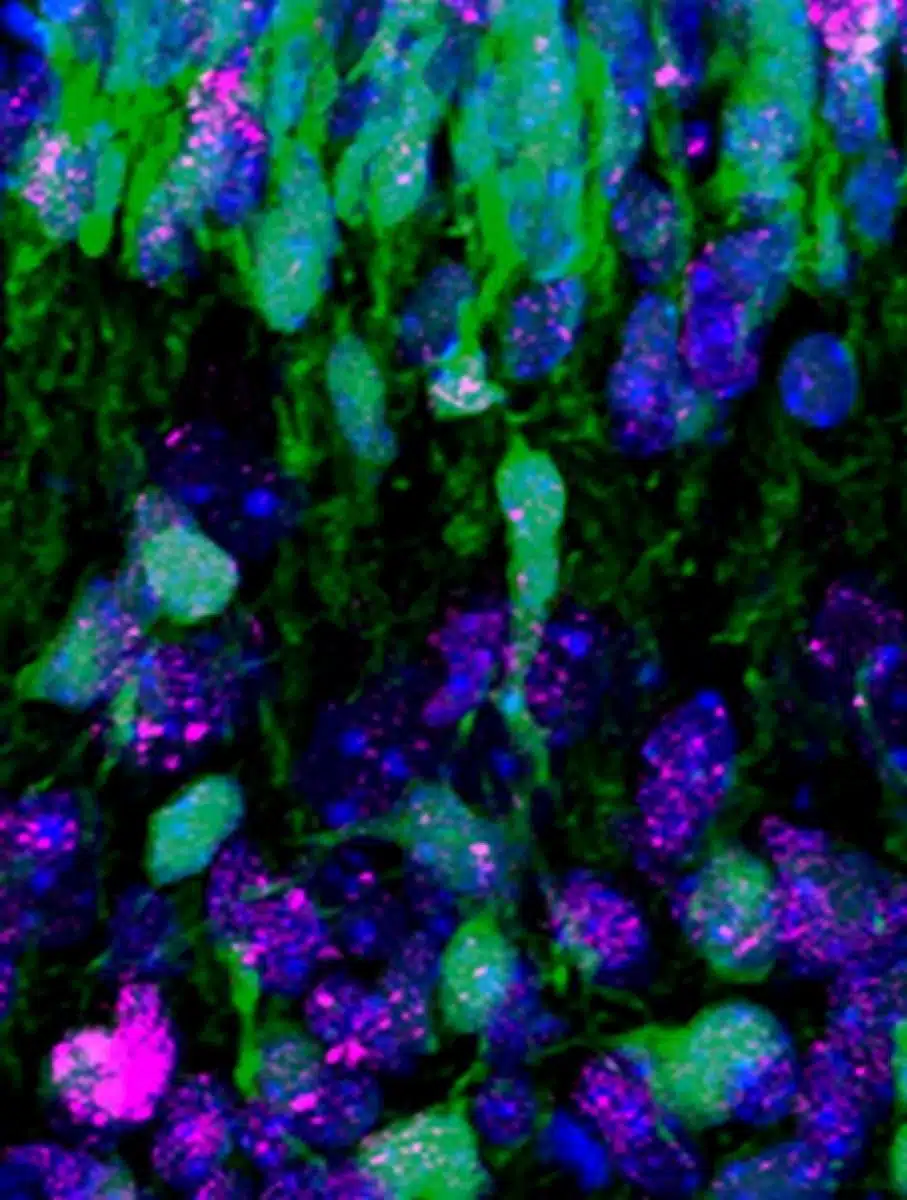
Summary: The physical migration of newborn nerve cells through the developing brain causes widespread, severe DNA damage. Researchers discovered that as migrating neurons squeeze through crowded, narrow spaces to form neural circuits in the cerebral cortex, they suffer double-strand breaks where both strands of the DNA double helix are severed. Instead of being a pathological anomaly, this severe damage is a normal, routine feature of healthy brain development that the brain efficiently repairs before permanent harm occurs.
By mimicking this cellular journey in engineered microchannels, the team traced the DNA breaks to the enzyme Topoisomerase IIβ, which becomes mechanically stuck mid-process while attempting to relieve torsional strain on the genome. Healthy neurons successfully repair these breaks within 24 hours using the non-homologous end joining pathway, selectively confining the damage to non-critical, inactive regions of the genome.
However, when researchers engineered mice lacking the critical repair enzyme Ligase 4, the animals developed progressive balance and coordination difficulties in adulthood. These findings suggest that the physical stress of brain development might permanently write unique genetic histories into individual neurons, offering a new framework for understanding neurodevelopmental and neurodegenerative diseases.
Key Facts
- Widespread Double-Strand Breaks: The mechanical squeeze experienced by migrating newborn neurons as they navigate dense brain tissue causes severe, routine double-strand DNA breaks.
- Enzymatic Trap: The damage is initiated by Topoisomerase IIβ, an enzyme that normally cuts and splices DNA to untangle torsional strain; mechanical pressure causes the enzyme to get stuck mid-cut, leaving severed genomic ends.
- Routine 24-Hour Repair: In healthy developing brains, neurons utilize the non-homologous end joining pathway to completely stitch the damaged DNA back together within 24 hours of completing their migration.
- Protected Active Genes: Unlike cancer cells, which experience random and lethal DNA damage under mechanical stress, neurons experience breaks primarily in non-critical, inactive genomic regions, preserving core cellular function.
- Progressive Deficits from Repair Failure: Knocking out the vital repair enzyme Ligase 4 in mice leads to the development of progressive balance and coordination difficulties from early adulthood, mimicking human genomic instability syndromes.
Source: Kyoto University
Newborn nerve cells must squeeze through crowded, narrow spaces—through dense tissue, past other cells, between fibres—to reach the areas where they form neural circuits in the brain cortex.
In a new study published in Nature, researchers at Kyoto University’s Institute for Integrated Cell-Material Sciences (WPI-iCeMS) and their collaborators report that this journey causes widespread DNA damage in neurons, resulting in double-strand breaks where both strands of the double helix are completely severed.
While this is the most severe type of DNA damage—capable of causing mutations and cell death—the team surprisingly found that it is a normal, routine feature of brain cortex formation, and a healthy brain quickly repairs it before harm occurs.
“The developing brain appears to have evolved to tolerate and repair the neuronal damage efficiently,” says Professor Mineko Kengaku, of WPI-iCeMS, who led the study. “But understanding the limits of that tolerance—and what happens when repair is incomplete—brings us closer to understanding a range of neurological conditions.”
The team mimicked the journey by guiding neurons through microchannels designed to replicate the narrow spaces in developing brain tissue. Fluorescent markers revealed DNA double-strand breaks forming as the cells passed through the channels, then disappearing after they had reached the other side. Most were repaired within 24 hours, with no lasting effects on function.
The researchers traced the DNA breaks to Topoisomerase IIβ, an enzyme that normally makes controlled cuts in DNA to release the torsional strain of everyday cellular activity. It’s similar to snipping a twisted cable to untangle it and then splicing it back together. Under mechanical stress, the enzyme becomes stuck mid-process, leaving broken ends of DNA. A repair pathway—known as non-homologous end joining—stitches these broken ends back together.
This differs sharply from what happens in some cancer cells migrating through the same microchannels, where DNA damage occurs more randomly, impairing cellular function or even killing the cells. In neurons, this damage occurs mainly in non-critical regions of the genome rather than in active genes, so overall function is preserved.
To test what happens if this repair fails, the team engineered mice in which new neurons in the cerebellum lacked Ligase 4, a key repair enzyme. The animals developed normally, but they gradually showed mild, progressive balance difficulties from early adulthood—symptoms reminiscent of human genome instability syndromes that affect the cerebellum.
The findings raise new questions about whether these early breaks contribute to neuronal individuality and to neurodevelopmental and neurodegenerative diseases.
“It shifts how we think about the neuronal genome,” says Professor Kengaku. “All neurons originate from the same DNA, but DNA damage and repair can introduce small genetic differences between individual neurons through a small mechanical journey. Some of that history may be written into the genome itself.”
The work was a collaboration between Kyoto University and groups at the University of Tokyo, the University of Osaka, the National University of Singapore, and the Tokyo Metropolitan Institute of Medical Science.
Key Questions Answered:
A: The study found that neurons possess a highly targeted, evolved tolerance system. While migrating cancer cells experience random, widespread DNA breaks that frequently hit vital, active genes and kill the cell, neurons experience these breaks primarily in non-critical, non-coding regions of the genome. Because their active, life-sustaining genes are protected from mechanical breaks, overall cellular health and function remain completely preserved during the journey.
A: The connection lies in an enzyme called Topoisomerase IIβ, which acts like a maintenance worker untangling a twisted cable. As a neuron compresses through tight spaces, its DNA twists and experiences intense physical, torsional strain. Topoisomerase IIβ steps in to make routine, controlled cuts to untangle the helix. However, the external mechanical pressure on the cell causes the enzyme to get stuck halfway through its job, leaving the DNA strands completely severed.
A: It completely changes how scientists view the neuronal genome. It implies that while all neurons in a brain start with the exact same genetic blueprint, the unique physical journey each cell takes to find its home alters its DNA. Because the process of breaking and repairing DNA can introduce tiny, permanent genetic variations, each neuron may carry a custom historical record of its migration written directly into its genome: contributing to cellular individuality.
Editorial Notes:
- This article was edited by a Neuroscience News editor.
- Journal paper reviewed in full.
- Additional context added by our staff.
About this neuroscience and genetics research news
Author: Nashaat Ghanem
Source: Kyoto University
Contact: Siyun Qin – Nashaat Ghanem
Image: The image is credited to Kyoto University iCeMS
Original Research: Open access.
“Confined migration induces non-lethal DNA damage in developing neurons” by Zhejing Zhang, Andres Canela, Junko Kurisu, Peilin Zou, Takumi Kawaue, Naotaka Nakazawa, Noriko Takeda, Mai Saeki, Masaki Utsunomiya, Merve Bilgic, Fumiyoshi Ishidate, Gianluca Grenci, Takahiro Furuta, Yusuke Kishi, Hiroyuki Sasanuma & Mineko Kengaku. Nature
DOI:10.1038/s41586-026-10648-8
Abstract
Confined migration induces non-lethal DNA damage in developing neurons
Migratory cells tend to have soft nuclei that deform and penetrate narrow spaces. Extensive nuclear deformation during migration can cause nuclear-envelope rupture and DNA damage in cancer cells, which may contribute to malignant transformation during tumour progression. However, the importance of DNA damage in physiological migration is less well understood.
Here we demonstrate that the migration of neurons in developing cerebral and cerebellar cortices is accompanied by massive DNA double-stranded breaks (DSBs) due to mechanostress during passage through narrow interstitial spaces. In contrast to many other migratory cells, these DSBs occur without detectable nuclear envelope rupture.
Confined migration increases topoisomerase-IIβ covalently bound DSBs, and these lesions are repaired through non-homologous end-joining during brain development without causing cell death. Genome sequencing revealed that DSBs tend to occur at transcriptionally inactive regions.
The deletion of ligase IV at the onset of neuronal migration leads to persistent DSB accumulation in cerebellar neurons with moderate transcriptional changes in genes related to synaptic function, neuronal development and stress and immune responses.
The mutant mouse develops mild motor deficits in later life, suggesting that the DNA damage generated during normal brain development poses a potential disease risk if left unrepaired.


