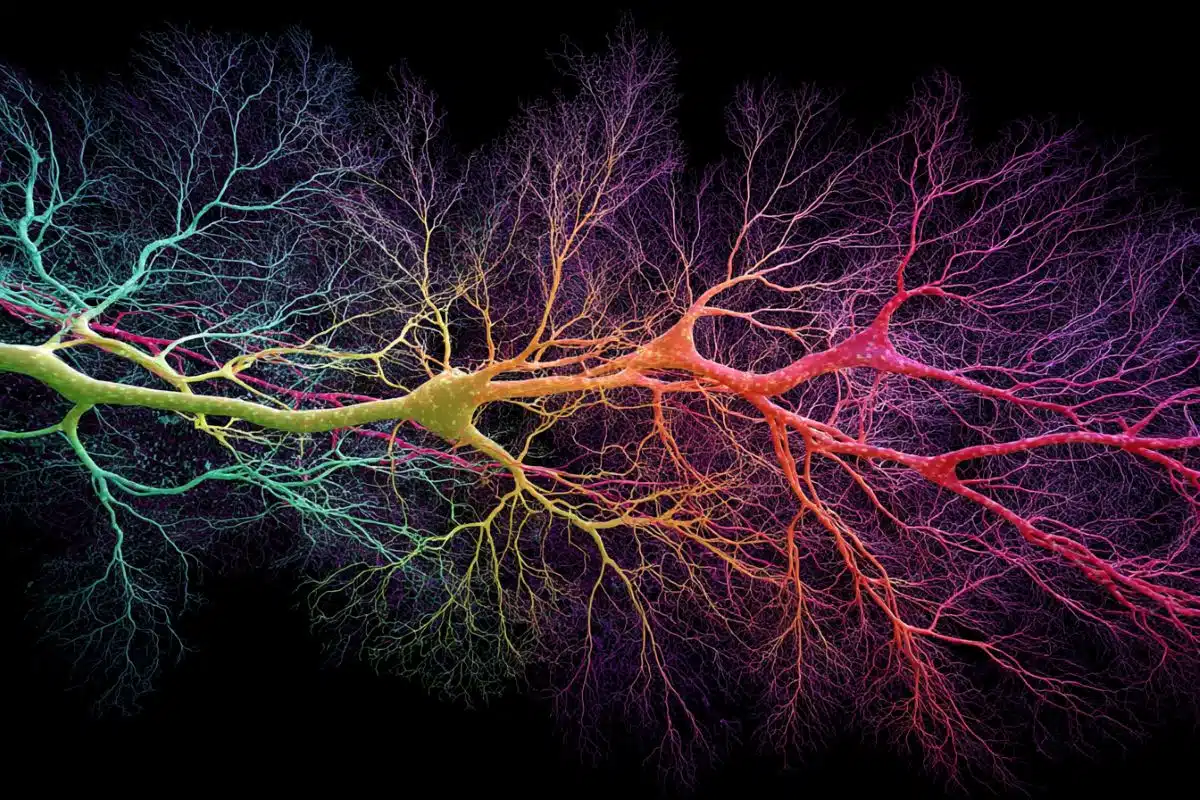
Summary: Why do we feel a sudden surge of motivation when we walk into our favorite coffee shop? New research has uncovered the physical “intersection” in the brain where memory and desire meet.
Scientists discovered that two different parts of the hippocampus—the dorsal (which handles maps and navigation) and the ventral (which handles emotion and mood)—team up on the exact same neurons within the nucleus accumbens, the brain’s primary reward center. By “talking” to the same cells at the same time, these two regions amplify each other’s signals, effectively turning a cold geographical memory into a hot, goal-directed drive to seek a reward.
Key Facts
- The Convergence Zone: For years, the “Where” (dorsal) and “Why” (ventral) pathways were thought to be separate. This study proves they converge on individual neurons in the nucleus accumbens.
- Synaptic Proximity: The two pathways attach to a neuron’s branches (dendrites) within just a few microns of each other. This physical closeness allows them to interact almost instantly.
- The Multiplier Effect: When both memory systems fire together, the resulting electrical response in the reward center is significantly stronger than the sum of its parts—a biological “1 + 1 = 3” effect.
- Dual-Color Optogenetics: Researchers used red and blue light to independently control the two hippocampal pathways, allowing them to watch in real-time as the signals merged within a single cell.
- Clinical Implications: This discovery could help explain why motivation is “broken” in conditions like depression (where rewards feel meaningless) or addiction (where certain places trigger an unstoppable drive for a substance).
Source: University of Maryland
New research from the University of Maryland, Baltimore County (UMBC) reveals how two different parts of the brain’s memory center team up in a key reward region to help mice—and likely humans—combine memories of places and contexts with the drive to pursue rewards.
The findings offer fresh insight into how the brain integrates information about “where” and “what feels good” to guide everyday decisions, such as heading to a favorite restaurant to meet friends or seeking out rewarding experiences.
Specifically, this discovery, published in the Journal of Neuroscience, shows that inputs from the dorsal and ventral hippocampus converge on the same individual neurons in another brain region, the nucleus accumbens, where they interact in ways that amplify each other’s effects.
“The connection between the hippocampus and nucleus accumbens is where the brain’s map of where to go meets a sense of why it’s worth going,” explains senior author Tara LeGates, assistant professor in UMBC’s Department of Biological Sciences.
For years, scientists viewed the connections from the dorsal hippocampus, which is more closely tied to spatial memory and navigation, and the ventral hippocampus, which is linked more strongly to emotions and motivation, as mostly separate. This paper challenges that understanding.
“A single neuron can receive inputs from different brain regions, and figuring out how it integrates them is crucial for understanding what drives goal-directed actions,” LeGates says.
While the current study focuses on individual cells, the implications reach further. Better knowledge of how these reward-related circuits process and combine information could shed light on conditions where motivation is disrupted, such as depression, addiction, or anxiety disorders.
A close-up on convergence
The research team used advanced methods including using light to stimulate specific pathways (a technique called optogenetics), precise recordings of electrical activity in neurons, and detailed microscope imaging to identify a group of neurons in a specific part of the accumbens that receives direct input from both the dorsal and ventral hippocampus.
Importantly, the synapses involved in these two pathways sit very close together—often within a couple of microns (thousandths of a millimeter)—on the same branches of the neurons’ dendrites, which look like tree roots on nerve cells. That proximity allows them to influence each other quickly.
The team found that when both inputs are active at the same time, they produce a stronger combined response than either one alone.
The researchers collaborated with Tagide deCarvalho, director of UMBC’s Keith Porter Imaging Facility, to obtain the high-resolution imaging that confirmed these close partnerships.
Upgraded software at the facility allowed the team to capture ultra-thin digital slices (0.2 microns thick) and create 3D reconstructions of neuron branches, clearly demonstrating the close proximity of the synapses that would allow them to interact.
The study’s first author, Ashley Copenhaver, Ph.D. ’25, neuroscience and cognitive sciences, led much of the hands-on work in recordings and imaging while mentoring undergraduate team members.
“One of the most exciting parts of this technically challenging project was performing dual-color optogenetics during electrophysiology—I was literally shining tiny beams of red and blue light onto brain tissue, which was activating the dorsal or ventral hippocampus neurons, so that I could record the electrical responses in the nucleus accumbens neurons. It was magical,” Copenhaver says.
“Beyond loving the technique, in my opinion, we identified some really critical and fundamental mechanisms of signal integration within the brain. I’m super excited to see where this work heads next.”
From cells to behavior
Understanding how a single neuron handles signals from different brain areas is key to grasping complex behaviors, says LeGates, who has a secondary appointment in the Department of Pharmacology and Physiology at the University of Maryland School of Medicine.
Signals from the dorsal and ventral hippocampus are “probably converging more than we’ve previously appreciated, which could change how people approach questions about motivation and learning,” she adds.
That kind of convergence likely helps animals form associations between rewarding outcomes and the environments where they occur—an essential capability for survival. Similar convergence has been seen in other brain areas involved in emotional learning, LeGates says, suggesting the brain may use this strategy widely to link a particular context with feeling and action.
LeGates’ lab is already building on this paper’s foundation by exploring how stress and substances like food, medications, and illicit drugs affect these same connections, with the long-term aim of informing more targeted treatments for various mental health conditions.
In the immediate future, the team hopes to record activity from these specially connected neurons during real behaviors to directly link the newly discovered crosstalk between the ventral and dorsal hippocampus to actions.
By uncovering this hidden layer of cooperation between hippocampal pathways, the LeGates lab has advanced our understanding of how the brain weaves together memory and motivation—a fundamental process that shapes the decisions driving daily life.
Key Questions Answered:
A: Exactly. Your dorsal hippocampus remembers the location (“Here is the sign”), while your ventral hippocampus remembers the feeling (“That food makes me happy”). This study shows that these two signals hit the same “Go” button in your brain’s reward center at the same time, supercharging your motivation to pull into the parking lot.
A: This could be a root cause of anhedonia—a common symptom of depression where you can’t feel pleasure. If the “Where” and the “Why” aren’t amplifying each other, a person might remember where their favorite park is, but they won’t feel the “pull” or drive to actually go there.
A: While this specific study was done in mice, the architecture of the hippocampus and nucleus accumbens is highly conserved across mammals. This fundamental mechanism—linking a map to a mood—is likely a universal survival strategy that helps animals (including us) return to places where they found food or safety.
Editorial Notes:
- This article was edited by a Neuroscience News editor.
- Journal paper reviewed in full.
- Additional context added by our staff.
About this neuroscience research news
Author: Sarah Hansen
Source: University of Maryland
Contact: Sarah Hansen – University of Maryland
Image: The image is credited to Neuroscience News
Original Research: Closed access.
“Heterosynaptic Interactions between the Dorsal and Ventral Hippocampus in Individual Medium Spiny Neurons of the Nucleus Accumbens Ventromedial Shell” by Ashley E. Copenhaver, Sydnee Vance, Sarah A. Snider, Kaela Befano, J. Branwen She and Tara A. LeGates. Journal of Neuroscience
DOI:10.1523/JNEUROSCI.1225-25.2026
Abstract
Heterosynaptic Interactions between the Dorsal and Ventral Hippocampus in Individual Medium Spiny Neurons of the Nucleus Accumbens Ventromedial Shell
Establishing learned associations between rewarding stimuli and the context under which those rewards are encountered is critical for survival.
Hippocampal input to the nucleus accumbens (NAc) provides important environmental context to reward processing to support goal-directed behaviors. This connection consists of two independent pathways originating from the dorsal (dHipp) or ventral hippocampus (vHipp), which have previously been considered functionally and anatomically distinct.
Here, we show overlap in dHipp and vHipp terminal fields in the NAc, leading us to reconsider this view and raise new questions regarding the potential interactions between dHipp and vHipp pathways in the NAc.
Using optogenetics, electrophysiology, and transsynaptic labeling in male and female mice, we investigated anatomical and functional convergence of dHipp and vHipp inputs in the NAc.
Transsynaptic labeling revealed a subpopulation of dually innervated cells in the NAc medial shell, confirmed by independent optogenetic manipulation of dHipp and vHipp inputs during whole-cell electrophysiological recordings.
Further analysis revealed closely apposed dHipp and vHipp inputs along dendritic branches, and simultaneous stimulation of both inputs elicited heterosynaptic potentiation.
Comparison of observed and theoretical success rates suggests heterosynaptic interactions may occur presynaptically.
Altogether, these results demonstrate that inputs originating from dHipp and vHipp converge onto a subset of NAc neurons with synapses positioned to enable rapid heterosynaptic interactions, indicating integration of these inputs at the single-neuron level.
Exploring the physiological and behavioral implications of this convergence will offer new insights into how individual neurons incorporate information from distinct inputs and how this integration may shape learning.