

Summary:
Researchers discovered a primate-specific DNA regulatory switch that governs the production of specialized brain-building stem cells called basal radial glia (bRG). The study shows that evolution expanded primate cerebral cortex complexity by altering how the shared DACH1 gene is regulated, boosting bRG progenitor production without needing to invent entirely new genes.
Key Facts:
- Same Gene, Primate-Specific Switch: The DACH1 gene exists in both mice and humans, but researchers identified a small noncoding DNA regulatory region unique to primates that acts like a genetic switch controlling DACH1 expression during cortical development.
- Boosting Cortex-Building Stem Cells: In human and rhesus monkey cortical organoids, deleting this regulatory switch sharply reduced basal radial glia (bRG), specialized stem cells abundant in primates that expand the cerebral cortex. Inserting the human switch into developing mouse brains increased bRG-like cells.
- Shifting Progenitor Fate: Live imaging of dividing neural stem cells demonstrated that boosting DACH1 activity raised the proportion of daughter cells becoming bRG-like progenitors from roughly 4% to nearly 15%, shifting downstream neuronal populations toward interhemispheric cortical connectors.
Source: National Yang Ming Chiao Tung University
What genetic innovations enabled the human cerebral cortex, the wrinkled outer sheet of neural tissue responsible for language, abstract reasoning, perception, and memory, to grow vastly larger and more intricate than the brains of most other mammals?
For decades, evolutionary neurobiologists have hunted for uniquely human genes that either expand the starting pool of neural progenitor cells or prolong the developmental window during which those cells divide.
Now, a collaborative team of researchers in Taiwan and Japan has uncovered a third evolutionary mechanism: rather than inventing new genes from scratch, evolution rewrote the regulatory instructions controlling an ancient, shared gene to alter which types of brain-building cells are manufactured.
Led by investigators at National Yang Ming Chiao Tung University (NYCU) and Academia Sinica in Taiwan, alongside collaborators at Kyoto University in Japan, the study pinpoints a small noncoding DNA element that drives the production of basal radial glia (bRG), a specialized class of neural stem cells essential for cortical expansion.
Changing the Factory’s Operating Instructions
To conceptualize how embryonic brain development evolved, the researchers compare the developing cortex to a biological factory staffed by neural stem cells. Evolution can scale up output by enlarging the workforce or extending factory operating hours, or it can modify the factory’s operating manual to produce a specialized mix of workers.
In developing primate brains, basal radial glia (bRGs) serve as high-capacity cortical builders. Abundant in humans and non-human primates yet remarkably scarce in rodents, bRGs undergo repeated rounds of self-renewing division within the outer subventricular zone, dramatically amplifying the neuronal output needed to fold and expand the cerebral cortex. They also generate upper-layer projection neurons that form long-range connections bridging distant cortical regions and hemispheres.
“What interested us was that the gene already exists in both humans and mice. The important difference may not be the gene itself, but the instructions controlling how it is used during brain development. That gives us another way to understand how evolution could produce different kinds of brains,” explained Professor Pei-Shan Hou at the Institute of Anatomy and Cell Biology, NYCU, Taiwan.
Testing the Primate Switch in Organoids and Mouse Brains
The research team focused on DACH1 (Dachshund Family Transcription Factor 1), a developmental gene conserved across mice, monkeys, and humans. Comparative genomic analysis revealed a compact regulatory DNA sequence acting as an enhancer switch for DACH1; while conserved across primates, this regulatory motif differs in non-primate vertebrates.
To determine how this evolutionary edit shapes cortical assembly, the investigators combined cross-species stem cell engineering with live-tissue neuroimaging:
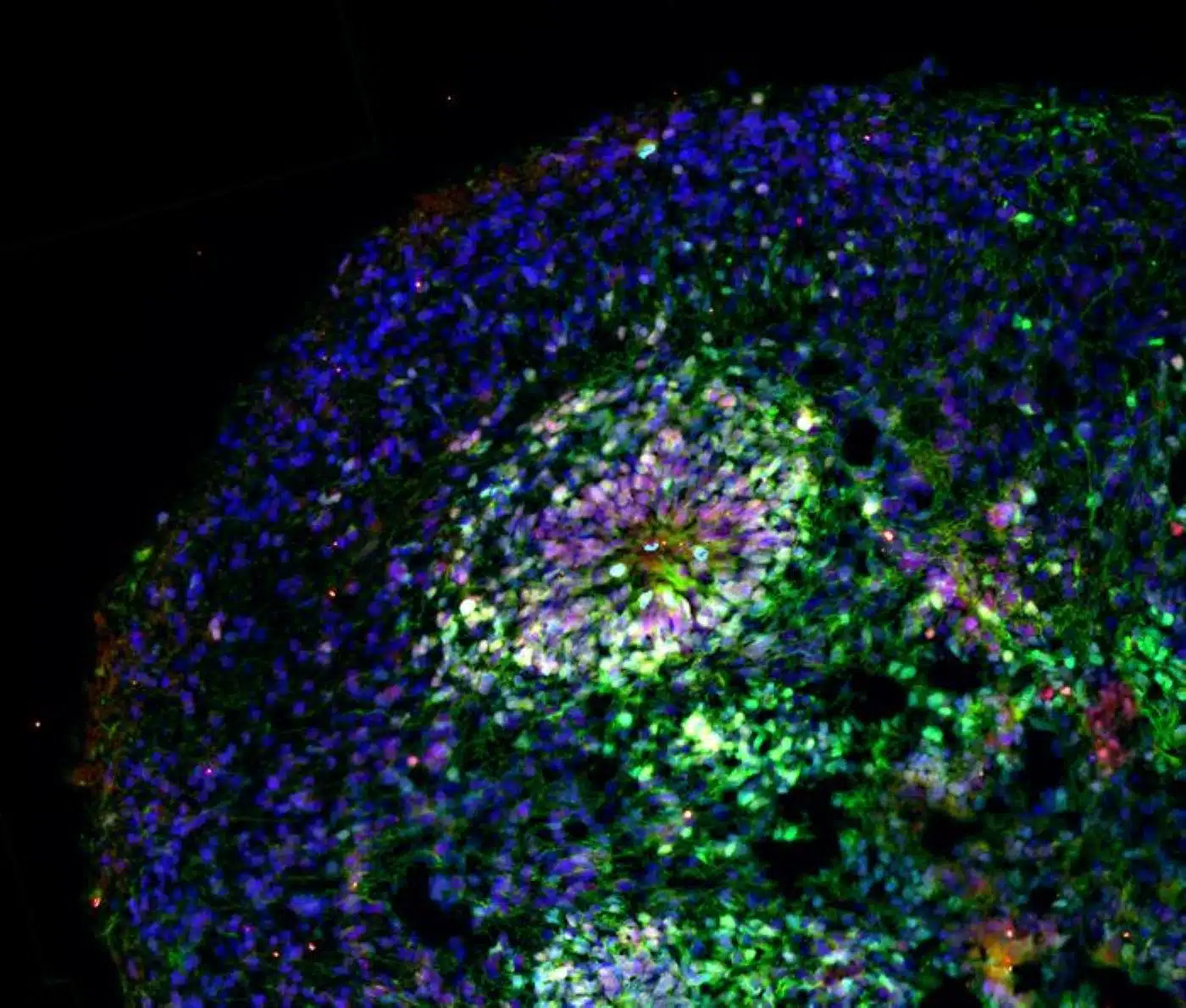
- Human and Monkey Cortical Organoids: Using pluripotent stem cells, the team grew three-dimensional human and rhesus monkey cortical organoids, miniature, self-organizing models of early embryonic brain architecture. When researchers excised the primate regulatory DNA region from the organoids, populations expressing hallmark bRG markers dropped sharply, while other baseline neural progenitor pools remained largely unaffected.
- Cross-Species Gain-of-Function: Conversely, when the scientists introduced the human regulatory DNA element into developing mouse embryos, the rodent brains generated a marked surge in progenitor cells exhibiting bRG characteristics.
- Live Cell-Fate Imaging: Tracking individual dividing neural stem cells in developing mouse brain tissue via time-lapse live imaging revealed that elevating DACH1 activity boosted the fraction of daughter cells adopting a bRG-like identity from roughly 4% to nearly 15%.
Further molecular dissection showed that DACH1 drives this cell-fate shift by suppressing an opposing signaling pathway that otherwise restricts neural stem cell diversification, ultimately shifting the balance of newborn neurons toward subtypes that wire the brain’s two hemispheres together.
A New Frontier in Evolutionary Neurobiology
While the authors emphasize that brain evolution and human intelligence emerge from complex, multi-gene networks rather than a single regulatory switch, the findings demonstrate how subtle tweaks in noncoding DNA can profoundly reshape cellular architecture.
By illuminating how regulatory DNA coordinates progenitor identity and developmental timing, the work provides both a clearer framework for understanding primate brain evolution and improved benchmarks for engineering high-fidelity human cortical organoids to model neurodevelopmental disorders.
Questions and Answers
How did evolution help make the human brain larger without creating new genes?
Researchers discovered that evolution modified a small regulatory stretch of noncoding DNA, acting like a genetic switch, that controls an existing gene called DACH1. By altering when and how strongly DACH1 is used during development, primates produce far more cortex-building stem cells than mice, even though both species share the DACH1 gene.
What are basal radial glia (bRG), and why are they important?
Basal radial glia are specialized neural stem cells that are abundant in developing primate brains but rare in mice. They divide repeatedly to generate huge numbers of neurons for the cerebral cortex—the brain’s outer layer responsible for memory, language, and complex thought—as well as nerve cells that connect the brain’s two hemispheres.
How did scientists prove this DNA switch controls brain cell production?
When researchers deleted the primate regulatory DNA region from lab-grown human and rhesus monkey brain organoids, the organoids produced significantly fewer basal radial glia cells. Conversely, inserting the human DNA switch into developing mouse brains increased the production of bRG-like cells.
Editorial Notes:
- This article was edited by a Neuroscience News editor.
- Journal paper reviewed in full.
- Additional context added by our staff.
About this neuroscience Research:
- Media Contact: Chien Wen Lo
- Source: National Yang Ming Chiao Tung University
- Image Credit: Image credited to the researchers
- Original Research is Open Access: Science Advances (Nov 13, 2026). “An LHX2-DACH1 regulatory innovation drives basal progenitor expansion in the primate neocortex.” Authors: Pei-Shan Hou, Ching-Yu Chuang, Feng-Lan Chiu, Chan-Hsien Yeh, Shih-Shun Hung, Quan Wu, Taeko Suetsugu, Fumio Matsuzaki, Shen-Ju Chou, and Hung-Chih Kuo.
- DOI: 10.1126/sciadv.aed3856
Abstract
An LHX2-DACH1 regulatory innovation drives basal progenitor expansion in the primate neocortex
A defining feature of the primate neocortex is an expanded cortical progenitor pool, especially the basal radial glia (bRG), contributing to complex intracortical circuitry underlying higher cognition.
Here, a comparative transcriptomic analysis of developing human and mouse neocortical cells identified DACH1 as a transcription factor enriched in human neurogenic RGs.
Using both primate ESCs and mouse models, we found an LHX2-DACH1-miR-215-5p program regulating bRG production. DACH1 loss in human cortical progenitors impaired bRG production and shifted neuronal output toward corticospinal neurons, whereas Dach1 depletion in mice had no effect.
Conversely, ectopic DACH1 expression in the rodent neocortex induced bRG formation and promoted callosal neuron production. Further, we found that DACH1 is regulated by LHX2 via a primate-evolved enhancer. Introducing this enhancer into mice promoted bRG generation, while its removal in primates impaired bRG production.
Mechanistically, DACH1 promotes bRG generation by suppressing miR-215-5p–mediated down-regulation of centromere- and centrosome-related genes. These findings reveal a mechanism by which cortical progenitor expansion shapes the primate cortical connectome for cognitive evolution.


