

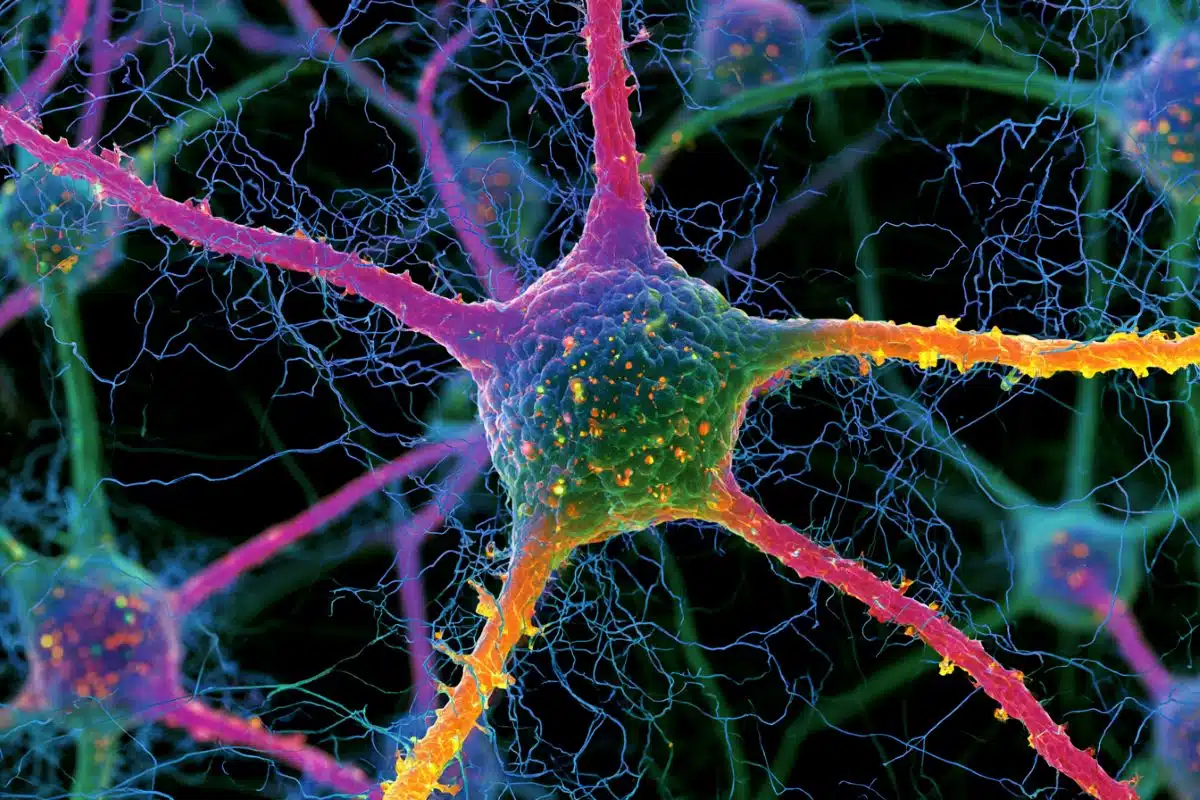
Summary: A new study utilizes International Brain Laboratory data across 43 mouse cortical regions to prove that multi-purpose generalist neurons constitute the overwhelming rule of mammalian brain architecture. While primary sensory zones utilize specialists, higher-order populations employ high-dimensional representations that simultaneously encode multiple variables without redundant cellular behavior.
This multi-tasking framework provides the foundational basis for cognitive flexibility, proving that neural computations can only be decoded by evaluating collective neural populations rather than individual single-cell inputs.
Key Facts
- The 11,000-Preprint Milestone: Reflecting the deep significance of this neurological debate, more than 11,000 preliminary copies of the manuscript were downloaded as preprints by global researchers before the finalized peer-reviewed paper debuted in today’s print edition of Nature.
- Generalists as the Overwhelming Rule: The investigation proves that single-purpose, hyper-specialized neurons are rare exceptions rather than the neurological norm. While primary sensory gateways (such as the early layers of the visual cortex) use dedicated specialists, the rest of the cerebral cortex relies entirely on an array of versatile generalists.
- High-Dimensional Representations: These multi-purpose neurons function by simultaneously encoding information about multiple distinct variables (e.g., color, shape, orientation, and behavioral value). Collectively, these signals yield a “high-dimensional representation,” which pools multiple attributes together, allowing the brain to reuse the same neural population for dozens of separate computational tasks.
- The Single-Neuron Decoding Blindspot: A key mathematical consequence of this architecture is that analyzing individual neurons one at a time makes it nearly impossible to decode what the brain is doing. Because each neuron encodes a blend of multiple variables, the true signal can only be extracted by zooming out to observe the population as a collective web, overturning decades of classic research that discarded neurons whose individual outputs were hard to categorize.
- Unique Versatility Without Duplication: Despite sharing a generalized processing style, these multi-purpose cells are not redundant. Each neuron maintains its own unique signature of blended variables, meaning the brain maintains maximum computational efficiency and flexibility without wasting space on identical, cloned cellular behaviors.
- The “Voter Opinion” Analogy: Dr. Lorenzo Posani highlights that mapping these networks is highly comparable to reviewing political voting maps. From a distance, clear regional clusters emerge where populations generally lean toward a shared behavior, allowing researchers to track which brain module a cell belongs to. However, when you zoom down to individual scales, you find a highly mixed ecosystem of individual processing opinions.
- Human Translation Pipelines: Moving beyond the rodent model, Dr. Stefano Fusi’s team is actively collaborating with Dr. Ueli Rutishauser’s group at the California Institute of Technology (Caltech) to map human neurosurgical data, verifying if the human cortex relies on an identical high-dimensional network architecture.
Source: Zuckerman Institute
What scientific findings proved so compelling that more than 11,000 preliminary copies of them have been downloaded before they finally appeared in today’s Nature?
The new research focuses on a mystery as old as neuroscience. Is each neuron in the brain a specialist devoted to a limited task, like a hammer or a saw, or do they tend to be generalists, jacks-of-all-trades like Swiss Army Knives?
By combing through a trove of recordings from an international collaboration that analyzed the brains of mice, researchers at Columbia’s Zuckerman Institute reveal that specialist neurons certainly do exist, but the majority appear to be generalists.
“We have to move away from this image of the brain as a machine made of gears, with every gear having an exact purpose that we can attach a label to,” said Stefano Fusi, PhD, a principal investigator at Columbia’s Zuckerman Institute, a member of the Kavli Institute for Brain Science and the paper’s co-senior author. “The brain doesn’t work like that. Instead, most neurons can display a huge diversity of responses, and this can help the brain solve a huge number of different tasks.”
These new findings shed light on how the brain may ultimately prove capable of performing complex tasks. In doing so, they may help reveal what happens when something goes wrong in the brain, and how those processes might be steered to go right again.
Whether neurons are specialists or generalists “is an old, important question, and one which researchers have really strong opinions on,” said Lorenzo Posani, PhD, the study’s co-lead author and a principal investigator at the Paris Brain Institute and France’s CNRS, who conducted this work while at Columbia’s Zuckerman Institute.
Previous research found the brain is organized into modules devoted to vision and smell and other processes; so perhaps such specialization might extend all the way down to the level of neurons. On the other hand, the brain is an incredibly powerful general-purpose computer that can respond in an extraordinary number of ways to a huge variety of situations, so maybe its neurons are similarly generalist in nature.
The problem with answering this question was that scientists often each tackled it with different approaches — for instance, they looked at different types of animals or brain regions or had the animals perform different tasks, Dr. Posani said. This often led to conflicting results — in some studies, some neurons were clearly specialized, while others appeared not to be.
To help resolve the debate, in the new study, the researchers developed a strategy where they looked only at mice, across many brain areas at once as the rodents all performed the same type of activity. This involved analyzing datasets much larger than typically studied, recordings of lots of neurons from the International Brain Laboratory consortium of activity in 43 regions across the mouse cortex on the level of single neurons.
In primary sensory areas, such as the brain region devoted to vision, neurons behaved in specialized ways. However, elsewhere, neurons generated far more diverse responses. In other words, when it comes to the question of whether neurons are typically specialists or generalists, these new findings suggest the latter holds true.
“We’re not saying that there are no specialized neurons,” said Dr. Fusi, also a professor of neuroscience at Columbia’s Vagelos College of Physicians and Surgeons and a member of Columbia’s Center for Theoretical Neuroscience. “We’re saying they are the exceptions. They’re not the rule.”
The scientists did find that based on a neuron’s pattern of responses to a given task, they could pinpoint with surprising accuracy which specific module in the brain it belonged to. However, these neurons still generally display generalist behavior.
“For example, compare this to maps of voter opinions,” Dr. Posani said. “There are clear clusters where people generally vote the same way. But when you zoom in, you see mixes of opinions.”
In addition, not only are most neurons generalists, but they rarely duplicate the behavior of one another. “Each is versatile in its own way,” says study co-lead author Shuqi Wang, a doctoral student at École Polytechnique Fédérale de Lausanne in Switzerland. This helps enable the brain’s flexibility and computational power, she explained.
All in all, the researchers suggest the multi-purpose nature of most neurons lets each of them encode information about multiple variables, such as whether a shape is red or black, or a circle or square. In turn, neurons collectively encode “high-dimensional” representations, which combine several different variables at the same time, such as, say, a red circle or black square.
“Such high-dimensional representations let populations of neurons behave flexibly in terms of what input they receive and output they generate. “You can reuse these high-dimensional representations for lots of different tasks,” Dr. Fusi said.
A key implication of these findings is that while each neuron generally encodes multiple variables, it is difficult to decode what any of these variables are from an individual neuron. It is only upon examining populations of neurons, like the brain does, that variables can be decoded. This is a major shift in thinking for the neuroscience community, “which for decades focused on one neuron at a time, discarding all neurons whose responses could not be understood,” Dr. Fusi said.
The scientists are now working with Ueli Rutishauser’s group at Caltech to investigate whether similar results are seen in humans, Dr. Fusi said. They also would like to see if neurons behaved more as generalists or specialists depending on what tasks a brain is asked to perform, he added. “There is still a lot to discover,” he said.
The paper, “Rarely categorical and highly separable: how neural representations change along the cortical hierarchy,” was published in Nature on July 15, 2026.
The full list of authors includes Lorenzo Posani, Shuqi Wang, Samuel P. Muscinelli, Liam Paninski and Stefano Fusi.
Funding: This work was funded by grants from the National Institutes of Health (RF1AG080818, U19NS123716), the Simons Foundation, the Kavli Foundation, the Gatsby Foundation (GAT3708), and the Swartz Foundation. This work is also supported by the funds provided by the National Science Foundation and by the DoD Office of the Under Secretary of Defense (R&E) under Cooperative Agreement PHY-2229929 (the NSF AI Institute for Artificial and Natural Intelligence). Dr. Posani was also supported by the NIH 1K99MH135166-01 grant.
The authors report no conflicts of interest.
Key Questions Answered:
A: This study tackles one of the oldest, most fiercely debated questions in the history of brain science: how are the basic units of our thoughts actually organized? For decades, laboratories were locked in conflict because they used mismatched methods, tracking different animals or isolated brain regions, leading to chaotic, contradictory results. By leveraging the standardized power of the International Brain Laboratory dataset to track single cells across 43 separate regions simultaneously during a single task, this team finally provided the definitive, large-scale evidence needed to settle the debate.
A: Imagine a simple computer where one wire only handles the color red, and another wire only handles squares. If you want that computer to recognize a red square, it has to route those signals together through a rigid, pre-wired circuit. A high-dimensional representation means that a single population of neurons can process color, shape, size, and motion all at once. By blending these multiple variables into a single, high-dimensional space, the brain can instantly reuse the exact same group of cells to process a red square, a black circle, or a moving blue triangle, giving us our unmatched cognitive flexibility.
A: For over half a century, the dominant methodology in neuroscience was to look at one single neuron at a time, record its activity, and try to decode its exact function. If a neuron’s activity looked messy or didn’t fit a clean label, it was often thrown out as meaningless background noise. This study proves that individual generalist neurons look like noise on purpose because they are encoding a mixture of different things. To understand the mind, we have to stop trying to label individual cells like gears in a clock and instead look at the mathematical trajectories of the whole population at once.
Editorial Notes:
- This article was edited by a Neuroscience News editor.
- Journal paper reviewed in full.
- Additional context added by our staff.
About this neuroscience research news
Author: Charles Choi
Source: Zuckerman Institute
Contact: Charles Choi – Zuckerman Institute
Image: The image is credited to Neuroscience News
Original Research: Open access.
“Rarely categorical, highly separable representations along the cortical hierarchy” by Lorenzo Posani, Shuqi Wang, Samuel P. Muscinelli, Liam Paninski & Stefano Fusi. Nature
DOI:10.1038/s41586-026-10668-4
Abstract
Rarely categorical, highly separable representations along the cortical hierarchy
A long-standing debate in neuroscience concerns whether individual neurons are organized into functionally distinct populations that encode information differently (categorical representations) and the implications for neural computation.
Here we systematically analysed how cortical neurons encode cognitive, sensory and movement variables across 43 cortical regions during a complex task (14,000+ units from the International Brain Laboratory public Brainwide Map dataset) and studied how these properties change across the sensory–cognitive cortical hierarchy. We found that the structure of the neural code was scale dependent.
At the whole-cortex scale, neural selectivity was categorical and organized across regions in a way that reflected their anatomical connectivity. However, within individual regions, categorical representations were rare and limited to primary sensory areas, and neuronal responses were instead very diverse.
With theoretical arguments and empirical evidence, we demonstrate that the diversity of neural responses enables high-dimensional representations and therefore high separability, allowing linear readouts to separate experimental conditions in many arbitrary ways. Indeed, when accounting for information that is actually encoded in each area, all cortical regions exhibit maximal separability.
Our results indicate that cortical circuits prioritize diversity over categorical structure, supporting a computational regime geared towards high-dimensional, highly separable neural representations.


