

Summary: For the average viewer, watching a cinematic film feels entirely effortless. We simultaneously digest spoken dialogue, track microscopic facial expressions, notice subtle background musical cues, and interpret rapid scene changes, merging them into a single, cohesive narrative. Beneath this seamless conscious experience, however, the human brain is engaged in an intense, split-second balancing act to determine which sensory stream deserves immediate priority.
A new study reveals that the frontal cortex acts as the master traffic controller of this process, dynamically shifting attentional resources between what we hear and what we see as an unpredictable environment unfolds.
Key Facts
- The Master Traffic Controller: The human frontal cortex does not process sensory inputs as a generic, mixed block; instead, it serves as an active filter, deciding which sensory stream takes priority before a scene enters conscious awareness.
- Anatomical Segregation Found: Direct neural tracking uncovered a rigid spatial map within the frontal lobe. The ventral (lower) frontal regions are inherently tuned to prioritize auditory processing, whereas the dorsal (upper) frontal regions are optimized for visual input.
- The Language Flip Mechanism: When scenes played in native English, the frontal cortex leaned heavily on auditory processing centers. However, the exact millisecond the film transitioned to an unfamiliar foreign language, neural activity dynamically pivoted toward visual centers to capture subtitles, gestures, and facial cues.
- Crowdsourced Validation: Independent online behavioral cohorts rated the narrative importance of audio vs. visual elements across identical film clips. Their subjective judgments perfectly mirrored the objective, millisecond-by-millisecond neural resource shifts observed in the surgical patients.
- Translational Potential: Mapping how the healthy brain dynamically reallocates sensory resources opens new avenues for creating advanced therapies for attention deficits, autism, language processing disorders, and profound hearing loss, while providing a framework for context-adaptive artificial intelligence.
Source: NYU
For most of us, watching a movie feels effortless. We follow dialogue, read facial expressions, notice music cues and shifting scenery, and somehow fuse it all into a coherent story. But beneath that smooth experience, the brain is constantly deciding which sensory stream matters most in each moment.
A new study published in Nature Communications suggests that the frontal cortex, a region associated with planning and higher cognition, may act as a kind of traffic controller for this process — dynamically shifting attention between what we hear and what we see as a story unfolds.
To investigate, neuroscientists recorded brain activity directly from 19 epilepsy patients who had temporarily implanted electrodes for clinical monitoring. While in the hospital, participants watched a 12-minute multilingual short film* containing scenes in English, Greek, German, and French. Some foreign-language scenes included English subtitles, creating a natural test of how the brain handles changing audiovisual demands. Because the electrodes sat on or inside the brain, the researchers could track neural responses with millisecond precision, far faster than MRI scans allow.
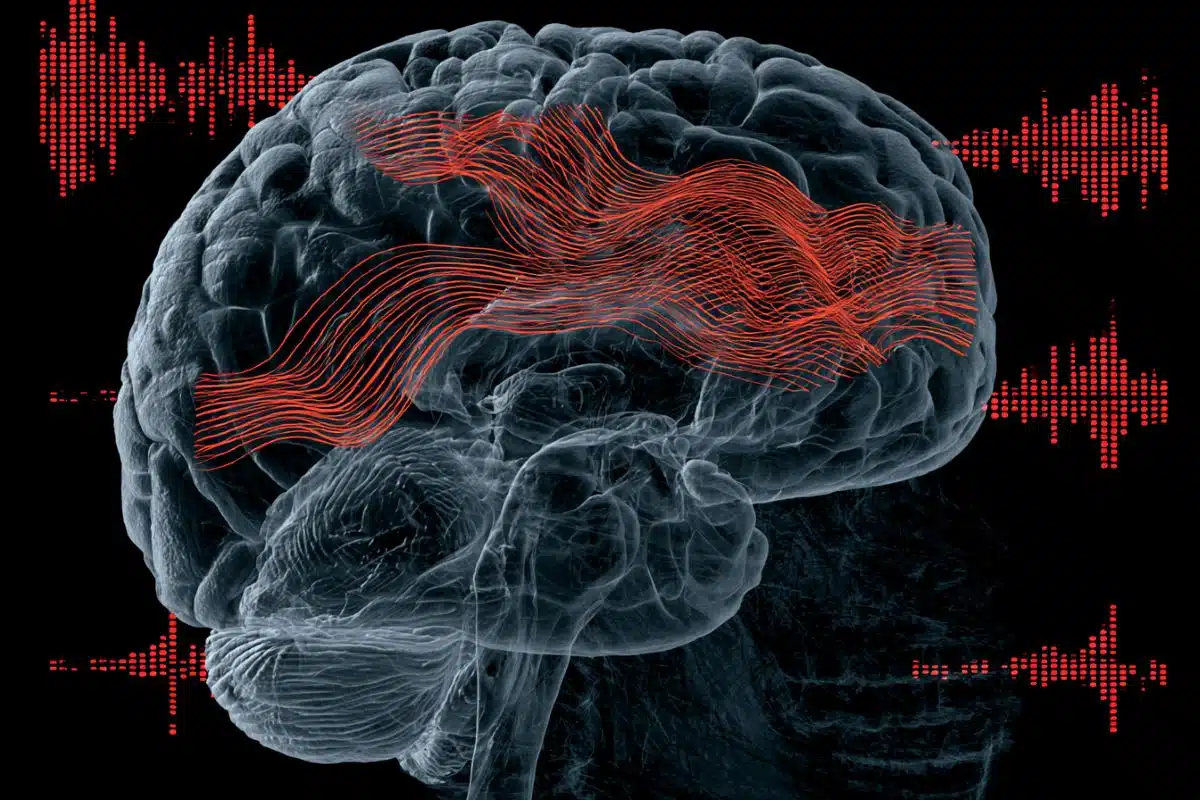
They found that the frontal cortex was not processing all sensory information equally. Instead, it showed a striking internal division. Ventral, or lower, frontal regions responded more strongly to auditory information, while dorsal, or upper, frontal regions were more tuned to visual input.
“This suggests the frontal cortex has an organized map for handling different kinds of information during real-world experiences,” said first author Faxin Zhou, a Ph.D. candidate in the NYU Tandon Biomedical Engineering Department. “It is not just a general control center, it appears to separate sound and sight in a structured way.”
The pattern became even more interesting when the language changed. During English-language scenes, when listeners could understand speech directly, frontal brain areas leaned more heavily on auditory processing. But during scenes in unfamiliar languages, activity shifted toward visual regions, suggesting viewers relied more on facial expressions, gestures, and subtitles to follow the plot.
To confirm that interpretation, the team recruited online volunteers to rate short clips from the film. Participants judged which moments were most important to understanding the story and whether audio or visual cues were more useful in each scene. Those ratings closely matched the neural data: spoken English favored sound, while foreign-language scenes favored visual cues. In other words, the brain appears to reweight its sensory priorities on the fly.
“When comprehension through speech becomes harder, the brain flexibly reallocates resources toward visual signals,” said senior author Adeen Flinker, Associate Professor of Biomedical Engineering at NYU Tandon and Neurology at NYU Grossman School of Medicine. “That adaptability may be essential for navigating everyday environments filled with competing information.”
The findings help illuminate a long-standing question in neuroscience: how the brain merges multiple senses in realistic settings. Much prior research has relied on simplified laboratory tasks. Movies, by contrast, more closely resemble real life, where sensory cues arrive continuously and unpredictably.
The study also hints that the frontal cortex may do more than merge information after the fact. It may actively decide which stream — sound or sight — deserves priority before conscious understanding emerges.
That insight could have practical implications. Better understanding how the brain reallocates sensory attention may help researchers design therapies for people with language disorders, autism, attention deficits, or hearing loss. It could also inspire more adaptive artificial intelligence systems that shift between audio and visual inputs depending on context.
The work has limitations. Because the participants were hospital patients with epilepsy, they may not perfectly represent the general population. Electrode placement was determined by medical need, not experimental design, leaving some brain areas less sampled than others. Still, the precision of direct neural recording offers a rare glimpse into how the living human brain manages everyday perception.
Key Questions Answered:
A: Traditional neuroimaging tools like functional MRI (fMRI) are excellent for spatial mapping but possess a massive structural delay, capturing changes over several seconds. Because a movie changes millisecond by millisecond, fMRI completely misses the rapid internal pivots of human thought. By studying epilepsy patients who already required surgically implanted intracranial electrodes for their medical evaluations, neuroscientists gained a rare, direct line to the living brain, allowing them to track the exact millisecond-level electrical shifts that occur when a viewer changes their focus from a spoken word to a written subtitle.
A: For decades, older models treated the frontal cortex as a generalized, homogeneous executive control center, a singular “office” that manages abstract planning after taking in pre-processed sensory information. This study radically flips that view. It proves that the frontal cortex is anatomically hardwired with a strict, divided map that physically separates auditory processing from visual processing, and that it actively intervenes before conscious awareness to dictate which sense gets a VIP pass to center stage.
A: Modern multimodal AI models struggle significantly with context-dependent efficiency; they typically expend massive computational power processing audio, video, and text inputs equally at all times, leading to processing bottlenecks. By mimicking the human frontal cortex’s elegant dual-network layout, computer scientists can design adaptive AI architectures. These next-generation systems will automatically mute or scale back heavy video processing when an audio stream is crystal clear, instantly reallocating their computational power to high-resolution visual processing the moment acoustic comprehension degrades.
Editorial Notes:
- This article was edited by a Neuroscience News editor.
- Journal paper reviewed in full.
- Additional context added by our staff.
About this auditory and visual neuroscience research news
Author: Leah Schmerl
Source: NYU
Contact: Leah Schmerl – NYU
Image: The image is credited to Neuroscience News
Original Research: Open access.
“Frontal cortex organization supporting audiovisual processing during naturalistic viewing” by Faxin Zhou, Amirhossein Khalilian-Gourtani, Patricia Dugan, Andrew Michalak, Orrin Devinsky, Peter Rozman, Werner Doyle, Daniel Friedman & Adeen Flinker. Nature Communications
DOI:10.1038/s41467-026-73947-8
Abstract
Frontal cortex organization supporting audiovisual processing during naturalistic viewing
Our brains dynamically adapt to a multisensory world by orchestrating diverse inputs across sensory streams. This process engages multiple brain regions, but it remains unclear how audiovisual stimuli are represented and evolve over time, especially in naturalistic scenarios.
Here, we employed a movie-viewing paradigm to explore this question. We recorded intracranial electrocorticography (iEEG) to measure brain activity in 19 participants watching a short multilingual movie.
Using unsupervised clustering and supervised encoding models, we identified a robust modality-specific gradient in the frontal cortex, wherein the ventral division primarily processes auditory information and the dorsal division processes visual inputs.
Further, we found that this cortical organization dynamically changed, adapting to different movie contexts. This result potentially reflects flexible audiovisual-resource assignment to construct a coherent percept of the movie. Leveraging behavioral ratings, we found that the frontal cortex is the primary site in this modality assignment process.
Together, our findings shed new light on the functional architecture of the frontal cortex underlying flexible multisensory representation and integration in natural contexts.


