

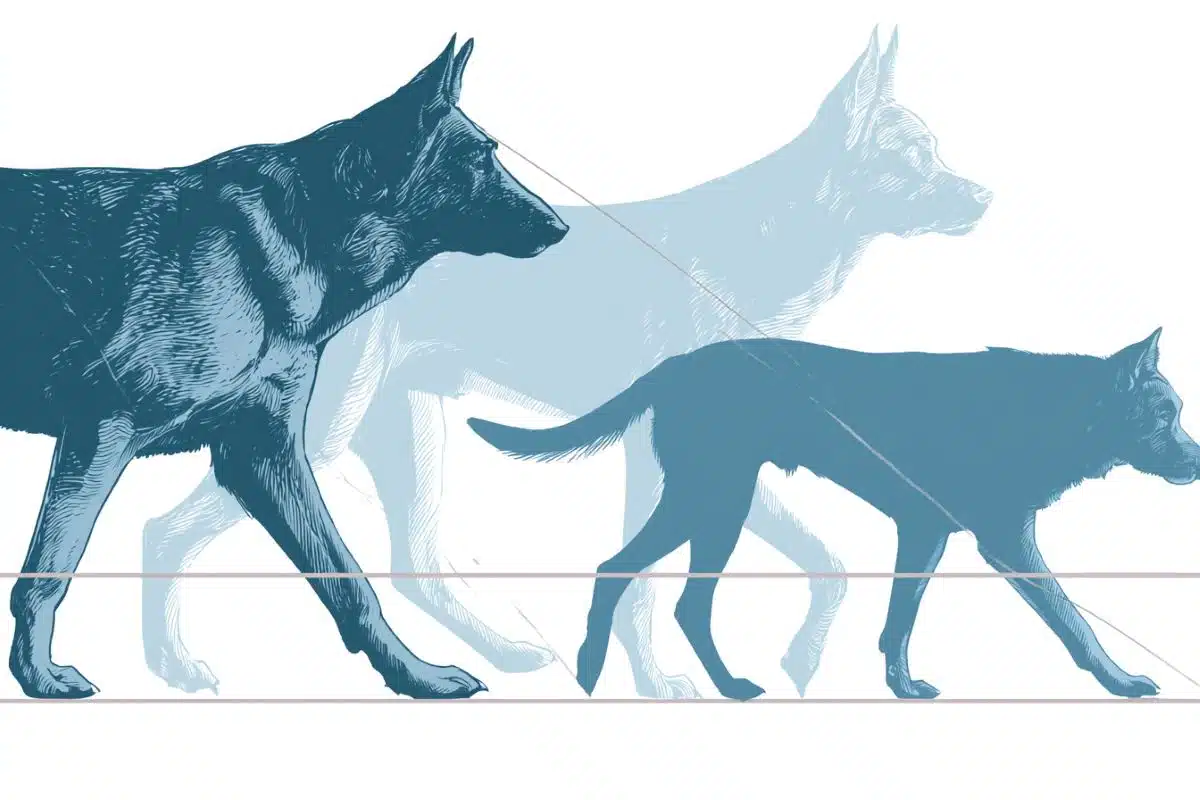
Summary: In humans, subtle changes in walking speed and stride length are well-established clinical biomarkers for the early detection of cognitive impairment and dementia. Now, research demonstrates that this exact same brain-body connection exists in our canine companions. The study provides a more holistic diagnostic picture of dogs developing canine cognitive dysfunction (CCD), essentially dog dementia, potentially allowing for earlier veterinary detection and better monitoring of disease progression.
The longitudinal study tracked 88 geriatric dogs with an average age of 12 years over multi-month intervals. The research team subjected the dogs to rigorous physical, neurological, and orthopedic testing alongside standardized cognitive assessments and owner questionnaires, such as the Canine Dementia Scale (CADES). Using a specialized indoor walkway to analyze gait metrics, investigators discovered that advanced cognitive decline directly correlates with a significantly shorter stride length, specifically and exclusively localized within the dog’s front (thoracic) limbs.
Key Facts
- The Front Limb Link: Owner-reported cognitive decline and elevated CADES scores correspond significantly with shorter thoracic (front) limb stride length when adjusted for the dog’s height.
- The 1.2% Calibrated Drop: Statistical modeling revealed that for every 10-point increase on the Canine Dementia Scale (CADES), a geriatric dog experiences an approximate 1.2% reduction in its front limb stride length.
- Pelvic Limb Immunity: Interestingly, hind (pelvic) limb stride length showed no correlation with cognitive deterioration, continuing to operate independently of mental decline.
- Cortical vs. Motor Influence: The selective degradation of front limb movement occurs because thoracic limbs are under heavier cortical control, making them highly sensitive to changes in a dog’s spatial orientation, vision, and executive brain function.
- Confounder Control: The association between a shortened front stride and cognitive decline remained highly significant even after mathematically factoring out and adjusting for age and physical pain scores (via the Canine Brief Pain Inventory).
- Early Warning Marker: While stride metrics alone cannot diagnose canine dementia, tracking an individual dog’s gait trajectory over time provides veterinarians with a vital, non-invasive early marker for functional brain decline.
Source: North Carolina State University
New research from North Carolina State University shows cognitive decline in dogs is associated with a shorter stride length – specifically in their front limbs. The work provides a more complete picture of dogs that are developing dementia, potentially allowing earlier detection and providing another means of monitoring progress.
“We know that in humans, changes in stride length have been linked to cognitive impairment and dementia,” says Natasha Olby, professor of neurology and the Dr. Kady M. Gjessing and Rhanna M. Davidson Distinguished Chair in Gerontology at NC State’s College of Veterinary Medicine.
“That relationship hasn’t been investigated in dogs, so we created this study to examine the problem.” Olby is the corresponding author of the research.
The researchers enrolled 88 geriatric dogs with an average age of about 12 years in the study. Dogs were evaluated approximately every six months, undergoing physical, neurologic, and orthopedic examinations, mobility assessments, hearing testing, and blood work. The dogs completed a standardized cognitive test, and owners were asked to complete several questionnaires at each six-month time point, including the Canine Dementia Scale (CADES), and Canine Brief Pain Inventory (CBPI).
Gait speed was assessed by two trained observers as the dogs walked a straight, five-meter indoor walkway. Stride length was measured for both front (thoracic) and back (pelvic) limbs, then data for front limb, back limb and height-adjusted stride length were generated.
The researchers found that owner-reported cognitive decline was associated with shorter thoracic limb stride length, adjusted for height. Higher CADES scores were also associated with reduced stride length, even after adjusting for age and CBPI scores.
A 10-point increase in CADES corresponded to an approximate 1.2% reduction in thoracic limb stride length. Interestingly, pelvic limb stride length did not correlate with cognitive changes.
“While thoracic limbs play a key role in braking and postural stabilization, pelvic limbs mainly act as a propulsion motor,” Olby says. “Thoracic limb movement is likely under more cortical influence than pelvic limbs and may be more sensitive to alterations in visual or spatial awareness than pelvic limb movement.”
The researchers add that while stride length alone isn’t sufficient as a diagnostic tool, it is useful in creating a larger picture of a dog’s cognitive status.
“Our results show that cognitive decline does have a small effect on stride length and this could serve as an early indicator of functional decline in aging dogs,” Olby says. “It could also serve as a useful marker of an individual dog’s overall health trajectory when it is monitored over time.”
The study was led by postdoctoral researcher Shaghayegh Rafatpanah Baigi. Other NC State contributors include veterinary students Akiya Stywall and Katherine E Simon; former postdoctoral researchers Alejandra Mondino Vero, Chin Chieh Yang, and Wojciech K. Panek; Dr. Gilad Fefer; research technician Beth C. Case; and Professor of Clinical Sciences Margaret E. Gruen.
Key Questions Answered:
A: This biomechanical divergence comes down to how the brain controls different limbs. A dog’s back (pelvic) legs act primarily as the propulsion motor, and their rhythmic movement is largely managed by lower-level, automated spinal pathways. The front (thoracic) legs, however, are responsible for braking, complex steering, and balance. Because of these demands, front leg movement requires much higher cortical input from the cerebral cortex. When dementia damages cortical tissues, a dog’s visual and spatial awareness degrades, and the front limbs immediately reflect this loss of higher-brain coordination by taking shorter, more cautious steps.
A: This was a critical hurdle, as old dogs often walk stiffly simply because their joints ache. To isolate pure cognitive decline, the NC State team required owners to fill out the Canine Brief Pain Inventory (CBPI) alongside physical orthopedic exams. They then used advanced statistical modeling to control for these pain and age variables. The data proved that even when comparing two dogs with the exact same level of physical arthritis, the dog with higher canine dementia scores still walked with a significantly shorter front stride, proving the gait change is rooted in the brain, not just the joints.
A: While you cannot diagnose dog dementia just by looking at a short stride once, these findings introduce a powerful new tool for long-term health tracking. By measuring a dog’s baseline walking stride during routine checkups starting around age seven or eight, veterinarians can monitor their trajectory over time. A sudden or gradual shortening of the front stride can serve as an early smoke detector for functional decline. Catching canine cognitive dysfunction early allows owners to implement environmental enrichments, dietary changes, and specialized supplements far sooner, significantly extending their pet’s quality of life.
Editorial Notes:
- This article was edited by a Neuroscience News editor.
- Journal paper reviewed in full.
- Additional context added by our staff.
About this canine dementia research news
Author: Matt Shipman
Source: North Carolina State University
Contact: Matt Shipman – North Carolina State University
Image: The image is credited to Neuroscience News
Original Research: Open access.
“Thoracic limb stride length is associated with cognitive impairment in aging dogs” by Shaghayegh Rafatpanah Baigi, Akiya Stywall, Chin Chieh Yang, Alejandra Mondino, Gilad Fefer, Wojciech K. Panek, Katherine E. Simon, Beth C. Case, Margaret E. Gruen, Natasha J. Olby. Frontiers in Veterinary Science
DOI:10.1038/s41591-026-04448-w
Abstract
Thoracic limb stride length is associated with cognitive impairment in aging dogs
Introduction:
Changes in stride length have been linked to cognitive impairment in humans with dementia. In aging dogs, cognitive decline is accompanied by slower gait speed. However, the relationship between stride length and cognitive decline has not been investigated. This study examined whether height-adjusted stride length is associated with owner-reported cognitive impairment in aging companion dogs.
Methods:
Data were collected from a cohort of client-owned senior and geriatric pet dogs, enrolled in the Longitudinal Study of Canine Neuroaging. On-leash gait was recorded on a standardized 5 m walkway, and stride lengths were derived from video analysis and normalized to withers height. Cognitive function was assessed using the Canine Dementia Scale (CADES), and pain was evaluated using the Canine Brief Pain Inventory (CBPI). Associations between height-adjusted stride length, age, CADES, and CBPI scores were examined using linear mixed-effects models.
Results:
Eighty-eight dogs were enrolled. Height adjustment reduced the influence of body size on stride length. Thoracic limb height-adjusted stride length decreased significantly with age, whereas pelvic limb stride showed no significant age-related association. Although CADES scores increased with age, their association with stride length persisted after adjustment for age and pain, while age alone was not a significant predictor in the multivariable model. Intra-observer and interobserver reliability for stride length measurements were excellent.
Conclusion:
These findings support the use of thoracic limb stride length as an objective, scalable functional mobility measure that reflects changes associated with cognitive decline and may be a useful tool for research and clinical monitoring of aging in dogs.


