

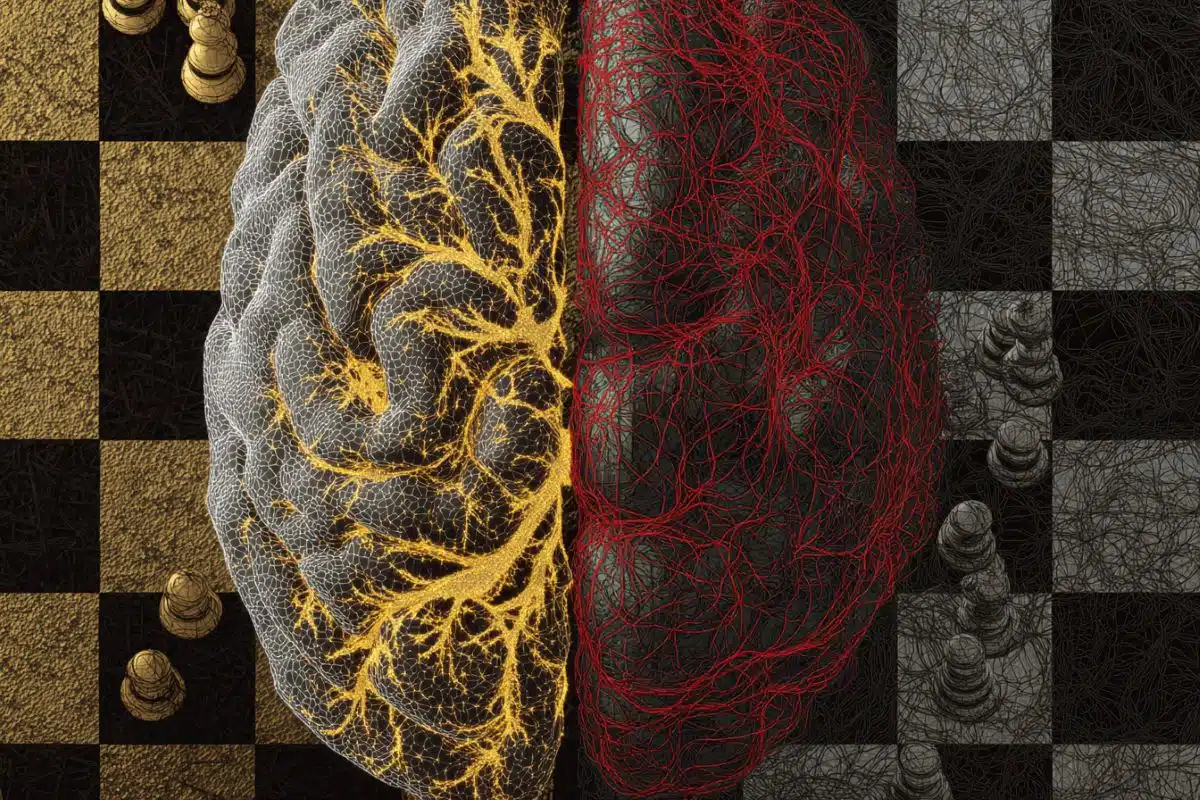
Summary: A new study published reveals a surprising paradox in human cognition: when making complex strategic decisions, faster choices are, on average, of higher quality. Investigating actual human behavior outside a laboratory setting, researchers analyzed individual move data from professional chess tournaments.
By comparing real-time decision speeds against objective evaluations from top-tier chess engines, the team demonstrated that when the objective difficulty of a problem is held constant, taking more time to think correlates with worse outcomes. The findings suggest that prolonged deliberation reflects a subjectively higher perception of difficulty, whereas rapid execution signals the power of human intuition.
Key Facts
- The Speed-Quality Paradox: In professional chess, faster individual moves are statistically associated with higher decision-making quality, defying the traditional assumption that longer deliberation yields superior choices.
- Objective Benchmarking: To measure decision quality outside a lab, behavioral economists compared the exact time players spent on a move with benchmarks set by high-powered chess engines.
- Control Variables: This correlation holds true even after mathematically accounting for the computational complexity of the board state, the distinctiveness of alternative moves, and overall time pressure.
- The Limit of Human Computation: When an individual fails to grasp a strategic situation immediately via intuition, continuing to compute the problem rationally becomes intensely difficult for the human brain, leading to diminishing returns and errors.
- Real-World Application: Researchers believe this phenomenon applies broadly outside of chess to any real-world environment requiring high-stakes, complex strategic decision-making.
Source: LMU
In chess, faster decisions are on average of higher quality. This is the conclusion of a study that has just been published in the scientific journal PNAS.
The team of researchers, which in addition to Professor Uwe Sunde from LMU includes scientists from Erasmus University Rotterdam and UniDistance Suisse, analyzed data from professional games of chess.
Their aim was to investigate how the time taken to make a complex strategic decision is related to the quality of this decision.
Sunde and his colleagues believe the outcome of their research indicates that the decision time reflects the subjectively perceived difficulty of the problem, which can vary depending on the situation.
Correlation between speed and quality
As a behavioral economist, Uwe Sunde is interested in exploring how people make decisions.
“Previously, most studies looking at decision time and quality have analyzed relatively simple decisions, frequently involving students in standardized lab settings,” says Sunde.
“In our research, when we’re examining actual decisions outside the laboratory, we often have to rely on observations that are not strictly comparable.”
Working with his team of coauthors, the economist found an alternative way of examining complex strategic decisions: They analyzed individual moves made by players in professional chess tournaments.
They measured the time the players took to make their decision and compared the result with the benchmarks set by chess engines to get an objective assessment of quality. The researchers compared decisions that a player made in different configurations on the chessboard against the same opponent.
The importance of intuition
The results show that faster decisions are associated with higher decision-making quality – even taking account of the computational complexity of the decision, the distinctiveness of the alternative decisions and the pressure of time.
“The correlation between the speed at which complex strategic decisions are made and the quality of these decisions is a priori ambiguous,” says Sunde.
Taking more time to make a decision may result in a better-considered decision, but may also indicate that the question requiring an answer is perceived to be more difficult, which may be associated with a lower quality of decision.
“With this study, we’ve been able to show that, if you keep the objectively measurable difficulty of the decision constant, somebody who thinks for longer will make worse decisions,” says the researcher.
A person who reflects on an issue for longer may possibly perceive the level of complexity to be subjectively higher. Conversely, a shorter decision-making time could indicate that the player has a strong intuition, so an innate sense of what the best move is.
“This is what distinguishes humans from machines: Humans can often recognize what’s good or what isn’t good from the situation. But if a person doesn’t manage to grasp the situation quickly, they find it difficult to continue computing the problem rationally,” says Uwe Sunde.
The LMU researcher thinks it is possible that the result could also be applied to situations outside the game of chess in which complex decisions have to be made.
Key Questions Answered:
A: A priori, it’s ambiguous. While more time could mean a better-considered move, the data reveals that in reality, a longer clock run down simply means the player is lost in the weeds. When objective difficulty is held constant, a longer decision time signals that the player finds the situation subjectively baffling. They are overthinking because their initial intuition failed them.
A: They bypassed the limits of traditional lab studies by tracking elite players in real professional tournaments against the exact same opponents across varying board configurations. They measured the precise seconds spent on an individual move and matched that move against a flawless mathematical benchmark: modern chess engines. If the human’s fast move matched the engine’s top choice, it proved speed and quality were linked.
A: It comes down to holistic pattern recognition vs. brute-force calculation. Machines excel at relentlessly computing millions of rational possibilities to finding the right answer. Humans, however, rely on intuition to instantly recognize what is fundamentally “good” or “bad” about a situation. If a human cannot grasp that image quickly, our ability to continue calculating the problem rationally breaks down, resulting in a worse choice.
Editorial Notes:
- This article was edited by a Neuroscience News editor.
- Journal paper reviewed in full.
- Additional context added by our staff.
About this decision-making and neuroscience research news
Author: Constanze Drewlo
Source: LMU
Contact: Constanze Drewlo – LMU
Image: The image is credited to Neuroscience News
Original Research: The findings will appear in PNAS


