

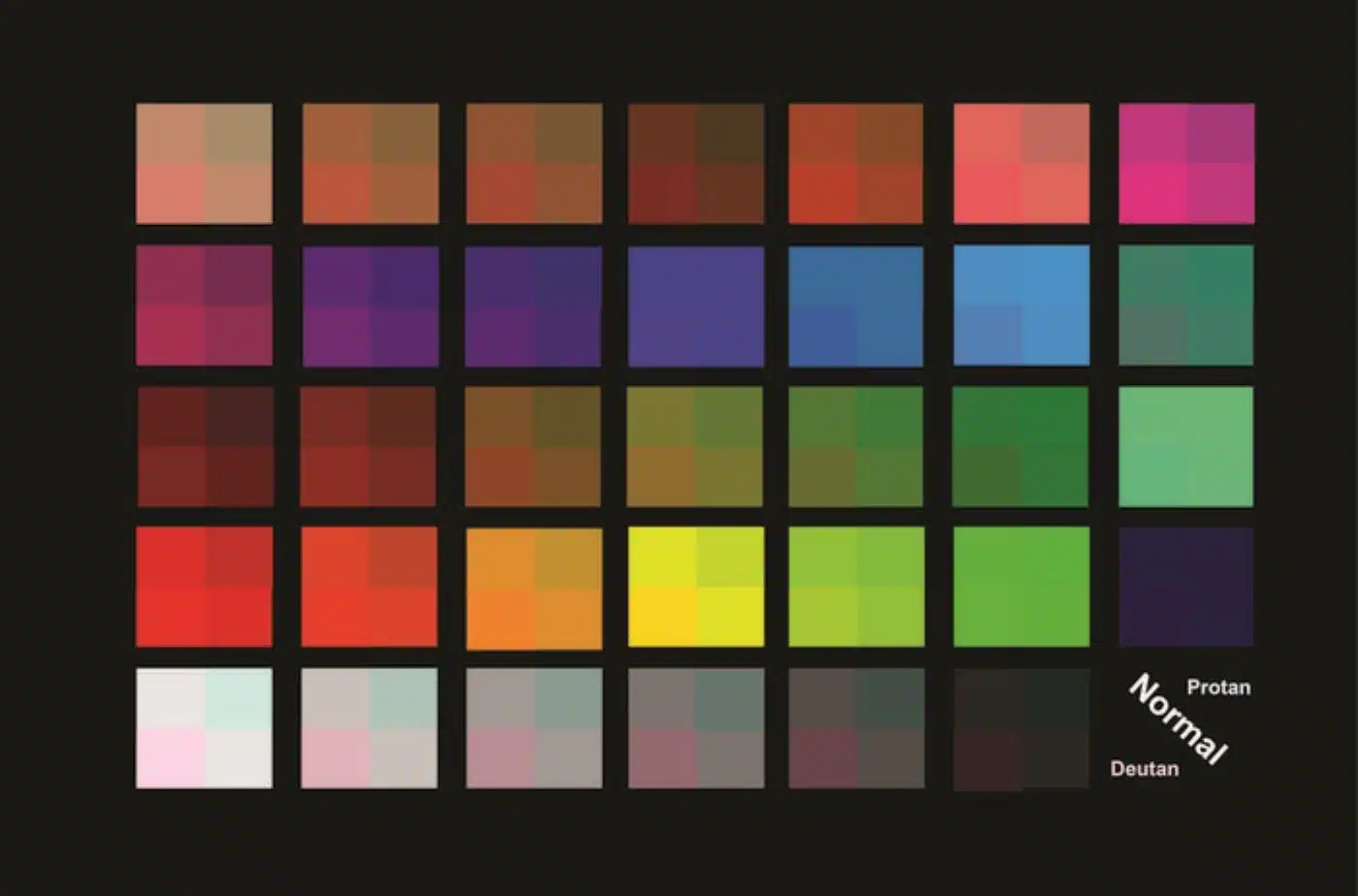
Summary:
A new physiological model developed by researchers at University College London explains why modern, wide-gamut displays often produce jarring color mismatches between viewers. Published in Optics Express, the study demonstrates that ultra-narrowband primary light sources interact with individual biological variations in retinal cones and ocular lens aging. By replacing century-old calibration standards with computational human vision models, the research lays the groundwork for displays that appear visually consistent across diverse human eyes.
Key Facts:
- The Narrowband Gamut Paradox: Modern displays (OLED TVs, cinema laser projectors, smartphones) use razor-thin narrowband primary emissions to produce ultra-vivid colors, but these sharp spectral peaks amplify perceptual differences between human observers compared to older, broadband displays.
- Flawed Century-Old Standards: Standard industrial calibration devices rely on color matching functions conceived nearly 100 years ago that fail to mirror true physiological color vision, causing screens to appear misaligned even when scientifically “calibrated” to match.
- Biological Sensitivity Profiles: The computational model reveals that the spectral bandwidth of the blue primary governs age-related perceptual discrepancies (driven by natural lens yellowing), while red and green primary spectra govern mismatches across individuals with common cone-opsin variations such as deuteranomaly.
Source: Optica
Over the past decade, television manufacturers, smartphone designers, and digital cinema engineers have engaged in an arms race to deliver broader color gamuts, deeper saturations, and high dynamic range. To achieve these hyper-realistic palettes, display technologies shifted away from traditional broadband phosphors toward precise, narrowband light sources, such as quantum dots and lasers.
Yet this engineering triumph brought an unintended perceptual side effect: colors that look calibrated and identical on an instrument often look noticeably different from one viewer to the next, and even look mismatched across different screens situated side-by-side.
A director grading a feature film on a mastering monitor may see a subtle teal sky, while an audience member on a calibrated high-end home television perceives an over-saturated cyan.
Now, vision scientists at University College London’s (UCL) Institute of Ophthalmology have unraveled the biological and optical mechanics driving this phenomenon.
Published in the Optica Publishing Group journal Optics Express, the researchers introduced a computational model that integrates biological variations in human ocular anatomy and retinal cone photoreceptors to predict how diverse populations perceive light emitted from commercial displays.
“The people who produce films and TV shows want their work to look the same whatever device it is being viewed on, which is complicated by differences in people’s color vision and outdated calibration methods,” said lead author Andy Rider, Ph.D., from the UCL Institute of Ophthalmology.
“Our model takes into account individual variability in color vision and can be used to determine how best to adjust the three primary colors of a specific display to provide the best viewing experience for as many people as possible.”
Bridging Engineering Calibration and Retinal Biology
A core obstacle to uniform visual experiences lies in the tools industry professionals use to calibrate screens. Colorimeters and photometers measure absolute physical irradiance and calculate chromaticity based on standard observer functions established roughly a century ago (such as the CIE 1931 standard). These legacy curves smooth over the nuanced reality of living retinas.
To resolve this blind spot, the UCL team constructed a physiological simulation incorporating natural human variances:
- Photoreceptor Opsin Tuning: The model simulates variations in the spectral sensitivity curves of long- (L), medium- (M), and short-wavelength (S) retinal cone cells, including variations found in deuteranomaly—a common form of anomalous trichromacy affecting approximately 1 in 20 biological males.
- Ocular Lens Density & Aging: The human eye’s crystalline lens naturally yellows and increases in optical density over time, absorbing and filtering out variable fractions of short-wavelength blue light before it ever strikes the retina.
The researchers tested their model across 16 real-world display hardware architectures, spanning consumer OLED and LED televisions, production-grade mastering reference monitors, and commercial theatrical cinema projectors.
The simulation revealed that some display technologies induce severe perceptual divergences between viewer groups, whereas others maintain broad stability.
The Anatomy of a Spectral Mismatch
The computational framework pinpointed how specific primary light channels interact with human visual anatomy:
- Blue Primaries and Aging Eyes: Variations in the short-wavelength (blue) primary emitter accounted for the widest perceptual discrepancies between younger and older observers, driven directly by differences in ocular lens transmission.
- Red and Green Primaries and Retinal Genotypes: The spectral distribution of red and green primaries primarily dictated whether images appeared distorted to viewers with subtle, common genetic shifts in M- and L-cone photopigments.
“Although this research focused on displays, the modeling approach can also be used to examine similar color discrepancies such as those from energy-efficient LED lighting compared to traditional incandescent lightbulbs or in other color applications where dyes and pigments change how objects reflect or absorb light,” noted Rider.
Designing the Next Generation of Screens
While the framework is grounded in physiological ocular data, the investigators note that physical psychophysical trials with human observers will follow to further benchmark model predictions against subjective experience.
Beyond diagnostic insights, the model provides an architectural blueprint for hardware engineers. Display makers could use the algorithm to optimize the peak wavelengths and spectral widths of primary emitters.
Furthermore, the research supports the development of multi-primary displays, screens that utilize four, five, or more primary color channels instead of the conventional three (RGB), enabling dynamic spectral tuning that guarantees color fidelity across the widest possible spectrum of human observers.
Editorial Notes:
- This article was edited by a Neuroscience News editor.
- Journal paper reviewed in full.
- Additional context added by our staff.
About this Visual Neuroscience Research:
- Media Contact: Kayla Hunt
- Source: Optica
- Image Credit: Image credited to Andy Rider and Andrew Stockman, Institute of Ophthalmology at University College London
- Original Research is Open Access: Optics Express (Sept 22, 2026). “Why the colours of modern displays can look so different to different observers.” Authors: Andrew T. Rider, John A. Frith, and Andrew Stockman.
- DOI: 10.1364/OE.613255
Abstract
Why the colours of modern displays can look so different to different observers
Normal human colour vision depends on photon absorption in three types of cone photoreceptors (sensors) with different spectral sensitivities. Colour vision is therefore trichromatic. Triplets of primary lights can be mixed to reproduce colours that fall inside the colour space or gamut delimited by each triplet.
Older displays with broadband primaries produce a small colour gamut and a relatively limited range of colours, but the colours generally appear similar to different observers. Modern displays with narrowband primaries produce a larger gamut and a wider range of colours, but the colours often appear different to different observers. These mismatches (or observer metamerism failures) stem from individual differences in colour vision caused by physiological and genetic variability in the population.
Here we use our model of those differences to simulate their effects on the colours produced by a large range of display types. Substantial colour differences are predicted for narrowband displays, especially for observers with forms of red-green colour vision deficiency and those with aged lenses.
Noticeable differences are also predicted for some observers whose colour vision deviates from the mean observer but would otherwise be classified as normal, including some who might be engaged in colour-critical industries.


