

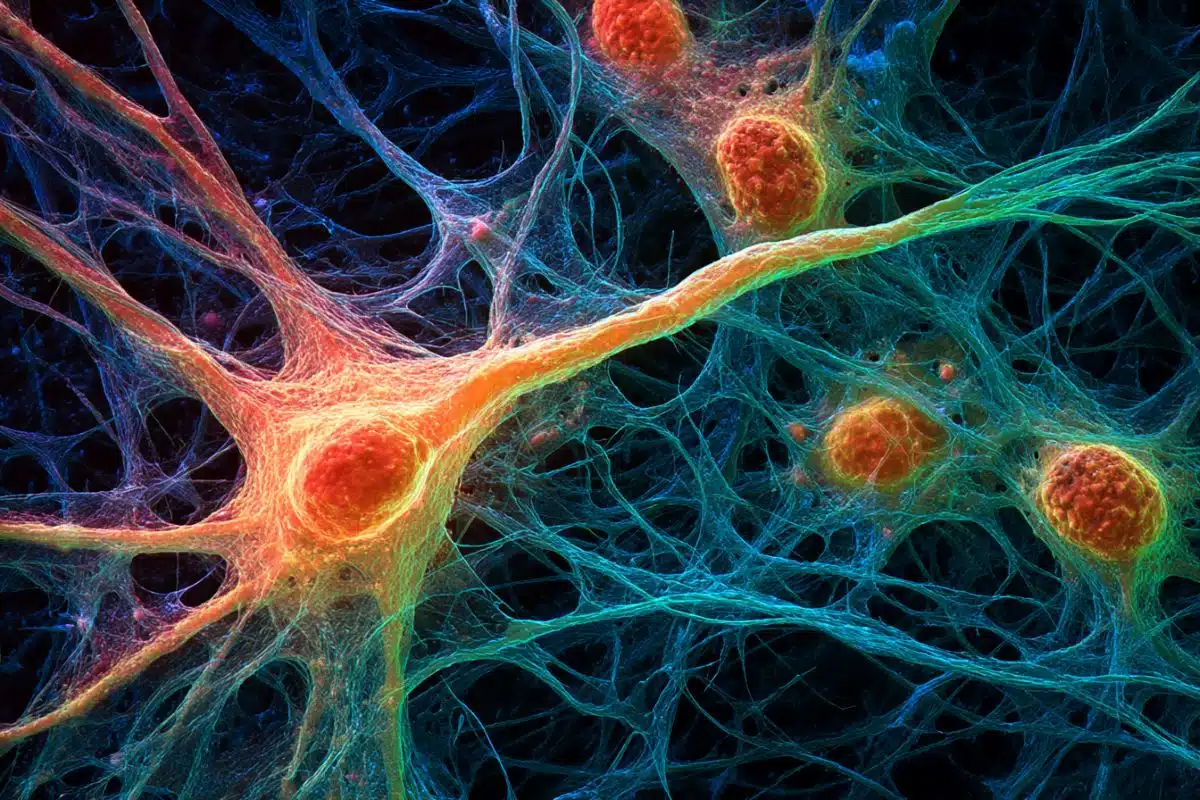
Summary: A new study uncovered a novel biological pathway and a promising therapeutic agent capable of slowing the progression of Alzheimer’s disease.The research reveals that the cellular enzyme GRK2 becomes inactivated and aggregates within the brain tissue of dementia patients, damaging mitochondria and triggering a pathological vicious circle of amyloid-beta production.
To break this destructive feedback loop, a research team developed “Compound 10,” a targeted chemical compound that prevents GRK2 aggregation, preserves mitochondrial energy output, and significantly delays nerve cell death in vivo.
Key Facts
- The 20-Year Tissue Assay: The foundational research began nearly two decades ago using post-mortem human brain tissue samples removed during tumor surgeries at Ain Shams University Hospital in Cairo, comparing dementia patients against non-dementia controls.
- The GRK2 Regulatory Engine: Professor Ursula Quitterer focused her research on G protein-coupled receptor kinase 2 (GRK2), a vital regulatory protein that helps cells in the brain and heart respond correctly to cellular stress and environmental strain.
- The Inactivation and Aggregation Mechanism: Molecular analyses of human tissues and mouse models unmasked a specific pathological shift in Alzheimer’s brains, where metabolic changes convert functional GRK2 into an inactive form that clumps together into harmful aggregates.
- Mitochondrial Pore Blockade: These inactive GRK2 aggregates deposit directly onto mitochondria (the cellular powerhouses), blocking their pores, starving the nerve cells of energy, and inducing severe intracellular stress.
- The Amyloid-Beta Vicious Circle: The researchers demonstrated that inactive GRK2 directly accelerates the production of toxic amyloid-beta fragments. In turn, the amyloid-beta inflicts further stress on nerve cells, forcing more functional GRK2 to inactivate and aggregate in a self-perpetuating cycle.
- Compound 10 Efficacy: To disrupt this loop, the ETH Zurich team synthesized and screened multiple chemical agents, identifying “Compound 10” as a highly effective inhibitor of GRK2 aggregation. In mouse models, the substance optimized mitochondrial function, lowered amyloid-beta accumulation, and prolonged animal survival.
- Systemic Anti-Aging Side Benefits: Beyond shielding cerebral infrastructure, mice treated with Compound 10 exhibited improved cardiac function and systemic anti-aging markers, such as developing significantly fewer gray hairs in old age.
- The Extended Longitudinal Timeline: Because Alzheimer’s is an age-related condition, basic validation required working with older mice aged 1.5 to 2 years, meaning each sequential, interlocking experiment took up to two years to complete. The basic research is now finalized, and a patent has been filed.
Source: ETH Zurich
“Compound 10” is how Ursula Quitterer refers to the chemical compound that her team has developed and which could slow down the progression of Alzheimer’s disease.
Quitterer is Professor of Molecular Pharmacology at ETH Zurich and has so far tested the active ingredient first on mice, revealing promising effects: the typical death of nerve cells seen in dementia is significantly slower, and the animals survive for longer.
The new substance is the result of research that began almost 20 years ago, when Quitterer received tissue samples from patients of a doctor and colleague at the Ain Shams University Hospital in Cairo. These were samples of brain tissue that the doctor had removed during tumour surgery – both on people diagnosed with dementia and non-dementia patients.
New point of attack for drug
Quitterer set about working on these samples – but to understand what exactly she did with them, we first need a bit of background. Then, as now, the main focus of her research was a bodily enzyme that performs a vital role in many human cells: GRK2. As a regulatory protein, this enzyme helps cells respond correctly to signals, stress and strain. As well as in the heart, for example, it is also active in the brain – where it supports the function of nerve cells.
Through molecular analyses of the tissue samples from Cairo and research on mice, Quitterer’s team showed what an important role the enzyme GRK2 plays in dementia.
The researchers recently published their findings in the journal Cell Reports Medicine.
When the protective protein stops working
Two forms of the enzyme GRK2 occur in cells: a normal, functional form and a form that has been inactivated by the cellular metabolism. Quitterer and her team discovered that the inactivated form occurs in large quantities in the brain tissue of dementia patients. They were able to demonstrate the same thing in mice – specifically in a mouse model for Alzheimer’s disease.
The researchers also showed that the inactive form of this enzyme forms aggregates in brain cells in the event of dementia. These aggregates deposit on – and damage – the mitochondria (the “powerhouses” of the cells). “The GRK2 aggregates block the pores of the mitochondria, reducing the amount of energy they can supply and leading to a situation of stress inside the cells,” Quitterer explains.
In experiments on mice, the researchers also observed that the inactive GRK2 promotes the production of amyloid beta, a protein fragment that is considered a main cause of Alzheimer’s.
What’s more, this leads to a self-perpetuating process: amyloid beta puts stress on the nerve cells and, in turn, this stress leads to the formation of more inactive and aggregated GRK2 – creating a vicious circle that contributes to the progression of dementia.
Anti-ageing effect
With a view to breaking this vicious circle, Quitterer and her colleagues developed several chemical compounds, which they tested in cell culture experiments and on mice. Here, compound 10 proved to be particularly effective, preventing the GRK2 molecules from forming aggregates. As a result, the mitochondria work better, there is less deposition of amyloid beta in the cells, and the nerve cells maintain their function and do not die off.
In the mice, the team also observed effects outside the brain. Compound 10 had a positive influence on heart function and ageing processes. For example, the animals developed fewer grey hairs in old age.
Why the research took so long
The researchers have applied for a patent on compound 10, and the basic research is now complete. “It took so long simply because everything takes so long in Alzheimer’s research,” explains Quitterer. As the researchers were investigating an age-related disease, they worked with older animals. For mice, this means an age of one and a half to two years. And it takes about one and a half to two years to complete each experiment from which conclusions can be drawn that then lead to the planning of the next experiment. “It’s all a great deal slower than in cancer research, for example.”
Now, Quitterer and ETH Zurich are looking for a company that is interested in taking the next steps towards developing a drug.
“Alzheimer’s is a very complex disease,” says Quitterer. Current medications do not cure the disease, but rather – at most – delay its progression by several months. “That’s why it’s so important that we’ve now identified a new target protein in the form of GRK2, as well as an active ingredient that operates via GRK2 and therefore via a different mechanism than existing Alzheimer’s drugs.” Using compound 10 in combination with other medications, it may one day be possible to improve quality of life for patients.
Key Questions Answered:
A: Through a metabolic malfunction. When a person develops dementia, the vital regulatory enzyme GRK2 becomes inactivated and clumps into large aggregates. These sticky clusters blanket the mitochondria, blocking their pores and stripping the nerve cells of the energy they need to survive.
A: Its self-perpetuating nature. The inactive, aggregated GRK2 enzymes force the brain to produce more toxic amyloid-beta. This amyloid-beta accumulation places immense stress on surrounding nerve cells, which in turn causes even more functional GRK2 to shut down and aggregate, locking the disease in a destructive loop.
A: Because testing age-related diseases operates on a fixed biological clock. To replicate human dementia accurately, researchers must use older mice that are one and a half to two years old. Because each individual experiment takes up to two years to unfold before data can be extracted, the research pipeline moves much slower than in other medical fields.
Editorial Notes:
- This article was edited by a Neuroscience News editor.
- Journal paper reviewed in full.
- Additional context added by our staff.
About this Alzheimer’s disease and neuropharmacology research news
Author: Marianne Lucien
Source: ETH Zurich
Contact: Marianne Lucien – ETH Zurich
Image: The image is credited to Neuroscience News
Original Research: Open access.
“Analysis of GRK2 aggregation in the pathology of Alzheimer disease in animal models” by Joshua Abd Alla, Alexander Perhal, Xuebin Fu, Andreas Langer, Yasser el Faramawy, and Ursula Quitterer. Cell Reports Medicine
DOI:10.1016/j.xcrm.2026.102707
Abstract
Analysis of GRK2 aggregation in the pathology of Alzheimer disease in animal models
The G-protein-coupled receptor kinase 2 (GRK2) exerts essential functions in cell growth and survival. Searching for a connection between GRK2 and the neurodegenerative Alzheimer disease (AD), we find increased aggregated serine-670-phosphorylated GRK2 (phospho-S670-GRK2) in brains of AD mice and patients with dementia likely due to AD.
Harmful phospho-S670-GRK2 aggregation is induced by two hallmark proteins of AD: beta-amyloid and the neurofibrillary-tangle-inducing, TAU-P301L. Aggregated phospho-S670-GRK2 triggers aggregation of TOMM6 (translocase of outer mitochondrial membrane 6), promotes mitochondrial dysfunction, and enhances beta-amyloid. Transgenic expression of inactive GRK2-K220R or a GRK-inhibitory peptide proves that neuropathological features are caused by GRK2 inactivation.
Restoration of TOMM6 by neuron-specific TOMM6 expression reduces beta-amyloid plaques but enhances soluble beta-amyloid and increases mortality. In contrast, reconstitution of monomeric GRK2 and proteasomal phospho-S670-GRK2 degradation by small molecules counteracts neuropathological AD features, prevents neuronal loss, and improves survival. Thus, targeting of pathological GRK2 aggregation slows aging-induced neurodegeneration.


