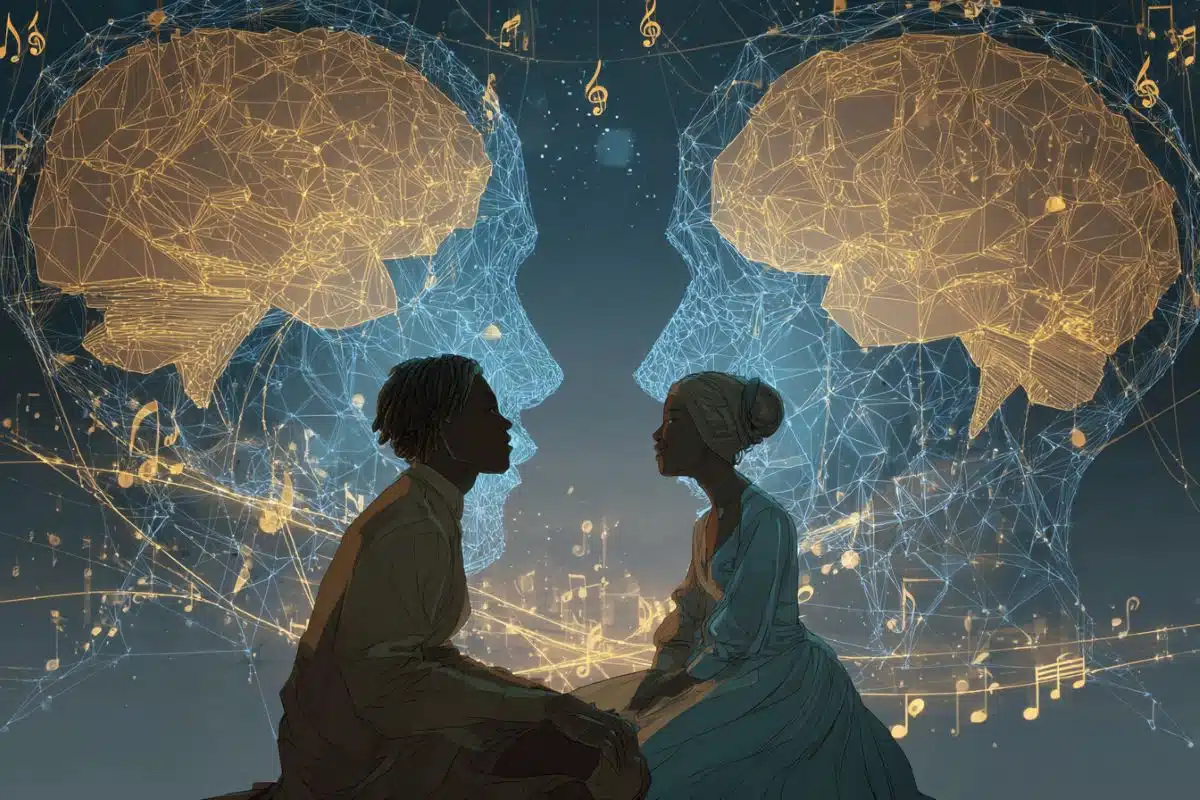
Summary: Music has long been the centerpiece of human rituals, from tribal dances to modern concerts. Now, a unique study has identified the biological “why.” The study reveals that listening to harmonically consonant chord progressions during face-to-face interaction physically strengthens the brain circuits responsible for social connection and emotional processing.
Key Facts & Findings
- The “Consonant” Effect: The researchers used pleasant, predictable chord progressions common in Jazz and Pop. These “consonant” sounds acted as a physiological primer, making participants feel more connected to the person sitting across from them.
- The Brain’s Social Hub: Functional near-infrared spectroscopy (fNIRS) showed increased blood flow in brain regions associated with social perception and emotional processing when harmonious music was playing.
- A Scientific Mirror: For the first time, researchers showed a direct correlation between a person’s subjective feeling of being “in sync” with someone else and the objective activity in their social brain regions.
- The “Scrambled” Control: When the music was removed or the notes were “scrambled” into dissonant, unpredictable patterns, the social enhancement disappeared.
- Imaging in Action: Unlike traditional MRI, which requires lying still in a tube, fNIRS allowed the pairs to sit face-to-face and maintain eye contact, capturing the brain in its natural social state.
Source: Yale
When neuroscientist and musician AZA Allsop discovered research by his Yale colleague Joy Hirsch about how group drumming and musical interaction can affect social behavior, he knew there was a collaboration in their future.
Five years later, their joint work has shown that music is a powerful social enhancer that directly impacts brain functioning.
“When I reached out to see if we could work together on a project focused on music, Joy was as excited as I was,” said Allsop, an assistant professor of psychiatry at Yale School of Medicine who is also a jazz artist. “As we drafted our new research, I really relied on my background in music production, theory, and performance to help shape things.”
Hirsch, also a neuroscientist, brought her own musical experience to the partnership. A veteran competitive ballroom dancer, she has won many accolades including national championship titles.
“AZA and I connected immediately, because of our shared love of music, our experience with music in one form or another, and our commitment to understanding how the brain operates under music conditions,” said Hirsch, the Elizabeth Mears and House Jameson Professor of Psychiatry and professor of comparative medicine and of neuroscience.
In a new study, published in The Journal of Neuroscience, they find that listening to harmonically consonant chord progressions during face-to-face interaction strengthened neural activity in brain areas that help people understand and respond to others.
The findings suggest that music may help promote social bonding on a biological level, they say, explaining why it often plays an important role in social rituals and group experiences.
The results could also have implications for therapies that use music to support people experiencing issues of social disconnectedness, such as neuropsychiatric conditions like autism or psychological conditions like social anxiety.
“We’re hoping that our contribution will provide an evidence-based mechanism that shows how music actually enhances the neural systems that promote sociality,” said Hirsch, the study’s senior author.
For the study, the researchers were quite deliberate in selecting the chord progression they’d examine.
“Part of our hypothesis was that certain chord progressions have a higher prevalence in the music of our culture because they’re doing something to our physiology,” said Allsop, the study’s first author. “So, we used a progression that’s found very commonly in jazz music, pop music, a lot of Western musical language.”
In a series of experiments, they measured brain activity in pairs of people during face-to-face interactions. Specifically, they used an imaging technique known as functional near-infrared spectroscopy, which tracks task-induced changes in blood flow in the brain.
“Unlike MRI, this technique lets us capture brain images of people who are engaged in social activities,” Hirsch said.
The participants, who sat across a table from each other, were asked to interact with their partner by staring directly, eye to eye, into their faces. In some trials, they listened to what are known as consonant chord progressions, a sequence of pleasant, predictable musical chords that promote feelings of relaxation. In other trials, there was either no music or music without the predictable chord progressions, i.e. the notes were “scrambled.”
When the harmonious chord progressions were played, researchers noted increased activity in regions of the brain associated with social perception, emotional processing, and interpersonal connection. Participants also reported feeling a more heightened sense of social connectedness.
Researchers say this suggests that music may help coordinate and strengthen human social relationships.
“One of the paper’s most important and unexpected findings was showing that one’s perception of connectedness to another person is directly related to the activity in these specific regions of the brain,” Hirsch said.
For Allsop, a keyboardist and vocalist, the connections between music and neuroscience feel natural. “I’ve always been interested in how the different structures and languages within music can move people from an aesthetic standpoint,” he said. “At Yale, I’ve started asking that question from the biological perspective, too.”
Dash Watts, a research assistant in psychiatry at the Yale School of Medicine, was the study’s co-first author. Other Yale authors include Adam Noah and Xian Zhang, associate research scientists in psychiatry, and Simone Compton, a former post graduate associate in psychiatry.
Key Questions Answered:
A: Predictable, harmonious chords promote a state of physiological relaxation. When your brain isn’t busy trying to resolve “scrambled” or jarring noises, it has more “bandwidth” to focus on the social cues of the person in front of you. The music essentially acts as a social lubricant at a cellular level.
A: That is the ultimate goal. The researchers believe this provides an evidence-based mechanism for Music Therapy. It could be used to help individuals with autism or social anxiety navigate face-to-face interactions by using harmonic backgrounds to “prime” the brain’s social centers.
A: The study focused on Western musical language (Jazz and Pop progressions) because of its prevalence in our culture. The key seems to be consonance—sounds that the brain perceives as “pleasant” rather than chaotic.
Editorial Notes:
- This article was edited by a Neuroscience News editor.
- Journal paper reviewed in full.
- Additional context added by our staff.
About this music and social neuroscience research news
Author: Bess Connolly
Source: Yale
Contact: Bess Connolly – Yale
Image: The image is credited to Neuroscience News
Original Research: Closed access.
“Listening to a consonant chord progression during live face-to-face gaze enhances neural activity in social systems” by Dash A. Watts, AZA Stephen Allsop, Simone Compton, Xian Zhang, J. Adam Noah and Joy Hirsch. Journal of Neuroscience
DOI:10.1523/JNEUROSCI.1116-25.2026
Abstract
Listening to a consonant chord progression during live face-to-face gaze enhances neural activity in social systems
Although music has been associated with increased pro-social behavior, the underlying mechanisms for music-facilitated social benefits are not known. We test the hypothesis that chord progressions promote social bonding between dyads by shared temporal alignment of frequency spectra.
Two musical conditions were presented to 20 pairs of participants (equal numbers of males and females), one with either a structured chord and predictable progression and the other with an unstructured and unpredictable composition of the same notes.
Functional near infrared spectroscopy signals were recorded simultaneously from both partners during the music conditions with and without gazing at a live partner’s face. The right angular gyrus, right somatosensory association cortex and bilateral dorsal lateral prefrontal cortex increased activation during live face gaze combined with the structured chord progression condition.
Further, subjective ratings of subjective connectedness were associated with both activity in right superior and middle temporal gyri during face gaze and the right angular gyrus during chord progressions.
These findings link live face-to-face gaze while listening to structured chord progressions to neural systems that are responsive to predictive alignment of co-occurring acoustic spectra and perceptions of social connectedness.