Summary: Researchers discovered a previously unknown cellular shield in the brain, dubbed the “base barrier cells.” Located within the choroid plexus, these cells utilize tight molecular junctions to act as a sophisticated gatekeeper, regulating the flow of substances between the body’s systemic circulation and the brain’s delicate environment.
The study reveals that while this barrier is a robust defense in healthy individuals, it becomes dangerously porous during systemic inflammation and severe infection. This breakthrough not only redraws the map of brain anatomy but also identifies a critical new target for treating neuroinflammatory diseases and protecting the brain from external immune triggers.
Key Facts
- The “Base Barrier” Discovery: Scientists identified a unique population of cells at the base of the choroid plexus that form a secondary, high-security seal previously unrecognized by modern anatomy.
- Vulnerability to Infection: During systemic inflammation, this barrier weakens, providing a “backdoor” for harmful substances and immune cells to infiltrate the central nervous system.
- Human Relevance: The study confirmed these gatekeeper cells exist in both mouse and human brains, suggesting this defense mechanism is a fundamental part of human neurobiology and aging.
Source: VIB
VIB and Ghent University researchers have identified and characterized a previously unknown cellular barrier in the brain, which sheds new light on how the brain is protected from the rest of the body.
In a study published in Nature Neuroscience, the scientists also reveal a new pathway by which the immune system can impact the brain.
Prof. Roosmarijn Vandenbroucke (VIB–UGent Center for Inflammation Research): “These findings reveal how vulnerable and protectable the brain is, opening new perspectives for more targeted interventions in brain disorders.”
The brain is protected from the rest of the body by multiple barriers that maintain a stable, tightly regulated environment and defend it against harmful substances and pathogens. The most well-known of these barriers is the blood-brain barrier but another critical interface is the choroid plexus, a small structure found within the brain’s fluid-filled spaces, which produces cerebrospinal fluid.
However, despite its importance, scientists know surprisingly little about the choroid plexus’ detailed cellular structure and how it protects the brain.
A new line of defense for the brain
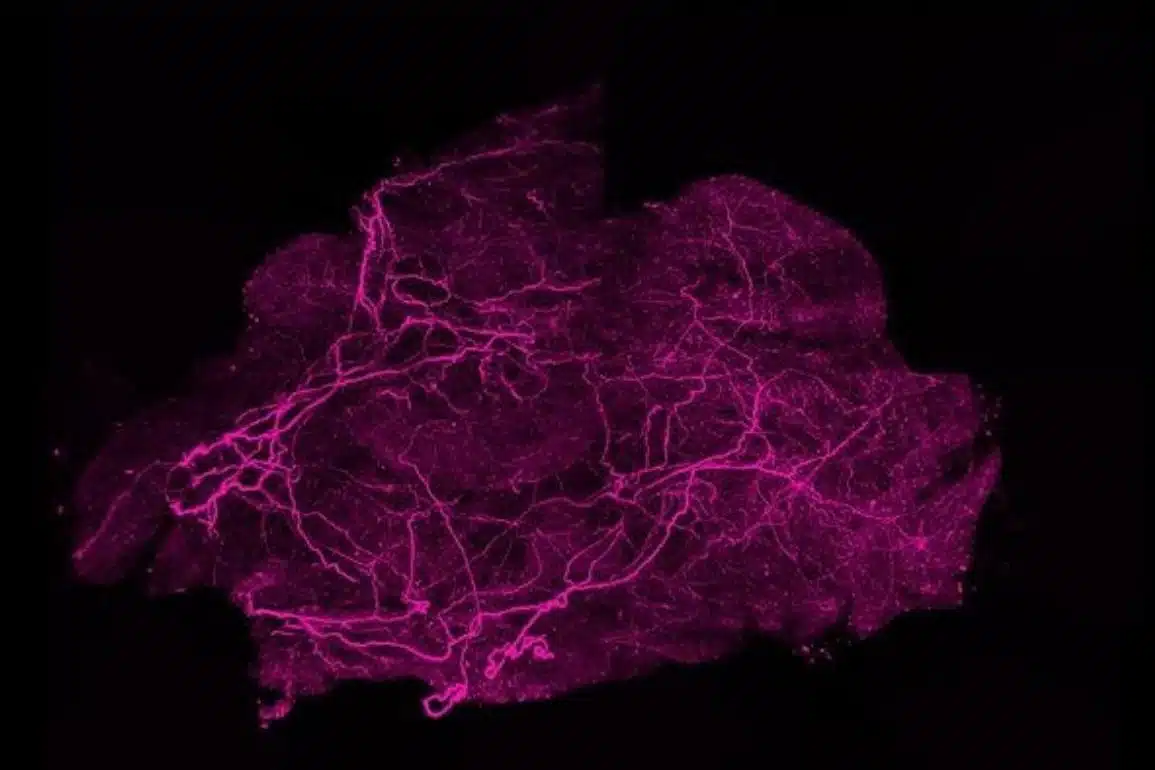
Researchers from the Vandenbroucke lab at the VIB-UGent Center for Inflammation Research set out to unravel this puzzle. Using advanced gene sequencing techniques and high-resolution microscopy, the research team identified a unique population of cells located at the base of the choroid plexus that they coined the base barrier cells.
These cells are linked together by tight junctions, molecular rivets that effectively form a seal. This barrier provides a functional compartmentalization of the choroid plexus, the brain, and the cerebrospinal fluid.
“We’ve uncovered a new line of defense for the brain,” explains Prof. Vandenbroucke (VIB-UGent).
“These cells form a smart, dynamic gate at a location we hadn’t fully appreciated. It’s exciting because it not only answers a fundamental anatomical question but also gives us a new target for understanding brain disease.”
A dynamic barrier vulnerable to disease
The team’s work shows that this barrier is not static. Under healthy conditions, it effectively limits the movement of even small molecules from the choroid plexus’ blood-rich core into the surrounding cerebrospinal fluid and brain tissue. However, during systemic inflammation, such as that caused by a severe infection, the barrier becomes compromised.
“We see that the base barrier cells become vulnerable during inflammation, potentially allowing harmful substances and cells to enter the central nervous system,” explains Dr. Daan Verhaege, who completed his PhD in the Vandenbroucke lab.
The base barrier cells emerge early in development and are maintained throughout life. Importantly, the researchers confirmed that these cells are present not only in mouse brains but also in human brains, making the findings highly relevant to human health and disease.
This discovery opens new avenues for investigating neurological conditions and neuroinflammation, and may lead to novel therapeutic strategies aimed at strengthening this gatekeeper barrier.
Key Questions Answered:
A: The BBB remains a primary shield, but this discovery proves the brain’s security system is “multi-layered.” Think of the BBB as the perimeter wall and the newly discovered base barrier cells as the high-tech internal security gate guarding the brain’s fluid-filled chambers. It’s a specialized line of defense we didn’t know we had.
A: The study found that the “rivets” (tight junctions) holding these base barrier cells together become compromised during severe inflammation. When these rivets fail, the “gate” swings open, potentially allowing toxins and inflammatory cells to leak from the blood into the cerebrospinal fluid, explaining why systemic illnesses often cause neurological symptoms.
A: Absolutely. Because these cells are the “gatekeepers” of the choroid plexus, they represent a brand-new therapeutic target. If we can develop drugs that strengthen these molecular seals, we might be able to “lock the gate” against neuroinflammation, potentially slowing the progression of diseases like Alzheimer’s or Multiple Sclerosis.
Editorial Notes:
- This article was edited by a Neuroscience News editor.
- Journal paper reviewed in full.
- Additional context added by our staff.
About this neuroscience research news
Author: Gunnar De Winter
Source: VIB
Contact: Gunnar De Winter – VIB
Image: The image is credited to Neuroscience News
Original Research: Open access.
“Base barrier cells provide compartmentalization of choroid plexus, brain and CSF” by Daan Verhaege, Clint De Nolf, Lore Van Acker, Wouter Claeys, Jonas Castelein, Elien Van Wonterghem, Griet Van Imschoot, Pieter Dujardin, Ward De Spiegelaere, Esther Hoste, Fleur Boone, Hart G. W. Lidov, Neil Dani, Julia Derk, Anna Kremer, Evelien Van Hamme, Peter Borghgraef, Saskia Lippens, Maria K. Lehtinen, Julie Siegenthaler, Lien Van Hoecke & Roosmarijn E. Vandenbroucke. Nature Neuroscience.
DOI:10.1038/s41593-025-02188-7
Abstract
Base barrier cells provide compartmentalization of choroid plexus, brain and CSF
The choroid plexus (ChP), located in the brain ventricles, is largely composed of ChP epithelial cells that produce the cerebrospinal fluid (CSF) and form the blood–CSF barrier.
At the ChP–brain attachment sites, we have discovered unique fibroblasts referred to as ChP base barrier cells (BBCs).
We show that ChP BBCs originate from meningeal mesenchymal precursors, arrive early during development, remain throughout life and are conserved across species.
ChP BBCs are transcriptionally similar to meningeal arachnoid barrier cells and are interconnected by both adherens and tight junctions.
Notably, we provide evidence that the BBCs function as a barrier, controlling communication between the periphery and central nervous system.
Moreover, during inflammatory insult, we observed a loss of barrier integrity and immune cell crossing.
Altogether, our research revealed a barrier at the ChP base, crucial in protecting the central nervous system by compartmentalizing the ChP stroma, brain parenchyma and CSF.