

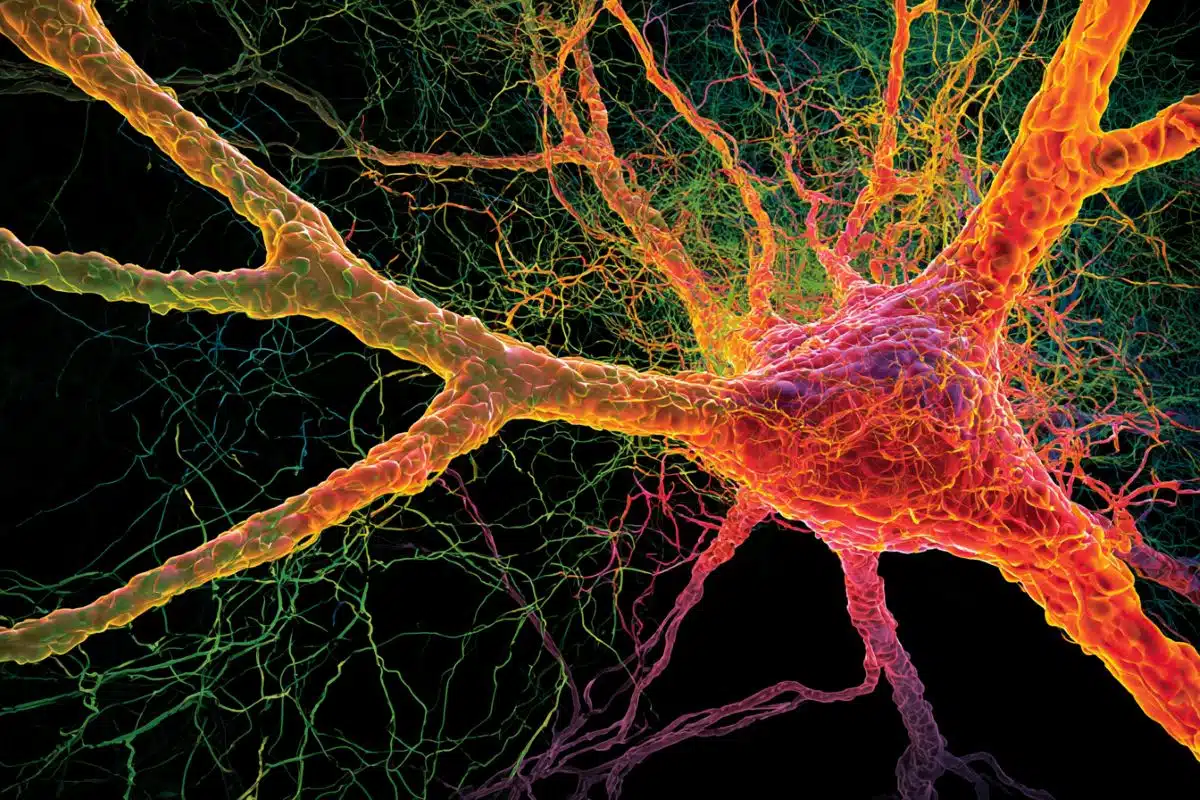
Summary: A new study uncovered a vital, protective function for Amyloid Precursor Protein (APP): a molecule historically infamous for generating the toxic amyloid-β (Aβ) plaques characteristic of Alzheimer’s disease (AD). The research demonstrates that full-length APP acts as a cellular guardian that actively saves stressed neurons by expelling leaked nuclear waste out of the cell.
Under conditions of aging, oxidative stress, or genetic instability, the structural integrity of a neuron’s nucleus can break down, leaking DNA fragments, histones, and chromatin into the cytoplasm, which triggers severe neuroinflammation and cell death. Utilizing an expansive experimental framework spanning human iPSC-derived neurons, mouse models, and postmortem human AD brains, the team discovered that wild-type APP binds to this cytoplasmic nuclear debris and orchestrates its removal via lysosomal exocytosis: a process where waste-filled lysosomes fuse with the cell membrane to dump toxic materials outside the cell.
When APP expression is reduced or when familial Alzheimer’s mutations are present, this cellular drainage system fails entirely, causing catastrophic intracellular accumulations of nuclear waste, rampant inflammation, and accelerated cell death.
Key Facts
- Paradigm-Shifting Protection: Full-length APP, long vilified as the source of toxic Alzheimer’s plaques, is actually a vital cellular defender that actively prevents neurodegeneration by managing cellular trash.
- Nuclear Garbage Cleanup: Aging and stress cause dangerous nuclear materials: like DNA fragments, chromatin, and histones: to rupture into the cell body; APP interceptively binds this debris to shield the neuron.
- Lysosomal Exocytosis Mechanism: APP clears the dangerous cellular waste by routing it into lysosomes, which then safely migrate, fuse with the cell’s outer membrane, and eject the debris into extracellular space.
- Mutational Failure: Familial Alzheimer’s-associated mutations or a general reduction in APP levels completely paralyze this waste-clearance system, trapping toxic debris inside and accelerating cell death.
- Human Tissue Confirmation: Analysis of postmortem human Alzheimer’s brain tissue confirmed a striking loss of individual neuronal APP levels accompanied by abnormal nuclear shapes and severe internal nuclear waste blockages.
Source: Niigata University
Researchers at Niigata University’s Brain Research Institute have uncovered a new function of amyloid precursor protein (APP), a molecule long studied as the precursor to amyloid-β (Aβ) in Alzheimer’s disease (AD).
The study demonstrates that APP actively protects neurons by expelling damaged nuclear material through a process called lysosomal exocytosis — offering a fundamentally new way of thinking about AD.
APP is best known as the protein from which Aβ peptides are generated through enzymatic cleavage; Aβ accumulation in the brain is a hallmark of AD. However, the physiological functions of full-length APP before cleavage have remained poorly understood.
It is well established that aging, oxidative stress, and DNA damage can compromise the integrity of the cell nucleus, causing nuclear contents — including DNA fragments, chromatin, and histone proteins — to leak into the cytoplasm.
This “nuclear waste” can trigger potent inflammatory responses and cell death, yet the mechanisms by which neurons dispose of this material have been largely unknown.
The research team used a comprehensive set of experimental models, including cultured cells, human iPSC-derived neurons, mouse brains, and postmortem human AD brain tissue, to investigate APP’s role in nuclear damage defense.
“When nuclear damage occurs, wild-type APP co-localizes with nuclear-derived material near lysosome-associated molecules and facilitates the expulsion of this debris out of the cell,” explains first author Dr Godfried Dougnon, Assistant Professor at the Department of Neuroscience of Disease, Brain Research Institute at Niigata University. Dr. Dougnon further explains that this clearance depends on lysosomal exocytosis, which is the fusion of lysosomes with the cell membrane to release their contents extracellularly.
Critically, cells with reduced APP expression, or those carrying familial AD-associated APP mutations, failed to clear nuclear waste efficiently, and instead accumulated this material intracellularly. This accumulation was accompanied by increased expression of inflammatory markers and cell death indicators. Inhibiting lysosomal function or exocytosis-related molecules abolished wild-type APP’s cytoprotective effects.
In mouse brain experiments, reducing APP rendered neurons more vulnerable to nuclear damage, while restoring wild-type APP reduced DNA damage markers. Notably, familial AD-associated mutant APP failed to replicate this protection. In postmortem human AD brain tissue, the researchers observed accumulation of nuclear-derived material within neurons, abnormal nuclear morphology, and reduced APP levels per neuron — findings consistent with a loss of APP-dependent nuclear waste clearance in disease.
“These findings invite us to reconsider APP’s role entirely,” says senior author Dr Hideaki Matsui, Professor at the same department.
Professor Matsui explains, “Rather than only being a source of harmful Aβ peptides, APP appears to be a cellular guardian that removes nuclear debris under conditions of nuclear stress. When this function is lost — through reduced APP levels or disease-associated mutations — the resulting accumulation of nuclear waste could drive the neuroinflammation and neurodegeneration seen in AD.”
The team’s findings add a new dimension to AD biology, positioning nuclear damage and lysosomal dysfunction as potential upstream contributors to disease pathology. Future research will examine how APP’s nuclear waste clearance function relates to Aβ accumulation, and at what stage during aging and neurodegeneration this mechanism fails.
Key Questions Answered:
A: Inside the nucleus, DNA and structural proteins like histones are safe and highly organized. However, if the nuclear envelope breaks down due to aging or stress, these components leak into the surrounding cytoplasm where they do not belong. The cell interprets free-floating cytoplasmic DNA as a hostile sign of viral infection or catastrophic structural failure. This mistake sounds a massive molecular alarm, triggering intense inflammatory pathways and internal execution signals that kill the neuron.
A: APP utilizes a specialized cellular trash-delivery process called lysosomal exocytosis. When nuclear damage occurs, full-length APP positions itself alongside the leaked nuclear debris right near the cell’s internal recycling centers, the lysosomes. APP helps package this toxic waste inside the lysosomes. Instead of just breaking it down internally, these lysosomes travel to the cell’s outer edge, fuse directly with the external cell membrane, and safely dump the toxic waste into the extracellular space where it can be cleared away.
A: For decades, Alzheimer’s research has focused almost entirely on the idea that APP is bad because it splits apart to create toxic amyloid-β plaques outside of cells. This study flips that narrative. It reveals that before APP is ever sliced into plaques, the full-length protein performs an essential life-saving chore inside the cell. If APP is mutated or depleted, neurons die from a buildup of their own internal nuclear garbage. This suggests that Alzheimer’s might be driven by a loss of APP’s protective housekeeping function rather than just the toxicity of its plaque fragments.
Editorial Notes:
- This article was edited by a Neuroscience News editor.
- Journal paper reviewed in full.
- Additional context added by our staff.
About this neuroscience research news
Author: Hideaki Matsui
Source: Niigata University
Contact: Hideaki Matsui – Niigata University
Image: The image is credited to Neuroscience News
Original Research: Closed access.
“A protective role for APP in nuclear waste clearance via lysosomal exocytosis” by Dougnon G, Otsuka T, Nakamura Y, Sakai A, Yamanaka T, Matsui N, Nakahara A, Ito A, Hatano A, Matsumoto M, Igarashi H, Kakita A, Ueno M, Matsui H. PNAS
DOI:10.1073/pnas.2524190123
Abstract
A protective role for APP in nuclear waste clearance via lysosomal exocytosis
Amyloid precursor protein (APP) is widely known for its role in Alzheimer’s disease (AD) pathogenesis through its proteolytic processing into amyloid-β peptides. However, its physiological functions remain incompletely understood.
Here, we uncover a protective role for full-length APP in facilitating the disposal of nuclear-derived debris under genotoxic stress. In both cultured cells and in vivo mouse models, loss of APP leads to nuclear waste accumulation, increased inflammation, and cell death, whereas APP overexpression mitigates these effects.
Mechanistically, we show that APP supports the extracellular release of nuclear waste material through lysosomal exocytosis. APP mutants associated with familial AD fail to mediate this process. Consistently, human AD brain tissue exhibits abnormal nuclear morphology, accumulation of nuclear waste in the cytoplasm, and reduced APP levels per neuron.
These findings highlight a conserved cellular mechanism by which APP contributes to nuclear and cellular homeostasis, and suggest that impaired nuclear waste clearance may represent an underappreciated contributor to neurodegeneration.


