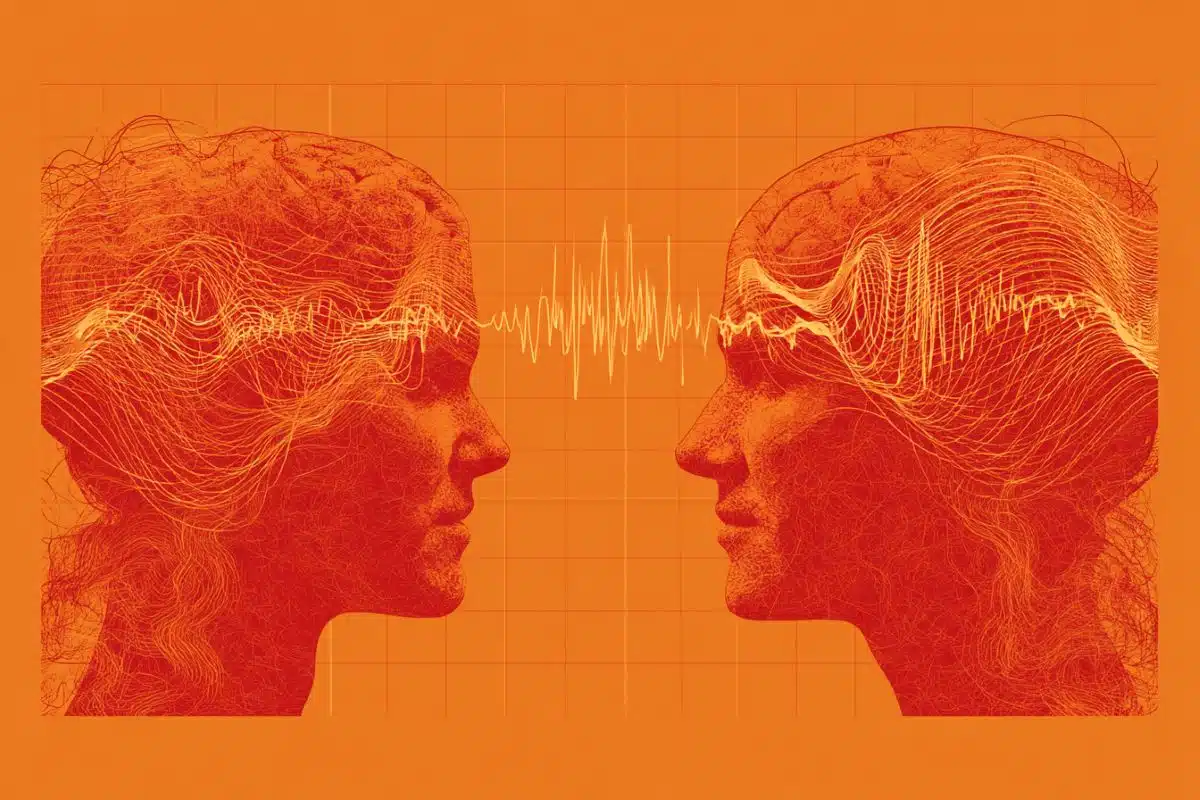
Summary: The colloquial phrase “being on the same wavelength” is far more than an emotional metaphor; it is a measurable neurobiological reality. A pioneering ten-year body of research has proven that during live, face-to-face communication, the neural rhythms of human beings physically lock into alignment. By collaborating with high schools, museums, and high-profile performance artists, an international team of neuroscientists has mapped this phenomenon, demonstrating that this shared brain state can be measured, visualized, and actively engineered to fight loneliness and enhance community bonds.
The retrospective analysis highlights experiments tracking the brain activity of thousands of participants using portable, non-invasive electroencephalogram (EEG) headsets. The data consistently show that when people are deeply engaged with one another, whether they are high school students in a classroom or global music icons like Bad Bunny and Residente collaborating in a studio, their brainwaves synchronize.
Backed by a new $4-million federal health grant, the researchers are now transitioning these findings from classrooms and performance spaces into clinical settings, designing interventions to harness this neural alignment to supercharge therapeutic outcomes and rebuild social cohesion.
Key Facts
- The Social Synchrony Phenomenon: Social synchrony is the physical, real-time alignment of brain rhythms, bodily movements, and linguistic patterns between individuals during face-to-face communication.
- Predicting Social Rapport: In longitudinal studies of high school classrooms, the degree to which students’ brainwaves synchronized with one another directly predicted how much they liked each other and how engaged they were with the course material.
- The Loneliness Footprint: The data reveal a stark neurobiological contrast in isolated individuals: lonely people exhibit highly idiosyncratic, unique brain activity that struggles to sync up with others during standard interactions.
- Studio Brain Mapping: In a 2019 project, researchers wired artists Bad Bunny and Residente with portable EEGs, displaying their shifting brain synchrony in real time to help them test different creative “syncing strategies” while composing the single “Bellacoso.”
- Everyday Banter as Medicine: The team emphasizes that simple, unscripted face-to-face interactions, such as casual banter, shared games, and live music, are neurobiologically essential for maintaining baseline social cohesion within communities.
- The ARPA-H Clinical Target: Armed with new federal funding, investigators are launching clinical trials to test whether engineering a high state of brainwave synchronization between therapists and patients can significantly accelerate psychological healing.
Source: NYU
We often feel that we are “on the same wavelength” with one another, but can science identify and engineer this phenomenon? Studies by a team of neuroscience researchers suggest that it’s possible—a connectivity that is both beneficial and that can be enhanced for therapeutic and other purposes.
The scientists collaborated with schools, museums, and performance artists—including Bad Bunny and Residente, Marina Abramovic, and Mike Gordon and Bob Weir—to design and conduct projects measuring and visualizing how the brainwaves of thousands of museum visitors, festivalgoers, and high school students became “in sync” with each other during live face-to-face communication.
Collectively, their research, which has encompassed friends, family members, and strangers, has shown that brainwaves match up in certain exchanges, and that when they do, this synchrony can be used to guide and improve social interactions—in other words, a way to engineer social connectedness.
“Our years of experiments show that we can consistently measure the seemingly elusive notion of ‘being on the same wavelength’ with someone else—a synchrony that is linked to healthy social relationships,” says Suzanne Dikker, a research professor at New York University and Ghent University. “Taking the next step, we’ve also been able to design interventions that boost social synchrony.”
The work, which appears in the journal Trends in Cognitive Sciences, also included Yafeng Pan, a professor at Zhejiang University, Xiaojun Cheng, a professor at Shenzhen University, and Guillaume Dumas, a professor at the University of Montreal.
The authors say their work offers the possibility of finding new pathways to utilize synchrony in order to improve social connectedness.
Over the course of a decade, the researchers conducted studies and projects in which thousands of participants’ brain activity was recorded using portable electroencephalogram (EEG) technology—a non-invasive headset.
For instance, Dikker collaborated with Bad Bunny and Residente in 2019 to map the artists’ brain activity while they created music and show them in real time how in sync their brainwaves were, so they could test different “syncing strategies.” The EEG data illuminated their brain synchronies during the creation of the single “Bellacoso.”
Overall, these findings pointed to a phenomenon they call “social synchrony”—the alignment of the rhythms of our brains, bodies, and language with people around us during social communication. For instance, the study of high school students found utility in brain synchronization—when students’ brainwaves were synchronized with each other, the more likely they were to report liking the other person as well as the class itself.
“Social synchrony plays an important role in healthy social relationships and in learning,” observes Dikker. “For example, lonely individuals show more idiosyncratic brain activity, and there is growing evidence suggesting that face-to-face activities that involve interpersonal synchrony, such as playing games or engaging in everyday banter, is important to maintaining social cohesion in communities.”
Dikker and her colleagues, Greg Appelbaum and Eric Garland at the University of California, San Diego, will now examine how to leverage brainwave synchronization under a $4-million grant from the Department of Health and Human Services’ Advanced Research Projects Agency for Health (ARPA-H). The researchers will test how to deploy this phenomenon in clinical settings by seeking ways to leverage the synchrony found in earlier experiments to improve therapeutic outcomes.
Key Questions Answered:
A: For a long time, brain-mapping research was trapped inside massive, stationary fMRI machines, making it impossible to study natural human interaction. This team broke out of the lab by utilizing advanced, lightweight, portable electroencephalogram (EEG) technology. These non-invasive headsets fit comfortably on a participant’s head, reading electrical brainwave activity through skin sensors. By deploying these portable rigs inside active high schools, crowded museums, and live music festivals, the researchers safely captured the raw, real-world neural data of thousands of people interacting naturally.
A: In 2019, Dr. Suzanne Dikker collaborated with the global music icons to see how deep creative collaboration manifests in the brain. As the duo worked on creating their hit single “Bellacoso,” the research team mapped their neural activity and displayed their brainwave alignment on screens in real time. This allowed the artists to visually see when their brains were perfectly in phase and actively test different “syncing strategies.” The experiment proved that complex, high-level creative collaboration acts as an incredibly powerful engine for social synchrony, locking two distinct minds into a unified rhythmic frequency.
A: The $4-million grant from the Advanced Research Projects Agency for Health is designed to take social synchrony out of the realm of art and observation and turn it into a targeted clinical tool. In traditional talk therapy, building a strong rapport between a therapist and patient can take months. Doctors believe that by tracking and visually feeding back brainwave synchronization patterns during a session, they can drastically accelerate this process. This intervention could unlock highly potent, fast-acting treatment pathways for treating treatment-resistant depression, severe PTSD, and the debilitating mental health toll of chronic, lifelong loneliness.
Editorial Notes:
- This article was edited by a Neuroscience News editor.
- Journal paper reviewed in full.
- Additional context added by our staff.
About this neurotech and social neuroscience research news
Author: Rachel Harrison
Source: NYU
Contact: Rachel Harrison – NYU
Image: The image is credited to Neuroscience News
Original Research: Open access.
“Multi-brain neurofeedback: what are we training for?” by Yafeng Pan, Xiaojun Cheng, Guillaume Dumas, Suzanne Dikker. Trends in Cognitive Sciences
DOI:10.1016/j.tics.2026.05.007
Abstract
Multi-brain neurofeedback: what are we training for?
Multi-brain neurofeedback offers new possibilities for guiding social interaction by capturing and modulating interpersonal neural dynamics in real time. We propose a hierarchical framework where neurofeedback targets shared sensory dynamics (signal), socio-cognitive processes (functional), or social outcomes (system). We highlight key methodological challenges and potential real-world therapeutic and pedagogical applications.