Summary: While current weight-loss blockbusters like GLP-1s focus on suppressing appetite, researchers have uncovered a completely different strategy: increasing energy expenditure by “building out” the body’s natural heat-generating tissue.
The study reveals how a protein called SLIT3 acts as a “split signal” to grow the essential nerve and blood vessel networks within brown fat. Without this infrastructure, brown fat cannot receive the brain’s “get warm” signals or the nutrients it needs to burn calories. This discovery suggests that obesity could be treated by enhancing the body’s internal “metabolic sink” rather than just eating less.
Key Facts
- The “Split Signal”: When brown fat cells secrete SLIT3, an enzyme called BMP1 cleaves it into two fragments. One fragment grows the blood vessels (supplying fuel), while the other expands the nerves (supplying the “on” switch).
- The Metabolic Sink: Activated brown fat acts as a “sink,” drawing in glucose and lipids from the bloodstream to generate heat (thermogenesis) instead of storing them as white fat.
- The PLXNA1 Receptor: Researchers identified PLXNA1 as the specific docking station for SLIT3 that controls nerve density. Mice lacking this receptor couldn’t maintain their body temperature in the cold because their brown fat lacked the “wiring” to hear the brain’s signals.
- Human Evidence: Analyzing fat samples from over 1,500 people, the team found that SLIT3 gene expression is closely linked to metabolic health, inflammation, and insulin sensitivity in individuals with obesity.
Source: NYU
Researchers have determined how a key protein activates brown fat by expanding blood vessels and nerves in the heat-generating tissue.
The findings, published in Nature Communications, point to a potential strategy for treating obesity that deviates from the current approach of suppressing appetite.
Most of the fat in our bodies is white fat, which stores excess energy and, at too high of levels, can lead to obesity. Humans and other mammals also have a smaller amount of brown fat, a specialized tissue that regulates body temperature and is closely linked to weight loss and metabolic health. When activated by exposure to cold, brown fat uses the body’s resources like glucose and lipids to generate heat, a process called thermogenesis.

“During thermogenesis, all of that chemical energy is dissipated as heat instead of being stored in the body as white fat,” said Farnaz Shamsi, assistant professor of molecular pathobiology at NYU College of Dentistry and the study’s senior author.
“By rapidly taking up and using fuel sources from our bodies and the food that we eat, brown fat acts like a metabolic sink that draws in nutrients and prevents them from being stored.”
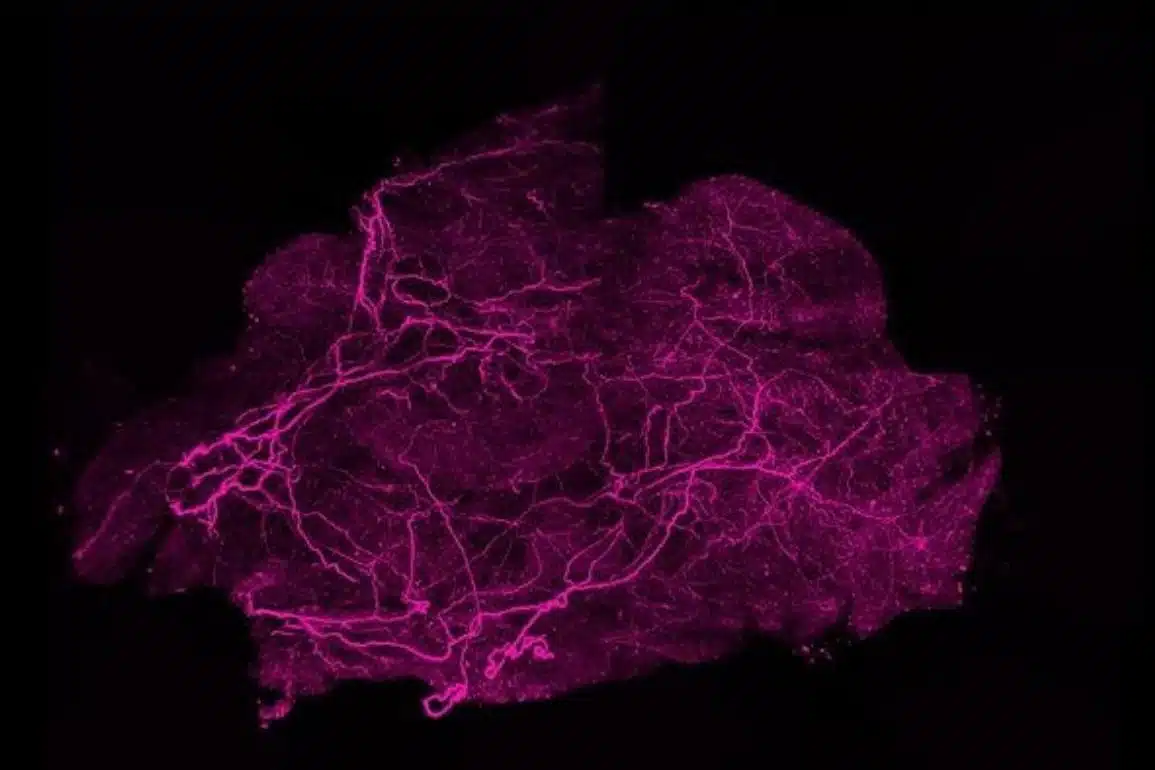
Brown fat has intricate, dense networks of nerves and blood vessels that are critical for its functioning. Nerves enable brown fat to communicate with the brain; when the brain senses cold, it rapidly signals to activate brown fat.
Blood vessels supply brown fat with oxygen and nutrients to generate heat, and then distribute this heat throughout the body. While research on brown fat has largely focused on stimulating fat cells to generate heat, less is known about how these underlying networks function.
Shamsi’s lab previously used single-cell RNA sequencing to identify SLIT3, a protein secreted by brown fat cells, which they thought may play a role in how fat cells communicate. When produced, SLIT3 gets cleaved into two different fragments.
In the Nature Communications study, using a combination of approaches in human and mouse cells, the researchers discovered the enzyme, BMP1, that is responsible for cleaving SLIT3 into two. They also determined that the two SLIT3 fragments control different processes: one grows the network of blood vessels, while the other expands the network of nerves.
“It works as a split signal, which is an elegant evolutionary design in which two components of a single factor independently regulate distinct processes that must be tightly coordinated in space and time,” noted Shamsi.
In addition, the researchers identified the receptor, PLXNA1, that binds to one of the SLIT3 fragments to control brown fat’s network of nerves. In studies in mice—which typically have very active brown fat and can tolerate cold temperatures for long periods of time—removing SLIT3 or the PLXNA1 receptor from brown fat resulted in mice becoming sensitive to cold and having difficulty maintaining their body temperatures. A closer look at brown fat tissue missing SLIT3 or its receptor revealed that it lacks the proper nerve structure and density of blood vessels.
To see if their findings translate to humans, the researchers examined samples of fat tissue from more than 1,5000 people, some of whom had obesity. Focusing on the gene that produces SLIT3, which prior studies show is associated with obesity and insulin resistance, they found that SLIT3 gene expression may regulate fat tissue health, inflammation, and insulin sensitivity in people with obesity.
“That really got our attention, as it suggests that this pathway could be relevant in human obesity and metabolic health,” said Shamsi.
While most weight loss drugs—including GLP-1s—suppress appetite, decreasing the amount of food people eat and therefore the amount of energy stored, treatments that involve brown fat have the potential to increase energy expenditure.
This new understanding of what’s happening inside brown fat—including how SLIT3 splits into two and binds to receptors to control nerves and blood vessels—highlights several processes that could potentially be harnessed for their therapeutic potential.
“Our research shows that just having brown fat isn’t enough—you need the right infrastructure within the tissue for heat production,” said Shamsi.
Additional study authors include Tamires Duarte Afonso Serdan, Heidi Cervantes, Benjamin Frank, Akhil Gargey Iragavarapu, Qiyu Tian, Daniel Hope, and Halil Aydin of NYU College of Dentistry; Chan Hee Choi and Paul Cohen of Rockefeller University; Anne Hoffmann and Matthias Blüher of the University of Leipzig; Adhideb Ghosh and Christian Wolfrum of ETH Zurich; Matthew Greenblatt of Weill Cornell Medical College; and Gary Schwartz of Albert Einstein College of Medicine.
Funding: The research was supported in part by the National Institutes of Health (K01DK125608, R03DK135786, R01DK136724, RC2DK129961, R35GM150942), the G. Harold and Leila Y. Mathers Charitable Foundation, the American Heart Association (24CDA1271852), the Einstein-Mount Sinai Diabetes Center, the NYU Dentistry Department of Molecular Pathobiology, and the Boettcher Foundation.
Key Questions Answered:
A: As senior author Farnaz Shamsi points out, “just having brown fat isn’t enough.” If your brown fat doesn’t have the right “infrastructure”—meaning enough nerves to hear the brain’s signals and enough blood vessels to get oxygen—it stays dormant. It’s like having a high-performance engine with no fuel line or ignition switch.
A: Most current drugs (GLP-1s) work by telling your brain you aren’t hungry, which reduces the energy going in. This SLIT3 pathway is about increasing the energy going out. By “upgrading” your brown fat, you are essentially turning up your body’s internal thermostat to burn through stored white fat and blood sugar.
A: We may not need to grow more brown fat, but rather optimize what we already have. By harnessing the SLIT3-PLXNA1 pathway, scientists hope to develop therapies that “renovate” existing brown fat, making it more efficient at drawing in and burning off excess nutrients.
Editorial Notes:
- This article was edited by a Neuroscience News editor.
- Journal paper reviewed in full.
- Additional context added by our staff.
About this neurology and aging research news
Author: Rachel Harrison
Source: NYU
Contact: Rachel Harrison – NYU
Image: The image is credited to Shamsi Lab, NYU College of Dentistry
Original Research: Open access.
“SLIT3 fragments orchestrate neurovascular expansion and thermogenesis in brown adipose tissue” by Tamires Duarte Afonso Serdan, Heidi Cervantes, Benjamin Frank, Akhil Gargey Iragavarapu, Qiyu Tian, Daniel Hope, Chan Hee J. Choi, Anne Hoffmann, Adhideb Ghosh, Christian Wolfrum, Matthew B. Greenblatt, Paul Cohen, Matthias Blüher, Halil Aydin, Gary J. Schwartz & Farnaz Shamsi. Nature Communications
DOI:10.1038/s41467-026-70310-9
Abstract
SLIT3 fragments orchestrate neurovascular expansion and thermogenesis in brown adipose tissue
Brown adipose tissue is an evolutionary innovation in placental mammals that regulates body temperature through adaptive thermogenesis. Cold exposure activates brown adipose tissue thermogenesis through coordinated induction of brown adipogenesis, angiogenesis, and sympathetic innervation; however, how these processes are coordinated remains unclear.
Here, we show that fragments of Slit guidance ligand 3 (SLIT3) drive crosstalk among adipocyte progenitors, endothelial cells, and sympathetic nerves. Adipocyte progenitors secrete SLIT3, which is cleaved into functionally distinct SLIT3-N and SLIT3-C fragments that independently promote angiogenesis and sympathetic innervation.
We identify PLXNA1 as a receptor for SLIT3-C and demonstrate its essential role in sympathetic innervation of brown adipose tissue. Moreover, we identify BMP1 as the first SLIT protease described in vertebrates.
Coordinated neurovascular expansion mediated by distinct SLIT3 fragments provides a bifurcated yet integrated mechanism that ensures a synchronized brown adipose tissue response to environmental challenges.
Finally, this study reveals a previously unrecognized role for adipocyte progenitors in regulating tissue innervation.