

Summary: Can an organism learn without a single nerve cell, let alone a brain? New research reveals that the giant, single-celled Stentor coeruleus does exactly that.
By using molecular machinery strikingly similar to human neurons, specifically involving calcium signaling and the enzyme CaMKII, this trumpet-shaped pond dweller “remembers” to ignore harmless disturbances. The discovery suggests that learning is not a complex byproduct of neural networks, but a fundamental biological feature that predates the evolution of the brain.
Key Facts
- The Habituation Hack: Stentor exhibits habituation, a basic form of learning where an organism stops responding to a repeated, harmless stimulus. When jolted once a minute, the Stentor eventually “decides” to stop retracting its tail.
- Molecular Memory: Unlike animal neurons that often require new protein synthesis to form long-term memories, Stentor relies on protein modification. It adds chemical tags to existing proteins to change its sensitivity to touch.
- The CaMKII Connection: The process is driven by calcium flowing into the cell, which activates CaMKII, the same enzyme human neurons use to strengthen synapses. This suggests our brains “borrowed” this learning mechanism from ancient, single-celled ancestors.
- Inherited Learning: In a startling twist, researchers found that Stentors can pass this learned habituation down to their daughter cells when they divide, indicating a form of non-genomic memory inheritance.
- Mechanoreceptor Sensitivity: The learning likely involves “tuning” the organism’s mechanoreceptors (touch-sensitive proteins), making them less reactive to physical jolts over time.
Source: UCSF
Scientists have known for more than a century that a single-celled organism with no nerve cells — much less a brain — can behave in ways that resemble learning. But those observations only went so far. How the organism did that was a mystery.
Now, scientists at UC San Francisco can explain how this simple organism, called Stentor coeruleus, learns: It uses molecular machinery that resembles what neurons have in the human brain. The results suggest that learning may be a fundamental feature of life.
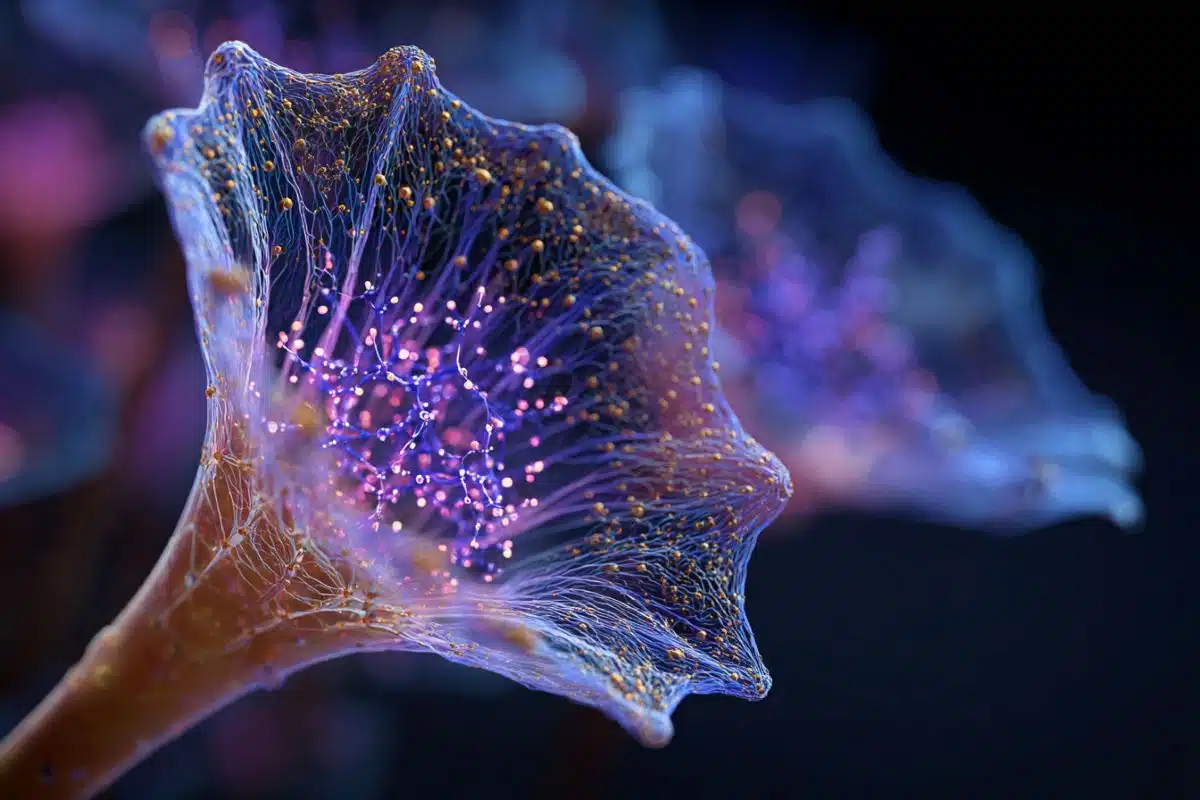
In findings published in Current Biology, the researchers used modern neuroscience tools to study the pond-dwelling Stentor, which is shaped like a trumpet and is large enough to be seen with the naked eye. These organisms contract when perturbed but stop after repeated jolts — a form of learning called habituation.
“We usually think learning must arise from large networks of neurons,” said Wallace Marshall, PhD, professor of Biochemistry and Biophysics at UCSF and senior author of the paper, which appeared on April 22. “But these single cells can perform behaviors that normally are associated with cognition and brains.”
To understand how the Stentor learns, UCSF researchers built a device that jostled them in petri dishes once a minute. Over time, the Stentors became insensitive to the jolts and stop retracting their tails.
The researchers then treated the Stentors with drugs that disrupted their ability to produce new proteins, assuming that like animal neurons, they would no longer be able to learn. Instead, the Stentors learned to ignore the disturbances even more quickly. It turned out Stentors rely on a different mechanism to store memories: modifying the proteins they already have.
“We’ve long thought that forming a memory meant making a molecule, and forgetting meant losing it,” Marshall said. “Here, it seems to work in a different way.”
The scientists also measured gene expression and protein levels and used drugs to track what was happening as the Stentors adapted.
The results suggest that Stentors reacted to the jolts by allowing calcium to flow into their cells, which triggered an enzyme called CaMKII to add chemical tags to certain proteins. With each jolt, the Stentors became less likely to respond — suggesting the chemical tags had changed how the organisms sensed the jolts. The Stentors also passed this knowledge to their daughter cells when they divided.
Scientists are still trying to understand how Stentors store this knowledge, but it may involve mechanoreceptors, which respond to touch. Animal neurons do something similar using CaMKII to change the sensitivity of receptors on their surface. It’s a tantalizing clue that learning may rely on molecular systems that existed long before the evolution of brains.
“Stentors and humans might not seem alike at all,” Marshall said. “But learning in both involves protein changes and calcium signaling, and it’s possible our brain cells may have borrowed this mechanism from earlier cells that could learn on their own.”
Authors: Other UCSF authors are Deepa H. Rajan; Ashley Albright, PhD; Ulises Diaz, PhD; and Yina Hudnall.
Funding: This work was supported by the National Institutes of Health (R35 GM130327); European Molecular Biology Laboratory; European Commission; EMBO; National Science Foundation; and Fondation Fourmentin-Guilbert.
Key Questions Answered:
A: Efficiency and scale. While a single cell can learn basic “yes/no” responses (like habituation), a brain allows for the integration of millions of these signals to perform complex tasks like language, logic, and abstract thought. Think of the Stentor as a single transistor and the human brain as a supercomputer.
A: Not in the way we usually define it. It doesn’t have “thoughts,” but it does have biological cognition. It can process environmental information, compare it to past experiences, and change its future behavior based on that comparison.
A: This was the study’s big surprise! Because Stentor doesn’t need to make new proteins to learn, blocking that process might have allowed the cell to divert all its energy and existing molecular tools toward the protein-tagging “memory” system, inadvertently supercharging its ability to habituate.
Editorial Notes:
- This article was edited by a Neuroscience News editor.
- Journal paper reviewed in full.
- Additional context added by our staff.
About this neuroscience and learning research news
Author: Levi Gadye
Source: UCSF
Contact: Levi Gadye – UCSF
Image: The image is credited to Neuroscience News
Original Research: Open access.
“Molecular pathways for learning in the single-cell Stentor coeruleus” by Deepa H. Rajan, Ashley Albright, Hyeyoon Kim, Ulises Diaz, Yina Hudnall, Niklas Steube, Gautam Dey, Tao Liu, and Wallace F. Marshall. Current Biology
DOI:10.1016/j.cub.2026.03.080
Abstract
Molecular pathways for learning in the single-cell Stentor coeruleus
The single-cell Stentor coeruleus contracts in response to mechanical taps but habituates and learns to ignore the taps after repeated stimulation.
Here, we explored the molecular changes that occur during the formation of this cellular memory in order to improve our understanding of non-synaptic learning.
We impaired cellular protein synthesis with cycloheximide and puromycin and found that, contrary to the effects of such treatments on metazoa, these drugs accelerate habituation and prolong memory retention in Stentor.
Exploratory proteomic and transcriptomic analyses identified candidate proteins and genes that changed over the course of habituation and response recovery, pointing toward the regulation of Stentor learning by calcium signaling and protein phosphorylation.
Building on these results, we found that using RNA interference to knock down the calcium-binding, EF-hand domain-containing protein SteCoe_6763 accelerated habituation.
Furthermore, increased extracellular calcium improved Stentor learning, while treatment with kinase and phosphatase inhibitors impaired learning. In particular, KN-93, a drug known to inhibit calcium/calmodulin-dependent kinase II and voltage-gated calcium channels, decreased both the rate and extent of habituation in Stentor, similar to its effects on learning in metazoa.
We also discovered that habituation memory can be maintained in progeny following cell division. Taken together, these results suggest that response recovery in Stentor requires new protein synthesis and that memory formation involves the modification of delocalized mechanoreceptors by phosphorylation and calcium signaling.
This is consistent with our previous model of Stentor learning, in which habituation occurs through the inactivation of cell-surface receptors.


