

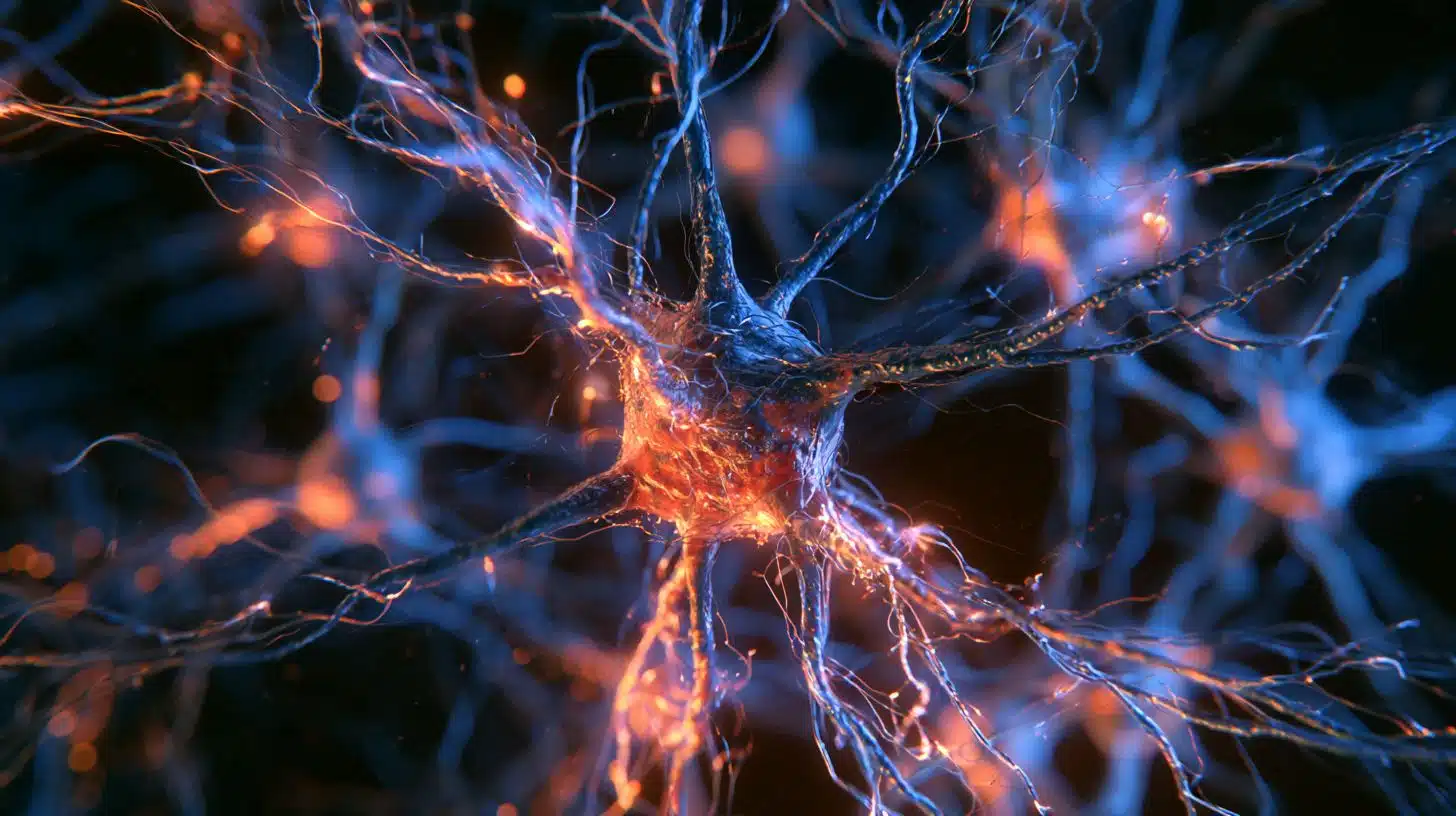
Summary:
A neurobiology study from NYU Langone Health has resolved a foundational mystery of working memory by uncovering a “split attractor network” in fruit flies. Published in Nature, the study reveals that short-term directional memories are formed through a gated partnership between two distinct neuron classes: PFG neurons, which track spatial orientation from the brain’s internal compass, and hΔK neurons, which control the timing of memory formation. When an odor cue appears, an inhibitory gate lifts, allowing the cells to communicate and lock in a persistent directional memory even after the sensory trigger vanishes.
Key Facts:
- The Split Attractor Architecture: Rather than relying on a continuously active feedback loop, the fruit fly brain employs a “split attractor network” where memory content (PFG neurons) and memory timing (hΔK neurons) remain physically separated until an inhibitory gate is lifted.
- Gated Directional Storage: When the communication gate opens, flies lock in their spatial navigation heading toward an attractive odor (apple cider vinegar), maintaining purposeful movement for seconds after the scent plume disappears.
- Connectome-Level Confirmation: The findings offer direct experimental validation for a longstanding theoretical model of working memory, leveraging the fully mapped connectome of Drosophila melanogaster to bridge computational theory with physiological circuitry.
Source: NYU Langone Health
Working memory is one of the most critical cognitive tools across the animal kingdom. Whether a human is temporarily holding a two-factor authentication code in mind or an insect is tracking the direction of a fleeting food scent, the brain faces a complex biophysical challenge: neural representations must be stable enough to persist over seconds or minutes, yet flexible enough to turn on instantly and clear away without consuming unnecessary energy.
For decades, theoretical neuroscientists hypothesized that this balance is achieved by “attractor networks”—circuits of interconnected neurons whose recurrent electrical activity settles into stable, persistent states of excitation.
However, confirming how living biological circuits implement attractor dynamics without getting stuck in runaway loops has remained difficult, largely because mammalian brains contain billions of dense, overlapping connections.
Now, a research team led by NYU Grossman School of Medicine has confirmed the physical existence and precise mechanics of an attractor network in the living brain.
Published online in the journal Nature, the investigation utilized the fruit fly (Drosophila melanogaster) to show that working memory relies on a specialized “split attractor network.” In this circuit, the cells carrying the content of a memory are separated from the cells that control memory timing, joined by an active biological gate that opens only when information needs to be retained.
“Our study shows how a neuronal circuit forms a short-term memory in response to a fly sensing an odor, enabling it to remember a direction and travel toward a smell it wants to remember,” said senior study investigator Katherine Nagel, Ph.D., an associate professor in the Department of Neuroscience at NYU Grossman School of Medicine. “Scientists have long assumed an arrangement like this powers working memory, but our experiments confirm this arrangement exists and show how it works in a specific context.”
The PFG and hΔK Circuit in Action
With fewer than 200,000 neurons and a fully reconstructed synaptic connectome, the fruit fly provides an unmatched model for decoding complex circuit logic.
Dr. Nagel’s laboratory set out to observe how flies track sensory cues in their environment. When exposed to an attractive plume of apple cider vinegar, the insects turned toward the odor source and continued walking along that heading for several seconds after the odor was completely shut off, a direct behavioral demonstration of working memory.
Electrophysiological and optical recordings revealed that this persistent navigation was coordinated by two interconnected classes of neurons:
- PFG Neurons (Memory Content): Under baseline conditions, PFG neurons continuously receive heading information from the fly’s central complex “compass” system, tracking where the insect is pointing in physical space.
- hΔK Neurons (Temporal Control): The hΔK neurons govern the precise timing of memory encoding. Most of the time, communication between PFG and hΔK cells is actively blocked by an inhibitory gate, keeping the system cleared of irrelevant data.
When the sensory olfactory cue arrives, the neural gate lifts. PFG and hΔK neurons begin exchanging reciprocal electrical signals, settling into a stable, self-reinforcing attractor state. This mutual feedback locks the fly’s spatial orientation in memory, providing a steady navigational reference that guides the insect toward the odor source even after the chemical trail has dissipated.
“Right now, one of the frontiers in neuroscience is understanding what specific networks are doing, and the fruit fly is one of the best models to study that,” noted Dr. Nagel. “The fly has an amazing track record for revealing how human biology works in a clear and simple way. My hope is that it gives us insight into processes like working memory that we have not yet had the tools to study in depth.”
From Fly Navigation to Cognitive Architectures
The discovery of the split attractor architecture provides an elegant solution to the stability-flexibility trade-off in neural engineering. By physically dissociating the memory content carrier from the timing trigger, the nervous system prevents noise from polluting working memory while allowing instantaneous updates.
Dr. Nagel and her collaborators plan to investigate how this circuit operates across longer time horizons and identify the modulatory neurotransmitters responsible for opening and closing the communication gate.
Because attractor dynamics are hypothesized to underlie human working memory, spatial orientation, and decision-making, mapping these computational principles in the fly connectome offers a baseline for understanding how executive circuits falter in cognitive disorders such as ADHD, schizophrenia, and dementia.
Funding: Funding for the study was provided by National Institutes of Health grants R01NS127129 and R01DC017979. Additional funding was provided by National Science Foundation grant 2014217.
Editorial Notes:
- This article was edited by a Neuroscience News editor.
- Journal paper reviewed in full.
- Additional context added by our staff.
About this Neurology and Neuropharmacology Research:
- Media Contact: David March
- Source: NYU Langone Health
- Image Credit: Image credited to Neuroscience News
- Original Research is Open Access: Nature (Oct 7, 2026). “A split attractor design for rapidly writing a navigational goal.” Authors: Aaron J. Lanz, Nicholas D. Kathman, Emily Hao, Bard Ermentrout & Katherine I. Nagel.
- DOI: 10.1038/s41586-026-11144-9
Abstract
A split attractor design for rapidly writing a navigational goal
Recurrent attractor networks are widely thought to form the basis of working memory, but how they can be rapidly switched on and off is unclear.
Here we investigate stability and switching in a recurrent circuit of the fly navigation centre. h∆K and PFG neurons are recurrently connected in a ring structure and exhibit shared persistent bump activity that turns on with odour and terminates at the end of a goal-directed run.
Using whole-cell recordings, we show that persistence in h∆K depends on recurrence, and that h∆K receives slow recurrent excitation and fast inhibition from its synaptic partners. Computational modelling reveals that these synaptic dynamics yield persistent attractor dynamics over a range of synaptic strengths. Next we examine the mechanisms of rapid switching.
We find that whereas both populations show similar activity during runs, they become decoupled during turns and rest. We can reproduce these differential dynamics in our model by using inhibition to dynamically uncouple activity in h∆K from PFG. When h∆K is inhibited, PFG neurons follow their inputs from the compass system; when h∆K is disinhibited, recurrent interactions lock this input into place, forming a heading memory.
Consistent with this model, we find that inhibitory inputs onto h∆K increase during turns and are suppressed during odour and goal-directed runs. Our work reveals how disinhibition can serve as a gate to rapidly write an ongoing measurement to a recurrent circuit.


