

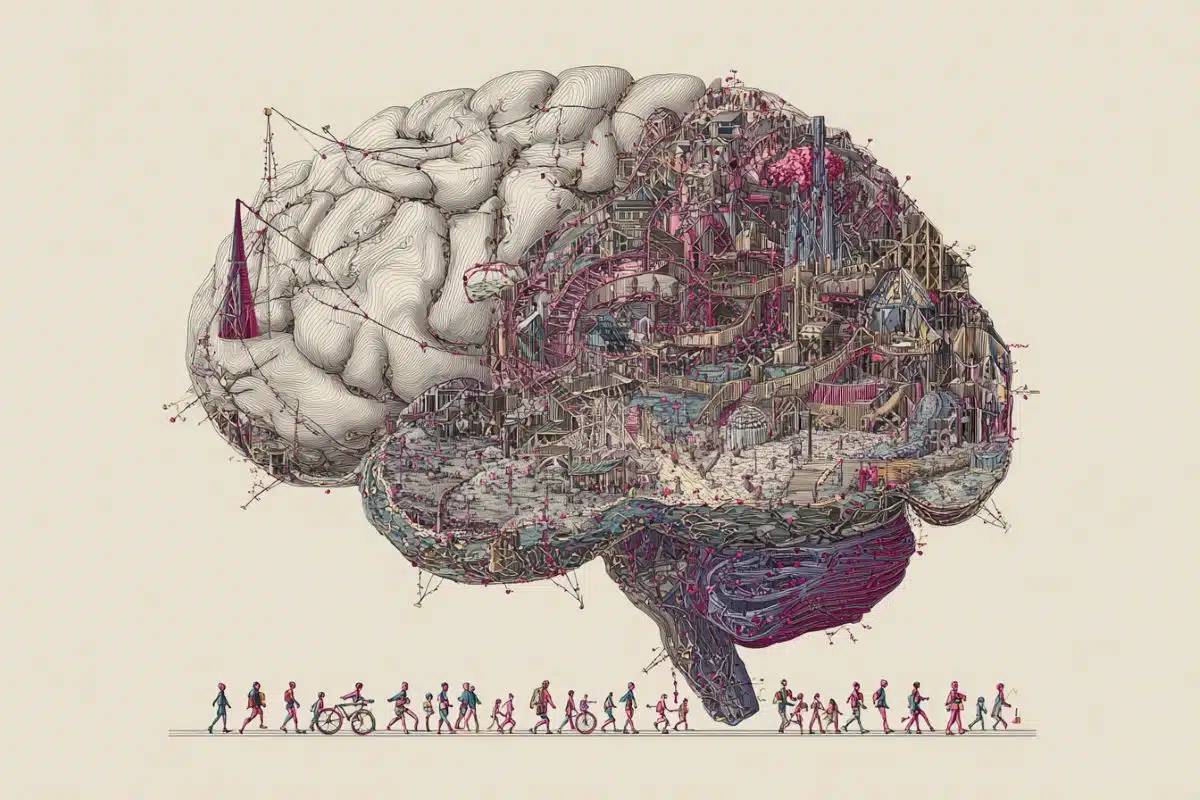
Summary: A precision system neuroscience and optical neuroimaging study cracked a foundational biological mystery: how and why living organisms choose to approach others. The research leverages single-cell resolution imaging in zebrafish models to prove that social interactions do not happen spontaneously.
Instead, they are preceded by a distinct, highly coordinated whole-brain transition several seconds before any physical movement occurs. By mapping this distributed neural shift, investigators identified a predictable “pre-decision state” controlled by a higher brain region that directly dictates an individual’s total baseline social drive.
Key Facts
- The Illusion of Spontaneous Intimacy: Why and how animals choose to initiate contact with others has long stood as a beautifully complex enigma in behavioral biology. While social encounters look spontaneous from the outside, the brain is actually running a massive, subcortical calculation sequence to prime the body for connection long before the physical framework responds.
- The Single-Cell Zebrafish Architecture: Led by Dr. Lilah Avitan, the laboratory utilized zebrafish as an optimized model organism. Zebrafish possess a highly transparent physical structure, handed engineers a pristine window to record and track deep-brain neural activity at single-cell resolution in real time.
- The Living Telemetry Setup: Executed by PhD student Imri Lifshitz, the team developed a novel behavioral rig where a subject fish observed and reacted to a separate swimming fish. Using advanced microscopy, the team captured the exact moment-by-moment biological processing lines where sensory social data transforms into motor action.
- The Whole-Brain Distributed Shift: Shattering the classical neurological theory that a single isolated “social center” governs connection, the team proved that social approach requires a massive, distributed shift across diverse neural regions. When an organism decides to move toward another, a brain-wide signature ignites several seconds before the animal physically twitches.
- The Pallium Pivot: This neural pre-decision state operates on a precise push-pull balance: electrical activity rises sharply in the pallium, a higher brain region heavily linked to complex behaviors, while activity simultaneously drops in other specialized regions. This localized signature predicts not only whether an upcoming action will be social, but also can be used to read the action before it happens.
- Quantifying Individual Social Drive: The intensity of this pre-decision state correlates directly with an animal’s unique baseline personality profile. Zebrafish that exhibited a stronger, more defined brain-wide pattern were found to be significantly more social overall, pinpointing the pallium as the central engine responsible for promoting approach toward others.
- Decoding Human Social Disorders: Because the deep neural structures that handle social behavior are highly conserved across the evolutionary spectrum from fish to mammals, this whole-brain signature provides a vital blueprint for human medicine. It opens up an objective diagnostic window to study human sociability variances and the circuit breakdowns that drive profound social dysfunction disorders.
Source: Hebrew University of Jerusalem
A new study from the laboratory of Dr. Lilah Avitan at the Hebrew University of Jerusalem sheds light on one of the most basic yet mysterious behaviors in biology: why and how we choose to approach others.
The research, led by Avitan and carried out by PhD student Imri Lifshitz together with other members of her lab at the Edmond and Lily Safra Center for Brain Sciences (ELSC) at Hebrew University, shows that social interaction is preceded by a distinct brain-wide neural process.
To understand how social decisions are formed, the researchers turned to zebrafish, a model organism that allows scientists to observe brain activity at single-cell resolution.
They developed a novel setup in which one fish observed and reacted to another swimming fish, while its entire brain activity was recorded in real time. This allowed the team to capture, moment by moment, how the brain processes social information and turns it into action.
The team found that when a fish is about to move toward another, its brain begins to change several seconds before the movement occurs.
Rather than a single “social center,” this process involves a distributed coordinated shift across the brain:
- Activity rises in the pallium, a higher brain region linked to complex behavior
- At the same time, activity drops in other regions
This pattern forms a kind of neural “pre-decision state” that signals an upcoming social action and can be used to predict it before it happens.
Importantly, the strength of this “pre-decision state” was linked to individual social drive: animals showing a stronger brain-wide pattern were more social overall. The findings also pointed to a central role for the pallium in generating this social drive, identifying it as a key brain region that helps promote approach toward others.
“This study identifies a brain-wide neural signature of social approach that emerges before movement begins,” said Dr. Avitan. “This signature predicts not only whether an upcoming action will be social, but also how strongly socially driven the individual is.”
Understanding how the brain generates social behavior could help explain why individuals differ in sociability. Because similar brain structures are involved in social behavior across species, these findings may also provide insight into human social function and disorders where it is disrupted.
Key Questions Answered:
A: By monitoring a newly discovered neural countdown called a “pre-decision state.” Hebrew University researchers discovered that when an organism is about to approach another, its brain begins to shift its electrical activity several seconds before any physical movement occurs. This pattern acts as a highly reliable, brain-wide signature that signals an upcoming social action, allowing observers to accurately read the animal’s intent before it takes a single step.
A: Through a coordinated, brain-wide push-pull system involving higher brain regions. Instead of relying on one isolated node, social approach requires a distributed shift across multiple networks. Activity rises sharply in the pallium, a region responsible for complex behaviors, while simultaneously dropping in other regions. This balanced, whole-brain transition is what generates the internal momentum needed to initiate contact.
A: Because the core neural wiring for social behavior has remained remarkably unchanged throughout evolutionary history. The foundational brain structures that handle sociability in zebrafish are highly similar to those found in higher mammals and humans. Mapping this precise pre-decision signature allows global medicine to understand why individual sociability differs so wildly, providing an objective map to evaluate human disorders where social communication breaks down.
Editorial Notes:
- This article was edited by a Neuroscience News editor.
- Journal paper reviewed in full.
- Additional context added by our staff.
About this neuroscience research news
Author: Danae Marx
Source: Hebrew University of Jerusalem
Contact: Danae Marx – Hebrew University of Jerusalem
Image: The image is credited to Neuroscience News
Original Research: Open access.
“Distinct distributed neural dynamics predict pallium-dependent social approach” by Imri Lifshitz, Asia Prag, Netta Livneh, Maayan Moshkovitz, Abeer Karmi & Lilach Avitan. Nature Communications
DOI:10.1038/s41467-026-71666-8
Abstract
Distinct distributed neural dynamics predict pallium-dependent social approach
A key component of social behavior is approach, where animals move toward social partners to maintain group cohesion and coordinate actions. While social cues are continuously encoded across modalities, it remains unclear whether a distinct neural process underlies social approach.
We developed an experimental assay in which a head-fixed, tail-free zebrafish interacts with a freely swimming conspecific, enabling precise behavioral quantification alongside large-scale functional imaging at cellular resolution. We demonstrate that approach movements are more likely to be temporally coupled with conspecific movements, highlighting the interplay between spatial positioning and temporal coordination.
Notably, distinct distributed neural activity emerges seconds before approach movements, characterized by increased activity in pallial neurons and reduced activity in midbrain and hindbrain populations. These coordinated dynamics reliably predict upcoming approach movements across regions and account for individual differences in social behavior.
Moreover, we show that these neural processes are specific to the social context and rely on pallial activity. Together, our findings uncover a distributed yet coordinated neural mechanism underlying social interaction.


