

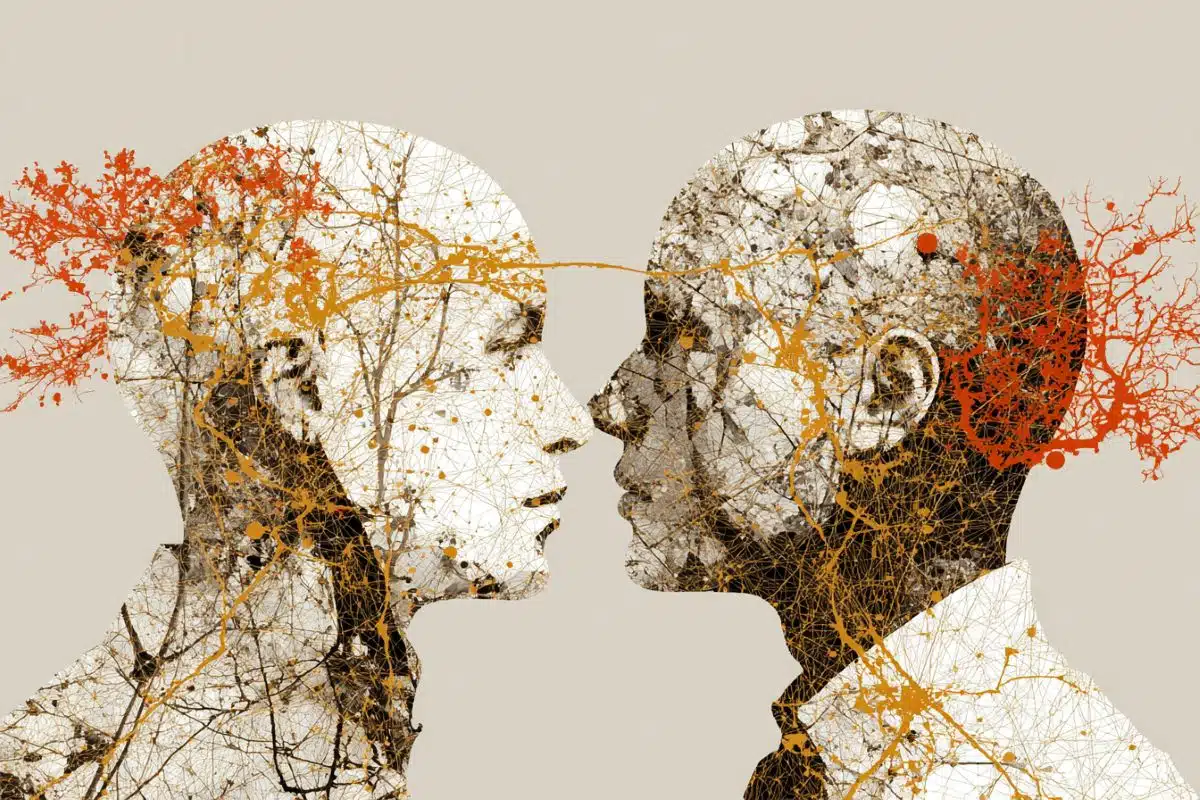
Summary: A new study has turned a 75-year-old game theory doctrine on its head, proving that cooperation can emerge and flourish naturally without special rules, enforcement, or genetic ties.
The research challenges the long-held assumption from the “prisoner’s dilemma” that evolution inevitably favors selfishness and complete societal breakdown. By deploying mathematical models, statistical mechanics, and populations of neural networks, scientists discovered that the missing key to evolutionary cooperation is simply memory and individual recognition.
Key Facts
- Dethroning the Cheater: For decades, the classical prisoner’s dilemma dictated that cheating always pays off more, leading to a long-term takeover of selfish traits. This new model proves that even in basic scenarios, cheaters do not always win.
- The Power of Recognition: The primary catalyst for spontaneous cooperation is tracking opponents. If an organism can identify who it previously interacted with and react in the same manner, cooperation becomes an “emergent property” that flourishes on its own.
- No Extra Conditions Required: Unlike prior evolutionary theories, this new model requires no complex assumptions like kin selection (helping relatives) or group conformity; it operates purely on individual memory traces.
- Microbial and Insect Memory: The study suggests that even simple organisms like microbes or insects can evolve cooperative structures if they can tell each other apart using physical traits or chemical signals.
- Fisher’s Theorem Generalization: Alongside the game theory breakthrough, the research team produced a major new theoretical result: a mathematical generalization of Fisher’s fundamental theorem of natural selection.
Source: Rutgers University
The “prisoner’s dilemma” is one of the most famous ideas in game theory. It even appeared in the Oscar-winning film A Beautiful Mind, which told the story of mathematician John Nash.
For decades, this game has been used to explain why selfishness often beats cooperation.
In the prisoner’s dilemma, two players can either cooperate or cheat. Cheating always seems to pay off more, so both players end up cheating and losing out even though working together would have given them the biggest reward.
Scientists have long used this idea to understand everything from microbes sharing resources to human societies negotiating peace. The takeaway message? In the evolutionary race, cheaters win.
A new study led by Rutgers physicist Alexandre Morozov turns that assumption upside down. His research, published in the Proceedings of the National Academy of Sciences, shows that cooperation can emerge naturally without special rules or genetic ties.
“The prisoner’s dilemma has told us for 75 years that cheaters always take over in the long run,” said Morozov, a professor in the Department of Physics and Astronomy at the Rutgers School of Arts and Sciences.
“The end point of any society, based on this, is complete breakdown. But that’s not at all the case. Even in a very simple scenario, cheaters don’t always win. In fact, it’s easier for cooperation to rise.”
Morozov and his collaborator, Alexander Feigel of the Hebrew University of Jerusalem, discovered that the key to cooperation is keeping track of your opponents. If individuals can recognize others, cooperation starts to flourish.
“All you have to do is remember who you interacted with and react in the same way,” said Morozov, who is also director of the Rutgers Center for Quantitative Biology. “That’s enough for cooperation to emerge by itself in many scenarios. It’s what physicists call an emergent property.”
This finding is striking because previous theories required extra conditions such as helping relatives or sticking with your group. Morozov’s model works without those assumptions. It suggests that, even in simple organisms such as microbes or insects, cooperation can evolve if these organisms are able to tell each other apart, perhaps through chemical signals or physical traits.
Game theory underpins this research. A game, in the mathematical sense, is a situation in which players make rational decisions according to defined rules to receive some sort of payoff. Game theory is the branch of mathematics that studies these interactions and helps explain why strategies such as cooperation or cheating emerge in nature and society.
Cooperation is the foundation of complex life, Morozov said. Without it, cells wouldn’t form tissues and societies wouldn’t exist. Yet Darwinian evolution seems to favor selfishness. Morozov’s work offers a new way of understanding how life overcame that hurdle.
“Evolution likes shaping things over long periods of time if it has some material to work with,” Morozov said. “If cooperation always dies off, there’s nothing to evolve. But if there’s a chance, evolution will refine it and make it more stable.”
The implications go beyond biology. Morozov said that his model shows periods of stability interrupted by upheaval, patterns that might sound familiar in human history.
“Cheaters don’t always win,” he said. “Cooperation can persist, and it does persist in many systems scientists look at, such as multi-cellular organisms in which individual cells have to cooperate to survive.”
Morozov started his career as a physicist focusing on protein folding and statistical mechanics, which deals with predicting the behavior of complex systems. Later, he realized those same mathematical tools could help explain how living things evolve. For years, he has explored evolutionary dynamics, building models that show how traits spread in populations under evolutionary forces such as mutation and natural selection.
That experience, Morozov said, gave him the foundation for his latest work. When he encountered game theory during a sabbatical at the Hebrew University, he saw a connection. The same methods he used to study molecules and genes, he realized, could also reveal why cooperation, rather than selfishness, sometimes wins in the prisoner’s dilemma.
The team used mathematical models and computer simulations, including populations of neural networks playing repeated games. A neural network is a computer system modeled after the human brain that teaches patterns and makes predictions by processing information through layers of interconnected nodes.
The scientists also produced a new theoretical result, a generalization of a classic evolutionary principle called Fisher’s fundamental theorem of natural selection.
Morozov said he hopes the work will spark new research on how cooperation evolves in nature and maybe even inspire fresh thinking about cooperation in human societies.
Key Questions Answered:
A: It isn’t completely wrong, but it was missing a vital piece of the puzzle. The traditional dilemma assumes players act blindly, making cheating the most logical choice for a high reward. This new physics-driven model proves that the moment you introduce a basic memory system into the equation, the entire mathematical landscape shifts, making it much easier for cooperation to rise and take over.
A: Not at all. The beauty of this model is that it functions in incredibly simple systems. An organism doesn’t need higher consciousness; it just needs a mechanism to tell others apart, such as tracking specific chemical signals or distinct physical traits. Microbes and insects possess these traits, meaning cooperation could be baked directly into the simplest building blocks of life.
A: It comes down to looking at living things through the lens of math and complex systems. Lead researcher Alexandre Morozov spent years utilizing statistical mechanics to predict how complex proteins fold and how genes spread in populations. By applying these exact same statistical and molecular math tools to repeated games played by populations of computer neural networks, he unlocked the mathematical proof behind why cooperation wins.
Editorial Notes:
- This article was edited by a Neuroscience News editor.
- Journal paper reviewed in full.
- Additional context added by our staff.
About this psychology research news
Author: Megan Schumann
Source: Rutgers University
Contact: Megan Schumann – Rutgers University
Image: The image is credited to Neuroscience News
Original Research: Open access.
“Emergence of cooperation due to opponent-specific responses in Prisoner’s Dilemma” by Alexandre V. Morozov and Alexander Feigel. PNAS
DOI:10.1073/pnas.2513282123
Abstract
Emergence of cooperation due to opponent-specific responses in Prisoner’s Dilemma
Complex life would be impossible without cooperation at all levels of biological organization. However, Darwinian selection is commonly believed to favor selfish behavior, making societies of cooperators vulnerable to cheaters.
A quintessential model of this behavior is the game of Prisoner’s Dilemma in which cheaters always win, even though being cooperative results in greater rewards.
Numerous scenarios have been proposed that allow for the evolution of cooperation in restrictive settings that postulate altruism between genetic relatives, explore mechanisms of direct and indirect reciprocity, focus on competition between groups, or impose spatial structure on the population.
It is difficult to imagine how these scenarios would account for the evolution of cooperation in populations of organisms that lack sophisticated assessment mechanisms and have no spatial constraints.
Here we demonstrate that it is possible to achieve high levels of cooperativity in the game of Prisoner’s Dilemma without introducing any additional assumptions about genetic relatedness, population structure, or explicit reciprocal arrangements.
The only requirement is that the willingness to cooperate varies depending on the opponent, for example in response to the opponent’s physical appearance and patterns of behavior. This mechanism requires consistent opponent recognition during multiple encounters.
Evolution of cooperativity due to opponent-specific responses may be the only available mechanism in many biological settings and may serve as a starting point for more sophisticated modes of cooperation observed in animal and human societies.


