

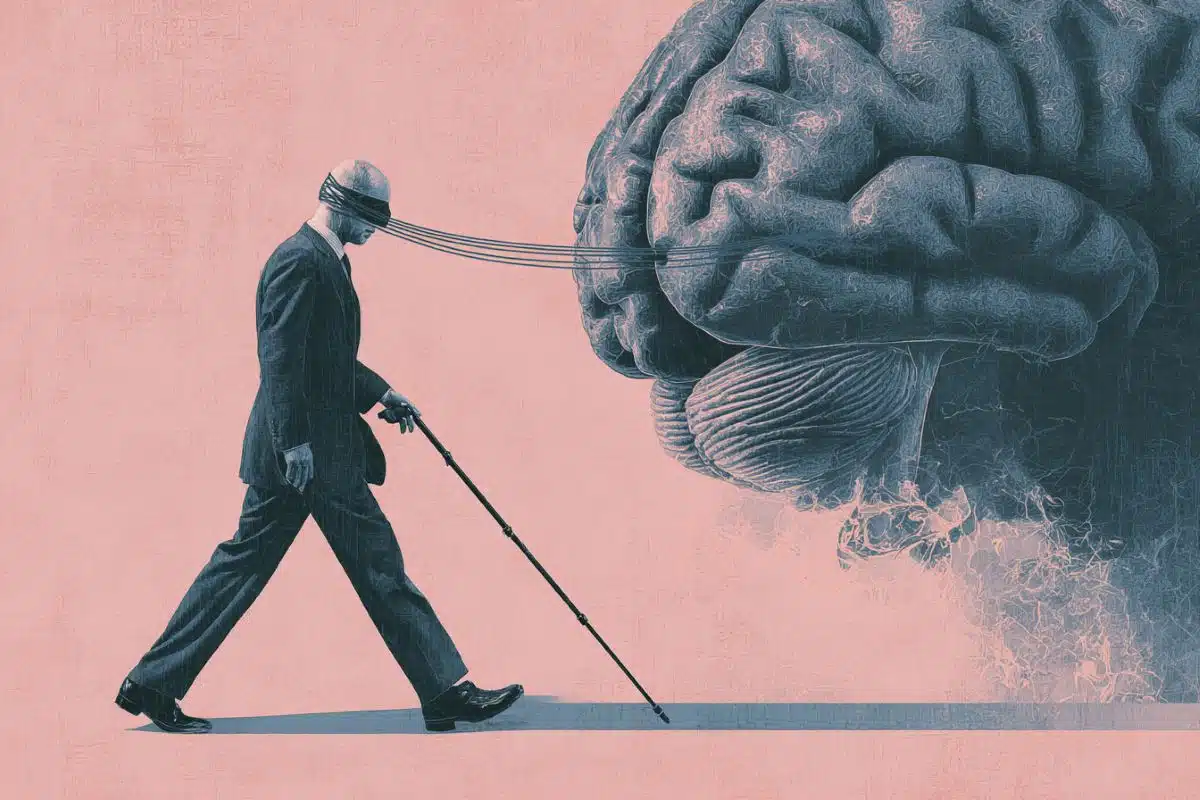
Summary: A new study has deciphered how the human brain dynamically remodels its neural circuitry to maintain walking stability when visual input is compromised. By using specialized occlusion foils to simulate low vision in healthy adults, researchers combined visual evoked potentials (PR-VEPs) and resting-state fMRI (rs-fMRI) to track brain changes immediately following locomotion.
The data reveals that the brain compensates for degraded sight through a dual-action survival strategy: rigidly activating primary sensorimotor loops while aggressively boosting functional connectivity between motor execution and higher-order cognitive control networks. This discovery provides a concrete neurological blueprint for designing advanced, personalized multimodal mobility rehabilitation for low-vision individuals.
Key Facts
- The Low-Vision Simulation: Investigators utilized Bangerter™ occlusion foils to model stable, low-quality visual input, confirming a significant reduction in signal-processing efficiency along primary visual pathways.
- Paracentral Lobule Rebound: Under normal sight, walking naturally downregulates the amplitude of low-frequency fluctuations (ALFF) in the right paracentral lobule compared to rest. When vision is blocked, this localized neural activity slightly rebounds, signaling a rapid, adaptive functional adjustment.
- Rigid Path Activation: Navigating with impaired vision triggers widespread baseline activation across multiple interconnected sensorimotor pathways, including the bilateral calcarine gyrus, middle temporal gyrus, supplementary motor area (SMA), cuneus, precentral gyrus, and cerebellar lobule VI.
- The Core Compensatory Switch: The most critical neuroplastic adjustment discovered was a powerful spike in functional connectivity between the right precentral gyrus (motor execution) and the middle frontal gyrus (cognitive control), serving as the brain’s main workaround for missing sight.
- Clinical Translation Matrix: The study advocates for a shift toward visual-somatosensory multimodal integrated training, actively stimulating these target pathways to build personalized, brain-level rehabilitation programs for low-vision populations.
Source: Chinese Medical Journal
Vision acts as the navigation radar for human locomotion, transmitting environmental information to the brain and regulating motor decisions through sensorimotor integration. When visual input is impaired, how does the brain maintain walking stability via functional remodeling?
Deciphering this neural mechanism can provide a brand-new brain function regulation approach for motor rehabilitation in low-vision populations.
The present study adopted Bangerter™ occlusion foils to simulate visual impairment, combined with pattern-reversal visual evoked potentials (PR-VEPs) and resting-state functional magnetic resonance imaging (rs-fMRI). It comparatively analyzed the visual electrophysiological characteristics and post-walking brain function changes of healthy young adults under normal vision and visual occlusion conditions.
This study was published in Volume 139, Issue 06 on March 20, 2026, in the Chinese Medical Journal.
The results demonstrated that the simulated visual impairment significantly reduced the signal-processing efficiency of the visual pathway, verifying the stability of the low-quality visual input model. Further rs-fMRI analysis revealed that the amplitude of low-frequency fluctuations (ALFF) in the right paracentral lobule decreased after walking under normal vision compared with the resting state. In contrast, the ALFF of this region slightly rebounded after walking under visual occlusion, reflecting the adaptive adjustment of local brain functional activities.
Meanwhile, walking activated functional connectivity in multiple sensorimotor pathways that support basic locomotion. These pathways included the bilateral calcarine and middle temporal gyrus, bilateral supplementary motor area and right cuneus, as well as bilateral precentral gyrus and right cerebellar lobule VI.
Most crucially, visual occlusion further strengthened the functional connectivity between the right precentral gyrus and middle frontal gyrus, which may serve as the core compensatory mechanism to make up for insufficient visual input.
The findings suggest that the brain achieves walking function compensation under low-quality visual input through a strategy of rigid activation of sensorimotor pathways combined with targeted enhancement of local functional connectivity.
This study provides a new way to enhance motor rehabilitation in low-vision populations. In the future, we can adopt visual-somatosensory multimodal integrated training. This training would be designed to strengthen the functional connectivity of key brain regions, such as the right precentral gyrus and middle frontal gyrus. On this basis, we will develop personalized motor rehabilitation programs for low-vision patients at the brain function level.
Funding information: This work was supported by a grant from the National Natural Science Foundation of China (grant number: 81600760).
Key Questions Answered:
A: Your eyes are continuously streaming real-time spatial and environmental data directly into your brain, which processes this visual information to regulate split-second motor adjustments. This seamless sensorimotor integration acts as an internal radar. When that radar is suddenly blinded or degraded, the brain loses its primary mapping tool and is forced to structurally remodel how it processes movement to keep you upright and stable.
A: This specific link is the crown jewel of the study’s findings. The precentral gyrus is primarily responsible for physically executing motor movements, while the middle frontal gyrus handles higher-level executive cognitive functions and decision-making. When sight fails, the brain hooks these two regions together in an aggressive compensatory handshake, essentially relying on conscious cognitive control to carefully guide and steady mechanical stepping.
A: Currently, a lot of mobility rehabilitation focuses purely on physical practice and external cues. This study allows us to design therapy from the brain level downward. By using targeted visual-somatosensory multimodal training—like combining tactile or balance exercises with residual visual inputs—clinicians can purposefully fire up and reinforce the precentral-to-frontal pathways, training the brain to rewire itself for maximum stability faster.
Editorial Notes:
- This article was edited by a Neuroscience News editor.
- Journal paper reviewed in full.
- Additional context added by our staff.
About this visual neuroscience research news
Author: Tingting Yang
Source: Chinese Medical Journal
Contact: Tingting Yang – Chinese Medical Journal
Image: The image is credited to Neuroscience News
Original Research: Open access.
“Resting-state functional magnetic resonance imaging study on the effects of visual status on walking-related brain functions in healthy young adults” by Mingxin Ao, Ruilan Dai, Xiaoming Shi, Yunan Zhou, Mingxuan Gao, and Yingfang Ao. Chinese Medical Journal
DOI:10.1097/CM9.0000000000004040
Abstract
Resting-state functional magnetic resonance imaging study on the effects of visual status on walking-related brain functions in healthy young adults
Background:
Visual input supports locomotion through sensorimotor integration. However, the neural mechanisms underlying how the brain adapts to degraded vision are not well understood. This study investigated the effects of visual occlusion on interactions between regions within the sensorimotor network.
Methods:
Twelve healthy young adults (8 males, 4 females; mean age 24.0 ± 2.1 years) were recruited from the Department of Ophthalmology at Peking University Third Hospital between December 2024 and September 2025. Pattern-reversal visual evoked potentials were recorded under both normal vision and visual occlusion condition (Snellen 20/60 acuity).
We acquired resting-state functional magnetic resonance imaging (rs-fMRI) data to calculate the amplitude of low-frequency fluctuations (ALFF) and seed-based functional connectivity (FC) focused on visuomotor integration regions. A one-way repeated-measures analysis of variance was conducted with three within-subject conditions: seated rest, level walking with normal vision, and level walking with visual occlusion.
Results:
Stimuli consisted of checkerboard patterns with large (1°) and small (15′) checks. Under 1° visual stimulation, visual occlusion prolonged binocular P100 latency (117.00 ± 8.55 ms vs. 111.81 ± 5.12 ms; 116.78 ± 9.79 ms vs. 110.96 ± 4.28 ms; all P <0.05) and reduced N75–P100 amplitude (5.798 ± 2.372 μV vs. 8.613 ± 3.949 μV; 6.230 ± 2.459 μV vs. 7.453 ± 2.692 μV, all P <0.05).
For 15′ stimulation, occlusion decreased both binocular N75–P100 (5.935 ± 3.500 μV vs. 10.794 ± 5.249 μV; 3.991 ± 1.585 μV vs. 10.361 ± 3.143 μV, all P <0.001) and P100–N135 amplitudes (6.218 ± 3.516 μV vs. 12.499 ± 4.236 μV; 4.427 ± 2.218 μV vs. 10.767 ± 4.904 μV, all P <0.001). Rs-fMRI analysis showed reduced ALFF in the right paracentral lobule after walking (peak Montreal Neurological Institute [MNI] coordinates: 3, –39, 66; P <0.001, F = 14.009).
Walking activated multiple visuomotor pathways (all P <0.001), including the bilateral calcarine and middle temporal gyri, the right calcarine and middle frontal gyri, the bilateral supplementary motor area and right cuneus, and the bilateral precentral gyrus and right cerebellar lobule VI. The visual occlusion strengthened FC between the right precentral and the right middle frontal gyri (peak MNI: 27, 57, 27; F = 16.456, P <0.001).
Conclusions:
Basic visuomotor pathways demonstrate consistent activation to maintain locomotion. Increased functional connectivity between the right precentral and middle frontal gyri serves as a compensatory mechanism for reduced visual input.


