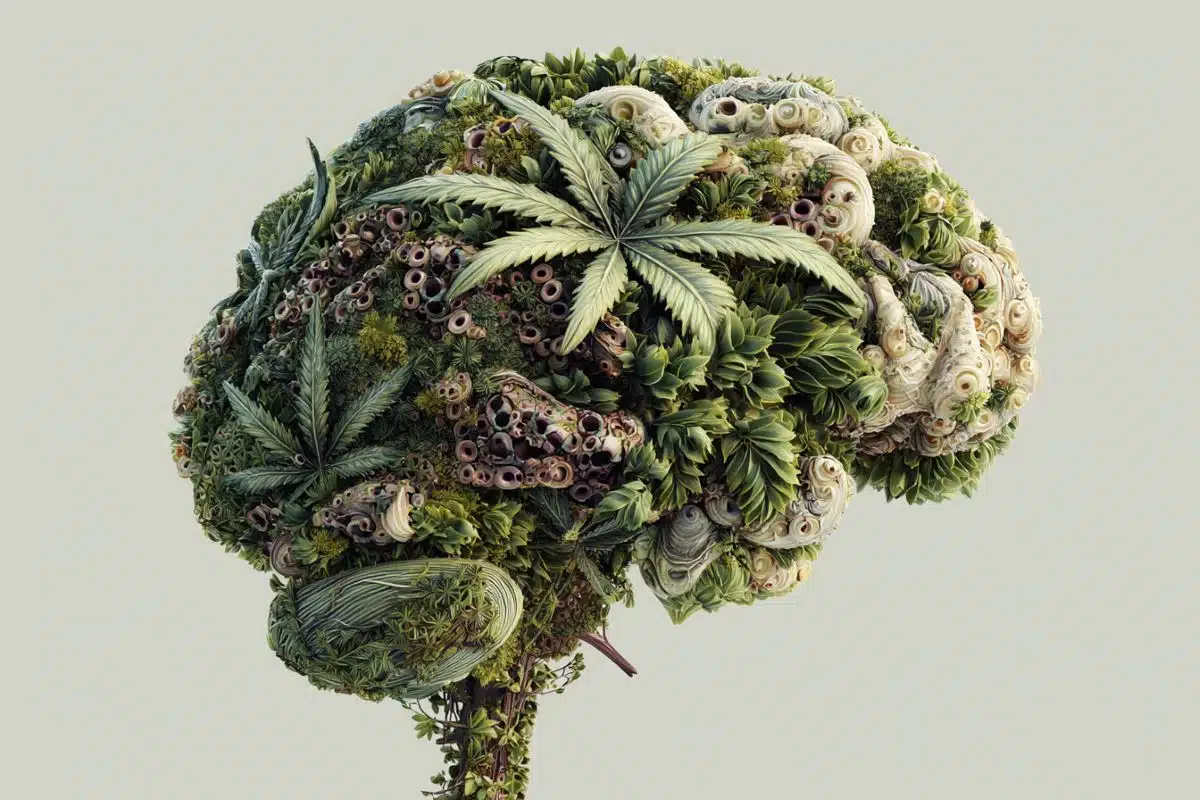
Summary: Does cannabis just make you forgetful, or does it actually change what you “remember”? A new study reveals that THC doesn’t just blur memories—it reshapes them.
In one of the most comprehensive looks at cannabis and cognition to date, researchers found that intoxicated participants were significantly more likely to “recall” words that were never there and struggled with “prospective memory”—the ability to remember tasks they needed to do in the future. Surprisingly, there was little difference between those who took 20mg and 40mg of THC, suggesting that even moderate doses cause broad disruptions across nearly every memory system.
Key Facts
- The False Memory Glitch: THC significantly increases “false memories.” Participants often firmly recalled hearing words that were never presented during tests.
- Source Confusion: Cannabis makes it harder to identify the “source” of information, making it difficult to distinguish if a fact came from a reliable news site, a conversation, or a random social media post.
- Prospective Memory Loss: Being high severely impairs the ability to remember to do things later, such as attending a meeting, taking medication, or stopping at the store.
- Broad Impact: The study tested seven different memory domains; THC caused significant impairment in 15 of the 21 specific measures used.
- Dosage Plateaus: Performance was equally poor for participants at both 20mg and 40mg of THC, indicating that higher doses don’t necessarily lead to linearly worse memory—the disruption happens early.
Source: Washington State University
Smoking cannabis can do more than blur memories. It can reshape them.
A new Washington State University study found that people who consumed THC were more likely to recall words that were never presented and struggled with everyday tasks such as remembering to do something later.
Published in the Journal of Psychopharmacology, the study is one of the most comprehensive looks yet at how cannabis affects memory. The findings suggest cannabis can impair not only simple recall, such as remembering a list of words, but also forms of memory people rely on in daily life, like remembering appointments, keeping track of conversations, or recalling where information came from.
Researchers were also surprised to find no meaningful differences between participants who consumed 20 milligrams of THC and those who consumed 40 milligrams, suggesting even moderate doses may cause substantial disruptions.
“Most previous studies have only looked at one or two types of memory, like recalling lists of words,” said Carrie Cuttler, senior author of the study and an associate professor of psychology at WSU. “This is the first study to comprehensively examine many different memory systems at once, and what we found is that acute cannabis intoxication appears to broadly disrupt most of them.”
To explore those effects, Cuttler and co-author Ryan McLaughlin, an associate professor in the Department of Integrative Physiology and Neuroscience at WSU, recruited 120 regular cannabis users and randomly assigned them to vaporize placebo cannabis, 20 milligrams of THC, or 40 milligrams of THC in a double-blind experiment. Participants then completed about an hour of tests measuring verbal, visuospatial, prospective, source, false, episodic content, and temporal order memory.
Participants who consumed cannabis performed significantly worse than the placebo group on most measures. Overall, cannabis affected the majority of the memory tests, with significant differences appearing in 15 of the 21 measures.
The strongest impacts appeared in false memory and source memory, systems that help people accurately recall information and identify where it came from. In one test, participants heard lists of related words but not the key word tying them together. Later, those who had consumed cannabis were more likely to “remember” related and unrelated words even though they had never been presented.
“I found it was really common for people to come up with words that were never on the list,” Cuttler said. “Sometimes they were related to the theme of the list, and sometimes they were completely unrelated.”
Researchers also found cannabis users had more difficulty remembering the source of information they had learned earlier. Problems with source memory can make it harder to distinguish whether information came from a reliable source, a conversation, or something seen online.
Such disruptions could matter in situations where accurate recall is important, such as eyewitness interviews where memory errors or suggestive questions can influence how events are remembered.
The study also found impairments in prospective memory, the ability to remember to carry out tasks in the future, such as taking medication, attending a meeting, or stopping at the store on the way home.
“These are things we rely on constantly in our day-to-day lives,” Cuttler said. “If you have something you need to remember to do later, you probably don’t want to be high at the time you need to remember to do it.”
One type of memory, episodic content memory, or the ability to remember personally experienced events, did not show a significant effect. Cuttler said more research is needed before drawing firm conclusions in that area.
The research comes as cannabis use becomes increasingly common in states like Washington. Despite growing legalization across North America, many of the drug’s short-term cognitive effects remain poorly understood because cannabis is still classified as a Schedule I substance under federal law.
“We’re living in a state where cannabis use is very common, but there’s still a lot we don’t know about its acute effects,” Cuttler said. “The goal is to help people make informed decisions about the risks and benefits.”
Key Questions Answered:
A: This is called a “False Memory.” THC affects how your brain categorizes information. In the study, people hearing a list of related words (like “bed, pillow, slumber”) would confidently swear they also heard the word “sleep,” even though it was never said. Your brain fills in the gaps with what “makes sense,” even if it’s fiction.
A: Probably not. The researchers found that people who took 20mg of THC (a moderate dose) were just as impaired as those who took 40mg. The “memory blur” hits a ceiling relatively quickly, meaning even a moderate session can mess with your ability to keep track of conversations or remember appointments.
A: It’s “Source Memory.” If you can’t remember where you heard something, you lose the ability to judge if that information is trustworthy. This can lead to spreading misinformation or misremembering critical details in high-stakes situations, like eyewitness accounts or legal discussions.
Editorial Notes:
- This article was edited by a Neuroscience News editor.
- Journal paper reviewed in full.
- Additional context added by our staff.
About this cannabis use and memory research news
Author: William Ferguson
Source: Washington State University
Contact: William Ferguson – Washington State University
Image: The image is credited to Neuroscience News
Original Research: Open access.
“Mapping the acute effects of cannabis on multiple memory domains: A randomized, double-blind, placebo-controlled study” by Carrie Cuttler and Ryan J. McLaughlin. Journal of Psychopharmacology
DOI:10.1177/02698811261416079
Abstract
Mapping the acute effects of cannabis on multiple memory domains: A randomized, double-blind, placebo-controlled study
Background:
One of the most robust acute effects of cannabis is impaired memory. Although memory is not a unitary construct, most cannabis research has focused on verbal memory. Less is known about its effects on more ecologically valid domains of memory, such as prospective and temporal order memory.
Methods:
We conducted a randomized, double-blind, placebo-controlled study to map out which aspects of memory are impaired following acute cannabis use. Cannabis-using participants (N = 120) were randomly assigned to vaporize flower containing 0 mg Δ-9-tetrahydrocannbinol (THC; placebo), 20 mg THC (moderate dose) or 40 mg THC (high dose) before completing a battery of memory tests, including tests of verbal memory (immediate, delayed, short-term, working), visuospatial memory (immediate, delayed, short-term, working), prospective memory (event-cued, time-cued), source memory, false memory, episodic content memory, and temporal order memory.
Results:
Relative to placebo, cannabis increased susceptibility to false memories and detrimentally impacted verbal memory (immediate, delayed, working), visuospatial memory (immediate, delayed), event-cued prospective memory, source memory, and temporal order memory. There were no significant differences between the moderate and high dose groups.
Conclusion:
This is the first study to detect acute effects of cannabis on prospective memory and temporal order memory, which is important because these tests better reflect everyday memory and predict daily functioning. Collectively, these results indicate that acute cannabis use has broad detrimental effects on most domains of memory rather than selectively impairing a limited number of these domains.