Summary: A new study reports that a brain complexity measure, calculated by recording EEG signals after a magnetic stimulation pulse, is significantly reduced in people with Alzheimer’s disease. This method, previously used to detect consciousness in coma patients, could provide a new way to evaluate the integrity of conscious processing in dementia.
Source: Boston University School of Medicine
Key Facts:
- New Metric: The study utilized the “perturbation complexity index-state transitions” (PCI-ST), a measure derived from Transcranial Magnetic Stimulation (TMS) combined with EEG.
- Reduced Complexity: Brain complexity in response to stimulation was lower in Alzheimer’s patients compared to healthy aging adults.
- Conscious vs. Unconscious: The findings align with the clinical observation that Alzheimer’s impairs conscious processes (like episodic memory) while often sparing unconscious ones (like muscle memory).
- Study Participants: The research compared 28 participants with Alzheimer’s disease against 27 healthy controls.
As individuals with Alzheimer’s disease (AD) move from the mild cognitive impairment stage to moderate and severe dementia, complex awareness deteriorates although lower-level sensory awareness is relatively maintained. Most conscious processes also become more impaired as AD progresses, including attention, working memory, episodic memory and executive function, while unconscious processes, such as procedural or muscle memory, operant conditioning (behavior controlled by consequences), and priming (where the experience of stimulus affects the processing of a similar stimulus) are relatively spared. However, as damage spreads across different cortical regions in dementias such as AD, corresponding aspects of conscious awareness becomes diminished and then lost.
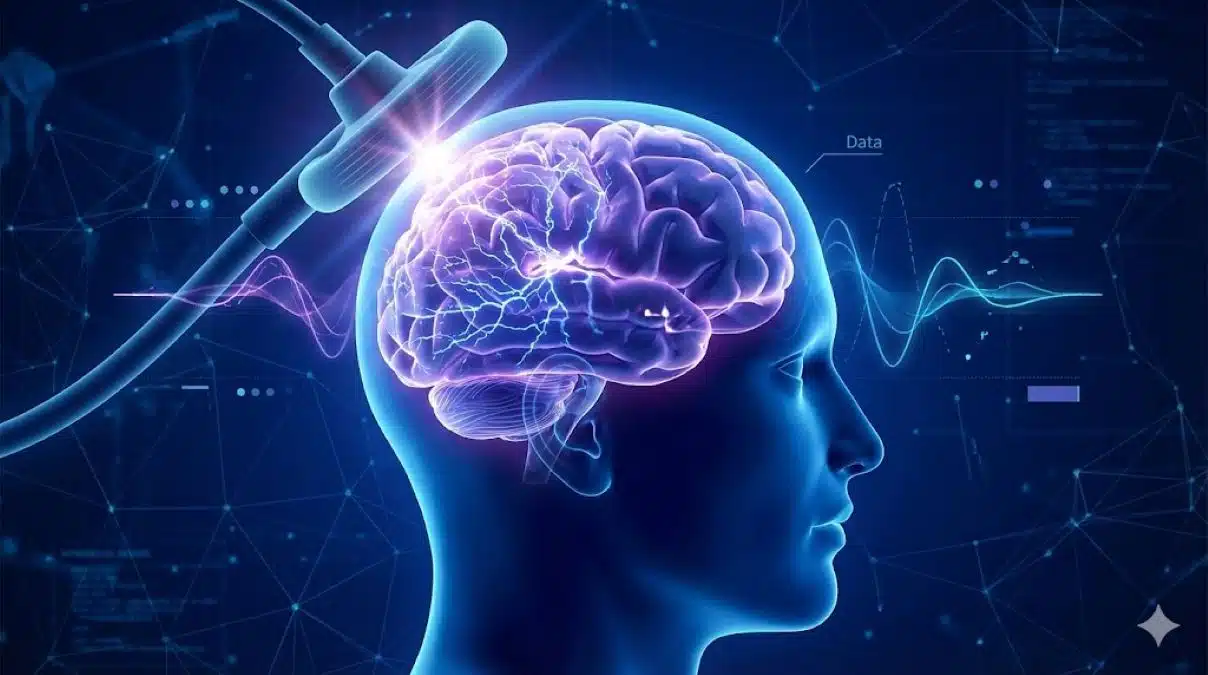
One measure of brain complexity, the perturbation complexity index-state transitions (PCI-ST), can be calculated by recording EEG signals following a transcranial magnetic stimulation pulse. This measure has previously been used to determine when people are in coma versus in a minimally conscious state. A new study asks whether this same measure could be used to evaluate the integrity of conscious processing in people with AD.
According to researchers from Boston University Chobanian & Avedisian School of Medicine, the answer is yes. They found that brain complexity in response to magnetic stimulation was reduced in people with AD compared with people aging normally.
“Despite their impaired conscious memory, individuals with Alzheimer’s disease may be able to use intact implicit, unconscious forms of memory, such as procedural memory (often termed ‘muscle memory’) to continue their daily routines at home. When they travel, however, their home routines are not helpful and their dysfunctional conscious memory can lead to disorientation and distress,” explains senior author Andrew Budson, MD, professor of neurology at the school.
The researchers assessed 28 participants with AD and 27 healthy controls, measuring their cognition and disease severity. They found lower PCI-ST in the AD group compared to controls across both the motor cortex and parietal stimulation sites, suggesting that PCI-ST may reflect the impaired conscious cognitive processes and functional capacity seen in AD.
“This research opens the avenue for future studies in individuals with cortical dementia to examine the relationship between conscious processes, global measures of consciousness, and their underlying neuroanatomical correlates, in addition to enhancing our understanding of dementia and suggesting possible therapeutic strategies,” adds Budson who also is chief of Cognitive & Behavioral Neurology and director of the Center for Translational Cognitive Neuroscience at the Veterans Affairs (VA) Boston Healthcare System.
Lead author Brenna Hagan, a Behavioral Neuroscience PhD candidate at the school, points out that pharmacologic therapies, including donepezil (Aricept) and memantine (Namenda) alter neurotransmitters that can improve conscious abilities in those with Alzheimer’s disease. Additionally, non-pharmacological interventions can take advantage of relatively preserved procedural memory and other unconscious forms of memory to strengthen habits that may lead to improved quality of life.
Editorial Notes
- This article was edited by a Neuroscience News editor.
- Journal paper reviewed in full.
- Additional context added by our staff.
About this Alzheimer’s research news
- Author: Gina DiGravio
- Source: Boston University School of Medicine
- Contact: Gina DiGravio – Boston University
- Image: The image is credited to Neuroscience News
Original Research:
Brenna Hagan, Stephanie S Buss, Peter J Fried, Mouhsin M Shafi, Katherine W Turk, Kathy Y Xie, Brandon Frank, Brice Passera, Recep Ali Ozdemir, Andrew E Budson, Evaluating Alzheimer’s disease with the TMS-EEG perturbation complexity index, Neuroscience of Consciousness, Volume 2026, Issue 1, 2026, niaf062, https://doi.org/10.1093/nc/niaf062
Funding:
This work resulted from data collected through NIH (R01 AG060987) and the BrightFocus Foundation (A2021288S). B.H. is a PhD student, and R.A.O. and K.X. are research fellows. S.B. is funded in part by NIA (NIH; 1K23AG068384), the Alzheimer’s Association (2019-AACSF-643094), and an internal BIDMC SPARK award. P.J.F. is funded in part by BrightFocus (A2021288S). M.M.S. is funded in part by NIH (R01 AG060987, MH115949, EB032820; P01 AG031720). K.W.T. is funded in part by the Veterans Health Administration (IK2 CX002065) and NIH/NIA (P30 AG072978). A.E.B. is funded in part by the Veterans Health Administration (I01 CX002400) and NIH/NIA (P30 AG072978). B.F. is funded in part by the Veterans Health Administration (IK2 CX002625).
This work resulted from data collected through NIH (R01 AG060987) and the BrightFocus Foundation
Abstract:
The Perturbation Complexity Index—State Transitions (PCIST) measures the complexity of the brain’s response to transcranial magnetic stimulation (TMS) using electroencephalography (EEG) and is sensitive to consciousness, such as minimally conscious states. Individuals with early-stage Alzheimer’s disease (AD) show dysfunction of conscious processes, such as attention, working memory, episodic memory, and executive function, with relatively spared unconscious processes, such as procedural memory, operant conditioning, and priming. We sought to test the hypothesis that PCIST would be reduced in AD compared to healthy aging. We assessed 28 participants with AD and 27 healthy controls (HC), measuring cognition with the Montreal Cognitive Assessment (MoCA) and disease severity with the Clinical Dementia Rating scale—Global (CDR-Global) and Sum of Boxes (CDR-SB). Results indicated lower PCIST in the AD group (M = 20.1) compared to controls (M = 28.2) across both the motor cortex (M1) and inferior parietal lobule (IPL) TMS stimulation sites, suggesting that PCIST may reflect the impaired conscious cognitive processes and functional capacity seen in AD. We therefore speculate that cortical dementias involve alterations in cortical complexity that may relate to deterioration of their conscious processes. This research opens the avenue for future studies in individuals with cortical dementia to examine the relationship between conscious processes, global measures of consciousness, and their underlying neuroanatomical correlates, in addition to enhancing our understanding of dementia and suggesting possible therapeutic strategies.