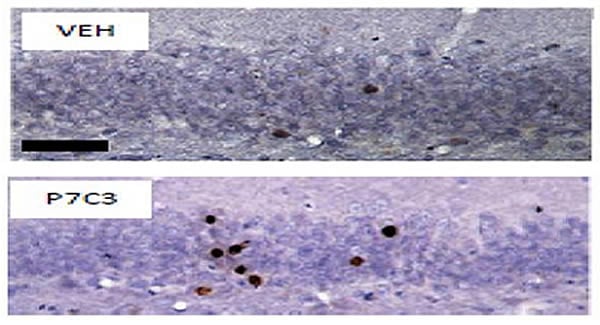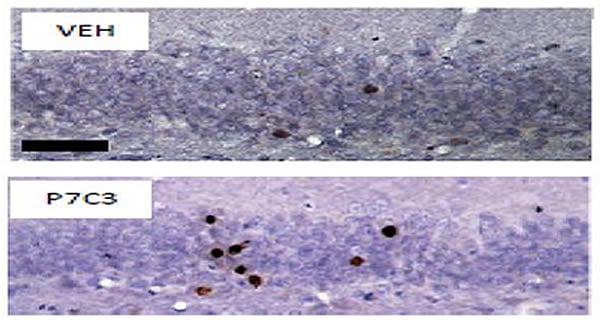
Scientists at UT Southwestern have found that the chemical P7C3 is capable of promoting new neuronal growth within the dentate gyrus of mice and aged rats. P7C3 and its derivatives have been shown to help new neurons grow in the hippocampus and aid in learning and memory. These findings are very promising for Alzheimer’s disease research, age related cognitive decline treatments and learning and memory research.
A chemical to make brain cells grow
Scientists have identified a chemical that makes new neurons grow. The substance works specifically in a part of the brain that is integral to learning and memory.
The discovery, made after researchers systematically and painstakingly infused each of 1,000 different chemicals into the brains of live mice, could point the way to a new type of neuroprotective drug for people with Alzheimer’s or other neurodegenerative diseases, according to the report in the July 9th issue of the journal Cell, a Cell Press publication.
“We really didn’t know if the screen would turn up a favorable compound or not,” said Steven McKnight of the University of Texas Southwestern. “It was blind luck.”
“Our chances were slim,” added Andrew Pieper, also of UT Southwestern. “But we knew if we did find something, we would already have evidence that it worked in a living animal.” Promising candidates landed in cell culture too often don’t pan out.
McKnight and Pieper were inspired by evidence that the mammalian brain continues to add new neurons into adulthood. The question was whether there might be a way to encourage the growth of those cells in ways that could be beneficial.
The researchers’ initial drug screen in mice turned up eight contenders that appeared to support the formation of neurons specifically in a brain region (called the dentate gyrus) known to sprout new neurons in adulthood. Of those eight chemical candidates, they focused their attention on one called P7C3, based on its other favorable drug properties.
To find out just how well P7C3 might work, the researchers put it to the test in mice carrying a mutation that renders them almost completely incapable of producing new neurons in the critical dentate gyrus region.
“These mice are bad at making new neurons,” McKnight said. “The question was: Can you fix that? And the answer to that was yes.”
Not only did new neurons form, but electrophysiological recordings also showed that processing in the dentate gyrus had been restored. “Sure enough, we had evidence that you can actually create new neurons that work,” McKnight said.
Prolonged treatment of aged rats with P7C3 also enhanced the birth of new neurons. “Aged rats normally show a decline in neurogenesis associated with an inability to form new memories and learn tasks,” Pieper explained.
In their study, rats treated with P7C3 each day showed evidence of an increase in the formation of newborn neurons and significant improvements in their ability to swim to the location of a missing platform, a standardized test of learning and memory in rats.
The key to the treatment’s success is the protection of newborn neurons, the researchers report. In fact, they explained, the normal process by which newborn neurons are incorporated into the brain as mature cells is a long and perilous one.
“It takes a long time – two to four weeks — from the birth of a new neuron until it becomes functional,” McKnight said. “Most of them die along the way.” P7C3 essentially seems to give newborn neurons better odds.
Notably, they say that two other drugs (Dimebon and Serono compounds) – both of which bear structural similarities to P7C3 –also encourage the growth of new neurons. It’s tempting to think that all three compounds work in the same way.
In fact, Dimebon first came to the attention of researchers based on anecdotal reports by Russian physicians that the drug may ameliorate the symptoms of age-related cognitive decline. Unfortunately, unpublished reports from a phase 3 clinical trial have since failed to provide evidence that the drug could stave off the memory loss that comes with Alzheimer’s disease.
In light of the new findings, it may be worth another look. “The speculative idea that these chemicals share a common mode of action will only be rigorously tested upon identification of their molecular target(s),”. Determining the molecular target of P7C3 is a question that the researchers are turning their sights on next.
The researchers include Andrew A. Pieper, UT Southwestern Medical Center, Dallas, TX; Shanhai Xie, UT Southwestern Medical Center, Dallas, TX; Emanuela Capota, UT Southwestern Medical Center, Dallas, TX; Sandi Jo Estill, UT Southwestern Medical Center, Dallas, TX; Jeannie Zhong, UT Southwestern Medical Center, Dallas, TX; Jeffrey M. Long, UT Southwestern Medical Center, Dallas, TX; Ginger L. Becker, UT Southwestern Medical Center, Dallas, TX; Paula Huntington, UT Southwestern Medical Center, Dallas, TX; Shauna E. Goldman, UT Southwestern Medical Center, Dallas, TX; Ching-Han Shen, UT Southwestern Medical Center, Dallas, TX; Maria Capota, UT Southwestern Medical Center, Dallas, TX; Jeremiah K. Britt, UT Southwestern Medical Center, Dallas, TX; Tiina Kotti, UT Southwestern Medical Center, Dallas, TX; Kerstin Ure, UT Southwestern Medical Center, Dallas, TX; Daniel J. Brat, Emory University School of Medicine, Atlanta, GA; Noelle S. Williams, UT Southwestern Medical Center, Dallas, TX; Karen S. MacMillan, UT Southwestern Medical Center, Dallas, TX; Jacinth Naidoo, UT Southwestern Medical Center, Dallas, TX; Lisa Melito, UT Southwestern Medical Center, Dallas, TX; Jenny Hsieh, UT Southwestern Medical Center, Dallas, TX; Jef De Brabander, UT Southwestern Medical Center, Dallas, TX; Joseph M. Ready, UT Southwestern Medical Center, Dallas, TX; and Steven L. McKnight, UT Southwestern Medical Center, Dallas, TX.
Contact: Cathleen Genova
Source: Cell Press