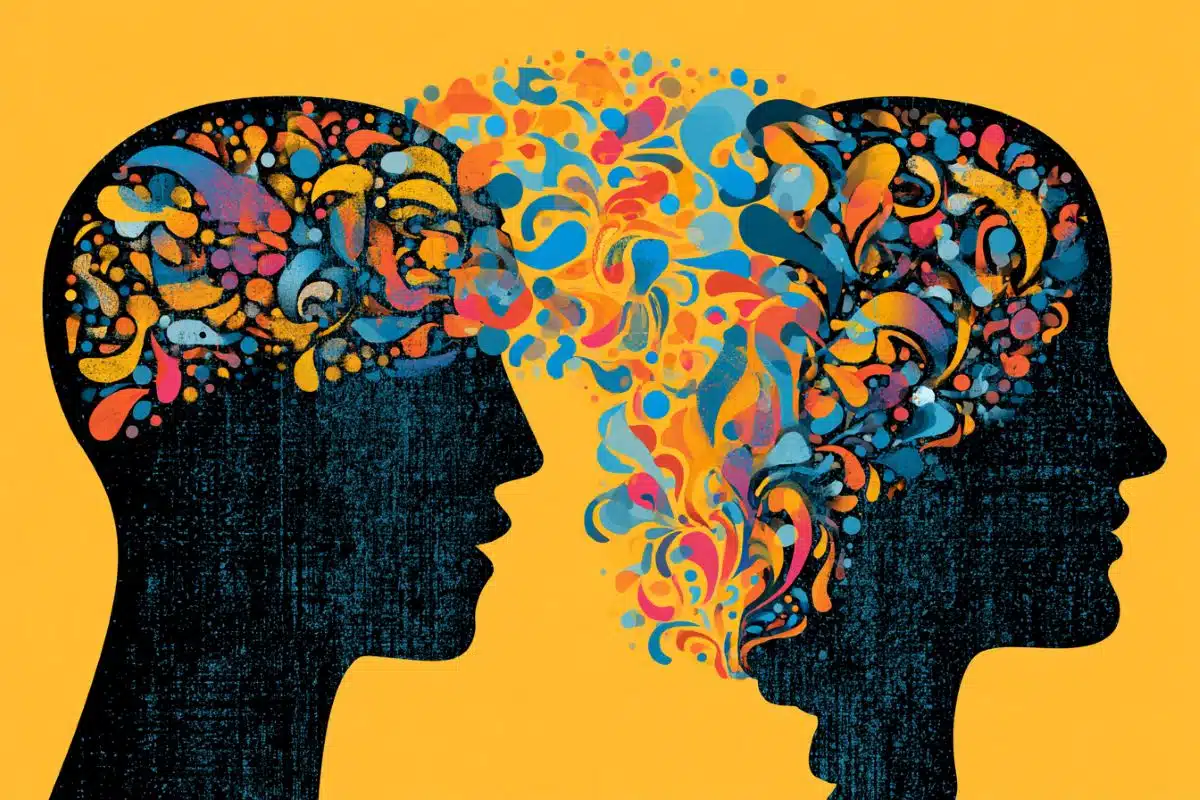
Summary: A new study challenged long-held human intuitions regarding cognitive focus, proving that the brain actively filters out and suppresses negative spoken language before it ever reaches conscious awareness. Bypassing traditional visual tracking setups, the research team engineered a specialized auditory task to evaluate how emotional language impacts the brain’s internal gatekeeping systems.
While conscious intuition predicts that threatening or insulting phrases automatically grab human attention, the empirical data revealed that participants engaged in a primary task were significantly less likely to notice negative spoken words compared to neutral ones, unmasking a systemic nonconscious bias designed to protect limited cognitive resources from harmful external inputs.
Key Facts
- Challenging Conscious Intuition: In daily life, individuals assume that emotionally charged or disturbing language is impossible to ignore. The Hebrew University research team proved that the reverse is true at the nonconscious level, showing that the brain actively screens out negative vocalizations to preserve immediate task performance.
- Overcoming the Auditory Time Deficit: Most historical nonconscious processing research uses vision because scientists can flash an image for a millisecond to hide it. Speech presents a massive logistical hurdle because spoken words unfold slowly over time. This trial successfully used a continuous stream of meaningless auditory pseudowords to isolate pre-conscious language selection.
- The Cognitive Cost Protection Model: Researchers hypothesized that consciously experiencing negative or distressing information carries a high psychological and operational cost. The nonconscious mind acts as an automated security filter, opting not to pay this price if the random background words threaten to disrupt or slow down primary behavioral goals.
- Persistence Across Varying Effort Grades: To test if this suppression was a byproduct of exhaustion or high effort, the team repeated the experiment across multiple groups of Hebrew-speaking adults. The nonconscious filtering trend remained completely unchanged, working effectively whether the participant was executing a complex visual matching puzzle or a highly basic task.
- The Clinical Gatekeeper Hypothesis: Chen notes that this protective filter represents the baseline standard for healthy, well-adjusted populations. The team hypothesizes that this gatekeeping system may function differently or fail entirely in clinical populations managing anxiety disorders, phobias, or post-traumatic stress disorder (PTSD), where negative stimuli routinely shatter conscious focus.
- Targeted Experimental Methodology: The study tracked the behavioral responses of 101 adults who were instructed to monitor a digital screen to determine if a floating figurine matched a previous image. While their visual attention was locked, a stream of nonsense audio played in their headphones, occasionally interspersed with real Hebrew words carrying either negative or neutral emotional weight.
- Future Linguistic Scale-Up: Recognizing the natural limitations of isolating single vocabulary terms, the research coalition is organizing follow-up tracking projects. These upcoming trials will scale up the linguistic complexity from isolated words to natural sentences, complex stories, and noisy, multi-person listening environments to map real-world cognitive gatekeeping.
Source: APS
We tend to assume that emotionally charged words are more likely to grab our attention. An insult shouted across a crowded room or a disturbing phrase overheard on television can seem impossible to ignore.
But a new study published in Psychological Science suggests the opposite may happen before words reach conscious awareness.
Researchers at the Hebrew University of Jerusalem found that when people were focused on a visual task, they were less likely to consciously notice negative spoken words than neutral ones. The findings offer new insight into how the brain determines which information enters conscious awareness and which remains outside it.
“This study is a nice example of how our conscious intuitions regarding what we notice are not always what our unconscious is doing,” said lead author Gal R. Chen, a doctoral candidate in psychology at the Hebrew University of Jerusalem.
Although much of the brain’s processing occurs outside of conscious awareness, scientists know little about how information is selected to enter consciousness, particularly in hearing. Insights into this process could explain how nonconscious information might influence an individual’s thoughts, feelings, and behavior.
Much of what scientists know about nonconscious processing comes from studies of vision in which researchers briefly flash images that participants are unable to consciously report seeing. Speech, however, presents a different challenge because spoken words, unlike images, cannot be delivered in a split second. Researchers have therefore struggled to determine how much information the brain can process from spoken language before a person becomes aware of it.
Chen and his colleagues set out to examine whether the emotional meaning of spoken words influences their chances of reaching awareness when people are focused on another task.
In the study, 101 Hebrew-speaking adults were instructed to identify whether a figurine on a screen was identical to the one before it while listening to a stream of meaningless pseudowords. Occasionally, a real Hebrew word, either emotionally negative or emotionally neutral, was inserted into the audio stream. After hearing the word, participants were asked whether they had noticed it and completed additional tests designed to measure their awareness.
“We assumed initially that people would notice the negative stuff more because that is our conscious intuition,” Chen said. “There is a lot of data showing that when you see or hear something negative you slow down or make more mistakes.”
Instead, the opposite happened: Participants were more likely to notice the neutral words over the negative words.
“We thought it was a mistake,” Chen said. “So we repeated the study while adding new words. The results gave us the same trend: People notice negative words less.”
The effect persisted when the researchers repeated the experiment with the same visual task but a larger set of words. To examine whether the observation was specific to conditions of high effort, the researchers conducted the experiment again, but this time replaced the demanding visual task with a much easier one. Again, participants were more likely to notice neutral words over negative ones.
One possible explanation for this observation, the researchers said, is that consciously experiencing negative information is costly, and the cognitive system sometimes opts not to pay this price.
“It may be the default of the unconscious mind to suppress information that may be harmful to us,” Chen said. “If your primary task is to talk to me, random words popping up are not helpful. And if these words slow you down, the default unconscious bias might be, ‘don’t bring them around.’”
The findings may offer new avenues for studying mental health conditions. Chen speculates that future research could investigate whether the same unconscious filtering process operates differently in people with anxiety disorders, phobias, or post-traumatic stress disorder.
“The normal population notices negative words less often compared to neutral words,” Chen said. “In a clinical population, they might not have this selection bias.”
“If you think of the unconscious as a gatekeeper guarding us against things that may harm us or influence our decisions, you might ask what happens if this gatekeeper screws up,” he added.
Chen noted that the study has limitations. For example, it examined single words rather than conversations or natural speech, and it did not test highly positive or taboo words, which could produce different results. He said that future research could explore whether the same effects appear in sentences, stories, and more realistic listening environments.
For now, he said, the findings suggest that the nonconscious mind may play a larger role in shaping our everyday experiences than we realize.
Key Questions Answered:
A: Because the brain prioritizes completing your immediate goals over processing random background noise. While a conscious mind assumes it should focus on everything negative, the unconscious mind treats random negative words as a costly distraction. If you are deeply focused on a task, letting a negative background word enter your consciousness would cause you to slow down and make mistakes. To prevent this performance drop, your unconscious gatekeeper blocks the word entirely.
A: By testing the phenomenon across completely different levels of mental workload. The researchers initially thought the suppression might only happen when participants were exhausted by a difficult visual matching puzzle. However, when they replaced the hard puzzle with an incredibly easy task, the results were identical: participants still consistently missed the negative words while noticing the neutral ones, proving the filter is a constant default setting.
A: By showing us what happens when the brain’s unconscious gatekeeper fails. In a healthy population, the unconscious mind successfully shields conscious focus from random negative background stimuli. Scientists suspect that in individuals with anxiety, phobias, or PTSD, this automated gatekeeping system might break down, allowing negative or threatening words to constantly breach their awareness and shatter their emotional stability.
Editorial Notes:
- This article was edited by a Neuroscience News editor.
- Journal paper reviewed in full.
- Additional context added by our staff.
About this language processing and auditory neuroscience research news
Author: Hannah Brown
Source: APS
Contact: Hannah Brown – APS
Image: The image is credited to Neuroscience News
Original Research: Open access.
“Conscious Detection of Spoken Words Depends on Their Valence” by Gal R. Chen et al. Psychological Science
DOI:10.1177/09567976261434113
Abstract
Conscious Detection of Spoken Words Depends on Their Valence
Conscious experiences appear to play a central role in human behavior, yet most neural processing occurs outside of consciousness. Understanding how the mind prioritizes information for consciousness is, therefore, crucial for theories of cognition.
Prior research has largely focused on vision, but generalization is tenuous given the vastly different characteristics of the senses—particularly for audition, which lacks foveation and cannot be intentionally stopped. We examine the affective domain, for which prioritization is not well understood. In three experiments (two preregistered), 101 Hebrew-speaking adults completed a visual task with a stream of auditory pseudowords in the background.
Occasionally a meaningful word appeared, and participants were asked about its presence. Using objective and subjective awareness measures, we found that neutral words were prioritized over negative words, regardless of task difficulty, intelligibility, and low-level features.
These findings challenge theorizing and modal intuitions, and we discuss ways in which those can be reconciled.