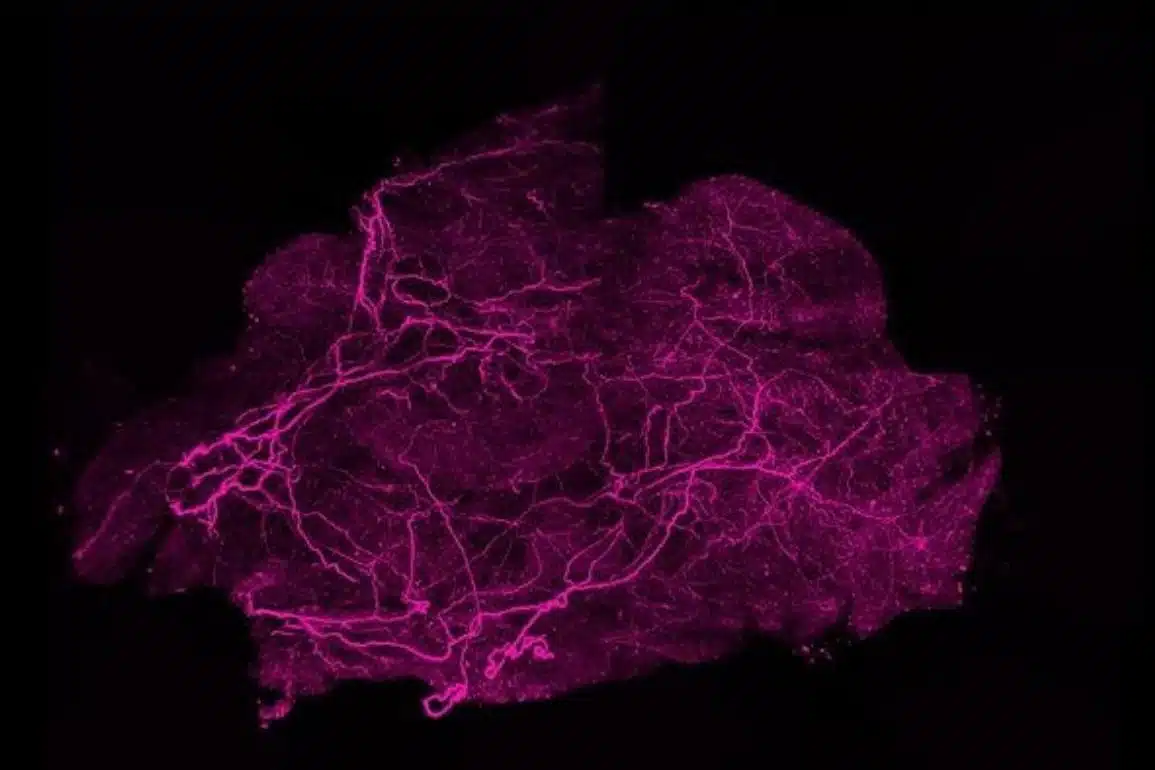
Summary: For years, the buildup of tau protein has been identified as a primary driver of Alzheimer’s disease. Now, a study has uncovered the brain’s “waste management” secret: specialized cells called tanycytes. These rare, non-neuronal cells act as a shuttle, capturing toxic tau from the cerebrospinal fluid (CSF) and dumping it into the bloodstream for disposal.
The research reveals that in Alzheimer’s patients, these tanycytes become fragmented and lose their ability to clear the “trash,” leading to the rapid accumulation of tau. This discovery shifts the focus from neurons to these structural shuttle cells as a potential new frontier for slowing neurodegeneration.
Key Facts
- The Tanycyte Shuttle: Tanycytes are primarily found in the brain’s third ventricle and are responsible for shuttling metabolic signals and toxic waste between the brain and blood.
- Degeneration in Humans: Patient tissue samples showed that tanycytes in the brains of those with Alzheimer’s were physically fragmented and showed altered gene expression compared to healthy brains.
- Tau Clearance: Using rodent and cellular models, researchers proved that healthy tanycytes are actively involved in removing tau from the brain’s internal fluids.
- Homeostasis Hub: These cells act as a communication hub between the brain and the body, maintaining the balance (homeostasis) necessary for cognitive health.
- Future Intervention: The study suggests that preserving “tanycyte health” could be a viable strategy to limit the progression of Alzheimer’s by restoring the brain’s natural clearing mechanism.
Source: Cell Press
Accumulation of the protein tau in the brain is one of the hallmarks of Alzheimer’s disease.
In a paper publishing March 5 in the Cell Press journal Cell Press Blue, researchers report a previously unknown mechanism that appears to enable the build-up of tau. The study, which employed animal and cellular models as well as patient tissues, suggests a key role for tanycytes—specialized brain cells that regulate brain-body signaling.

“Our findings reveal a previously underappreciated, disease-relevant role for tanycytes in neurodegeneration,” says corresponding author Vincent Prevot of INSERM in France. “Focusing on tanycyte health could be a way to improve tau clearance and limit disease progression.”
Tanycytes are a type of non-neuronal brain cell that are primarily found in the third ventricle of the brain. Previous research has shown that these cells play an active role in shuttling metabolic signals between the blood and the cerebrospinal fluid (CSF)—the liquid that surrounds the brain and spinal cord and acts as a communication hub for maintaining homeostasis.
In this study, the researchers sought to better understand how tanycytes clear toxic molecules such as tau to preserve brain health. They found that the brain cells carry toxic molecules out of the CSF and into the blood for disposal, and that when they don’t work properly, tau can accumulate in the brain.
“Surprisingly, we were able to show in rodent and cellular models not only that tanycytes were indeed involved in clearing tau but also that tanycytes in the brains of human Alzheimer’s patients were fragmented and had changes in gene expression related to this shuttle function,” Prevot says.
The team says these findings highlight the potential of developing interventions aimed at maintaining brain homeostasis to prevent neurodegeneration but acknowledge several challenges to targeting tanycytes as a way to develop interventions for Alzheimer’s.
One key limitation is the lack of good animal models for Alzheimer’s disease. Another is the need for larger cohorts and more longitudinal data to establish causality and define the sequence of events linking tanycyte dysfunction to tau pathology.
“Our findings provide the first evidence for structural and functional alterations in these little-known but key brain cells in human disease,” says Prevot.
Funding:
This work was supported by the European Research Council, National Institutes of Health, the Fondation pour la Recherche Médicale, and the Fondation NRJ for Neuroscience-Institut de France.
Key Questions Answered:
A: These are specialized cells that line the ventricles of your brain. Think of them as the “shuttle buses” of the brain. They pick up molecules from the fluid surrounding your brain and transport them across the blood-brain barrier to the rest of your body.
A: The study found that in Alzheimer’s patients, these cells physically break apart (fragmentation). When the shuttle bus breaks down, the “trash” (toxic tau protein) has no way to leave the brain, so it piles up and starts damaging neurons.
A: That’s the goal! By finding ways to keep tanycytes healthy and intact, we might be able to keep the brain’s waste-clearance system running, which could significantly slow down the progression of the disease.
Editorial Notes:
- This article was edited by a Neuroscience News editor.
- Journal paper reviewed in full.
- Additional context added by our staff.
About this Alzheimer’s disease research news
Author: Julia Grimmett
Source: Cell Press
Contact: Julia Grimmett – Cell Press
Image: The image is credited to Neuroscience News
Original Research: Open access.
“Tanycytic degeneration impairs tau clearance and contributes to Alzheimer’s disease pathology” by Florent Sauvé, Ricardo Martinez-Gómez, Yvon Mbouamboua, Gaëtan Ternier, Sreekala Nampoothiri, Elian Dupré, Lolie Garcia, Marie Couralet, Julie Dewisme, Thibaud Lebouvier, Clément Danis, S. Rasika, Marc Dhenain, Young-Bum Kim, Philippe Ciofi, Luc Buée, Isabelle Landrieu, Florence Pasquier, Matthieu Lilamand, Claire Paquet, Paolo Giacobini, Pascal Barbry, Claude-Alain Maurage, Ruben Nogueiras, Markus Schwaninger, and Vincent Prevot. Cell Press Blue
DOI:10.1016/j.cpblue.2026.100003
Abstract
Tanycytic degeneration impairs tau clearance and contributes to Alzheimer’s disease pathology
Alzheimer’s disease (AD) is characterized by pathological tau protein accumulation in the brain and cerebrospinal fluid (CSF) instead of timely efflux into the blood. However, the underlying mechanisms are unclear.
We show, using animal and cellular models and patient tissues, that tanycytes of the hypothalamic median eminence, which bridge the blood and CSF, are involved in tau transport and AD pathogenesis. In mice, tanycytes take up CSF-borne tau and release it into pituitary portal capillaries, where it enters the systemic circulation.
Blocking tanycytic vesicular transport blunts CSF-to-blood tau efflux and potentiates tau pathology. In patients with AD, plasma-to-CSF ratios of total and p181 tau are decreased.
Tanycytes from postmortem AD patient brains display dramatically fragmented processes and significant transcriptomic alterations by single-nucleus RNA sequencing, notably in vesicular-transport-related genes, explaining this clearance deficit.
The involvement of tanycytic dysfunction in human pathophysiology and evidence for a brain-to-blood tanycytic shuttle have far-reaching implications.