

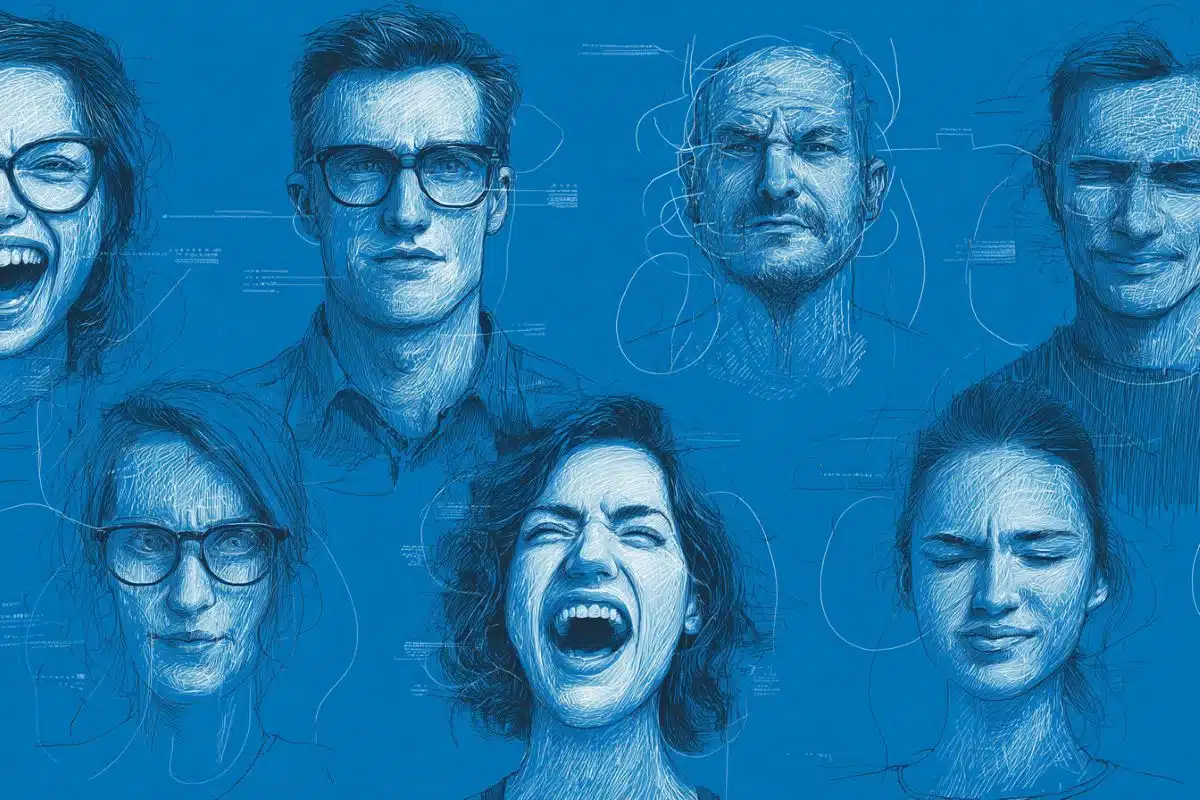
Summary: People instinctively mimic others’ facial expressions, but new research shows we do this far more with joyful faces than with sadness or anger—and that the intensity of mimicry predicts how much we trust someone. Across three experiments using EMG and behavioral tasks, participants copied smiles more readily and rated smiling individuals as more attractive, confident, and trustworthy.
Mimicking positive expressions strengthened social judgments, while anger was rarely copied and led to the lowest trust ratings. These findings highlight emotional mimicry as a key mechanism shaping first impressions and social decision-making.
Key Facts
- Joy Is Most Contagious: Participants mimicked happy expressions more than sadness or anger.
- Mimicry Builds Trust: Stronger mimicry predicted higher trust and more positive trait judgments.
- Smiling Shapes Perception: Smiling faces were consistently rated as more trustworthy and attractive.
Source: SWPS University
How does mimicry affect the way we judge other people? Whose behaviour do we imitate, and in what situations?
It turns out that we are more likely to mimic people who express joy, and we perceive those people as more attractive and more trustworthy.
Scientists, including researchers from SWPS University, published a paper on this topic in the journal Emotion.
People tend to make judgments about personalities of others based on their appearance. For example, a square jaw, high forehead, or heavy eyebrows cross-culturally connote social dominance. Another important cue based on which we attribute specific character traits to others is facial expression.
Facial expressions play a significant role in non-verbal communication and are a source of a lot of information about another person. Just by briefly observing another person’s face, we draw conclusions about their feelings and intentions.
Moreover, we tend to imitate the person we interact with, a phenomenon called emotional mimicry. This mimicry plays an important role in building social relationships because it helps to better understand others.
The role of emotional mimicry in making judgments about others
The researchers decided to investigate the role of emotional mimicry in attributing specific character traits to others. They took several factors into account: the emotional meaning of the facial expression, the context in which the evaluation takes place, and the character traits being evaluated.
The new study was conducted by Michał Olszanowski, PhD, a professor at SWPS University, Aleksandra Tołopiło, PhD, from the Center for Research on Biological Basis of Social Behavior, SWPS University Faculty of Psychology in Warsaw, and Professor Ursula Hess from the Humboldt University in Berlin.
“We hypothesized that participants would evaluate smiling people better and trust them more than people expressing anger or sadness. Additionally, we predicted that participants would be more willing to mimic expressions of happiness than sadness, while anger would be least likely emotion to be imitated.
“Importantly, it is the intensity of mimicry that will predict how much participants will trust the people they mimic. In other words, the more someone mimics another person’s smile, the more they will trust that person,” says psychologist Michał Olszanowski, PhD, a professor at SWPS University.
Traits displayed on the face
To explore the interplay between social context and emotional mimicry on trait judgments, the researchers asked participants to assess the different social characteristics of faces expressing happiness, sadness, and anger. Three experiments were conducted. In two experiments, the researchers measured facial muscle activity using electromyography (EMG).
In Experiment 1, 62 participants (including 43 women) rated trustworthiness, confidence, and attractiveness of people whose faces (with various expressions) were shown to them in few seconds long video clips. EMG confirmed that participants were more willing to mimic joy than sadness and anger, and this more often concerned people who were socially similar to them.
Before the experiment, the participants completed a questionnaire with statements designed to give them the impression of social connections with some of the people they would be watching.
The second experiment examined the cause-and-effect relationship between the facial expressions of 46 participants (32 women) and the assessment of the character traits of the people they were presented with. The participants were asked to watch recordings of various people’s faces and rate their credibility. They were also asked to mimic the presented reactions, but some of the images did not match the emotions they were supposed to reflect.
The participants were informed that their own facial expressions would be recorded and analysed by special software. This experiment confirmed that facial muscle activity associated with imitating emotions can influence the assessment of another person’s character traits.
In Experiment 3, the researchers behaviourally assessed trust by asking participants (64 people including 43 women) to share virtual points in a “trust/investment game”. The participants share points with other players about whom they had obtained information earlier.
The third experiment confirmed that people who smiled were imitated more often than those who were sad. Moreover, emotional mimicry played a significant role in terms of expressed trust. In contrast to the first experiment, social similarity was not significant.
A smile means you can trust
The researchers confirmed previous observations that people judge smiling people better and trust them more, especially when they are socially similar to them. The observation that we are more likely to mimic joy than signs of sadness or anger was also verified.
“Our study shows that people draw conclusions about others based on their facial expressions. Most importantly, this study reinforces the view that facial expressions predict character trait judgements, and that happiness is particularly important here.
“To some extent, this confirms the common observation that expressing positive emotions can result in better attitudes towards a given person. From a scientific point of view, these results expand our knowledge about the role of emotional mimicry in social interactions,” Olszanowski says.
Key Questions Answered:
A: The study found that people instinctively mimic joyful expressions more than sadness or anger, and this mimicry directly shapes social judgments. When participants copied someone’s smile, they consistently rated that person as more trustworthy, more attractive, and more confident. In contrast, mimicking negative expressions happened far less often and produced weaker positive impressions.
A: Happiness triggered the strongest and most frequent mimicry, while sadness and anger produced minimal imitation. Mimicking joy was closely linked to higher trust and more cooperative attitudes, suggesting that positive emotional signals play a unique role in strengthening social bonds and guiding first-impression decisions.
A: Yes. In a behavioral trust game, participants who mimicked smiles were more willing to share resources with the smiling individuals they observed. This confirms that emotional mimicry doesn’t just influence how people feel about others—it also changes real decisions, highlighting mimicry as a mechanism that drives cooperative behavior.
Editorial Notes:
- This article was edited by a Neuroscience News editor.
- Journal paper reviewed in full.
- Additional context added by our staff.
About this social neuroscience research news
Author: Marta Danowska-Kisiel
Source: SWPS University
Contact: Marta Danowska-Kisiel – SWPS University
Image: The image is credited to Neuroscience News
Original Research: Closed access.
“Smile and the world smiles (and trusts) with you: Happiness mimicry shapes first impressions” by Michal Olszanowski et al. Emotion
Abstract
Smile and the world smiles (and trusts) with you: Happiness mimicry shapes first impressions
Numerous studies have shown that the processes underlying trait judgments can be influenced by concurrent affect processing. The present project explores the role of emotional mimicry in trait attribution.
Across three experiments, we asked participants to assess social characteristics of faces expressing happiness, sadness, and anger.
In Experiments 1 and 3, we used facial electromyography to predict participants’ inferences about trustworthiness, confidence, and attractiveness (Experiment 1) or their behaviorally assessed trust by asking participants to share virtual points in a “trust/investment game” (Experiment 3).
In Experiment 2, we tested the causal relationship between facial activity and trait judgments. Participants were asked to assess trustworthiness while performing facial movements that either enhanced or inhibited muscle activity during mimicry of given emotional expressions.
The results indicate that mimicry of happiness not only predicts but is causally linked to perceptions of trustworthiness—the stronger the imitation, the more positive the assessments.
The results of Experiments 1 and 3 show that increased sadness mimicry is associated with lower trust ratings, although the results of Experiment 2 do not support a causal relationship.
Additionally, we confirmed previous observations that people are more likely to mimic affiliative displays (i.e., happiness and sadness) than antagonistic ones (i.e., anger), with happiness being the most likely to be mimicked.
In summary, these studies provide evidence that facial mimicry modulates social trait inferences and underscores the functional role of mimicry in social interactions.


