

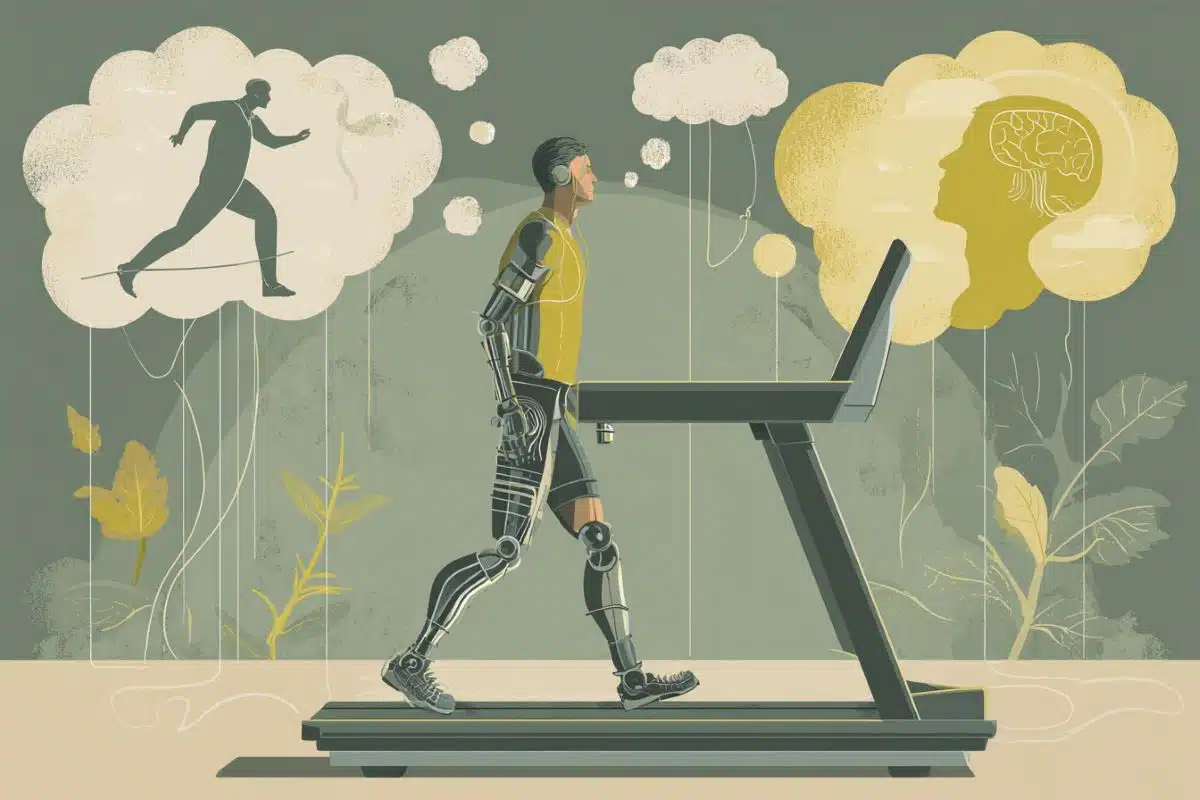
Summary: Learning to use a robotic prosthetic isn’t just a physical challenge; it’s a psychological one. A new study reveals that our “body image”—the mental map of how we move—struggles to accurately track robotic limbs.
Researchers found that when people first start using a robotic leg, they perceive their gait as much more awkward and stilted than it actually is. However, as they improve, the error flips: users begin to believe their movement is more natural and fluid than reality. This shift into overconfidence could actually hinder rehabilitation, as patients who think they’ve mastered the device may stop pushing for further improvement.
Key Facts
- Perceptual Flip: Initial users overestimate their awkwardness, while experienced users overestimate their fluidity and “natural” gait.
- Persistent Inaccuracy: Despite physical performance improving significantly over four days, users’ mental assessments remained consistently inaccurate.
- Torso Focus: When assessing their own gait, participants focused almost entirely on their torso position rather than the behavior of the robotic prosthetic itself.
- The Feedback Gap: Because users receive little direct sensory feedback from the device, their brain “fills in the blanks” with inaccurate mental projections.
- The Overconfidence Trap: Researchers warn that thinking one’s gait is “perfect” can lead to a plateau in recovery, as the motivation to practice decreases.
Source: North Carolina State University
The way we understand the movement of our own bodies plays an important role when learning physical skills, from sports to dancing. But a new study finds this phenomenon works very differently for people learning to use robotic prosthetic devices.
“When people first start walking with a prosthetic leg, they think their bodies are moving more awkwardly than they really are,” says Helen Huang, corresponding author of a paper on the work.
“With practice, as their performance improves, people still do a poor job of assessing how their bodies move, but they are inaccurate in a very different way.
“This is the first study to look at this phenomenon in people using lower-limb robotic prosthetics, and it raises a number of questions that should help us improve people’s ability to walk with these devices,” says Huang, who is the Jackson Family Distinguished Professor of Biomedical Engineering in the Lampe Joint Department of Biomedical Engineering at North Carolina State University and the University of North Carolina at Chapel Hill.
Everyone has a personal body image – an understanding of how their body is structured, how it moves, and so on. And this understanding of our bodies informs the way we move. When learning a new physical skill, such as dancing, we have a mental image of how our bodies are moving – but that’s often not the way our bodies are actually moving. Over time our mental image of how our body moves more closely aligns with our actual movements, and our physical performance improves.
“We wanted to learn more about how and whether people who are using robotic prosthetics incorporate that prosthetic device into their body image,” Huang says.
“Does that change as people become more familiar with using these devices? Is there any relationship between incorporating these devices into one’s body image and their performance using these devices?”
For this study, the researchers recruited nine able-bodied study participants. Over the course of four days, study participants were tasked with walking using a robotic prosthetic attached to a knee bent at a right angle. Specifically, they were asked to walk on a treadmill as quickly as possible without touching handrails.
Participants practiced using the prosthetic device each day. After each practice, participants were shown a computer animation that displayed a range of different biomechanical walking gaits, and were asked to select which gait was closest to their recent performance using the prosthesis.
“Initially, participants felt their gait was more off-balance and stilted than it actually was,” Huang says.
“By the end of the four-day study, participants felt their gait was more fluid and natural than it actually was. The performance of all participants did improve significantly over those four days. However, the participants were all still inaccurate at assessing the way their own bodies moved – just in a more confident way.”
The researchers found that one of the things study participants were focused on when assessing their own gait was the position of their torso. The participants did not place much emphasis on the behavior of the prosthetic device itself.
“One reason for this is likely because they are receiving very little direct feedback about the behavior of the device – they can’t see themselves moving,” Huang says. “This raises the possibility of improving performance by giving people visual or other feedback they can use to calibrate their body image and gait while training with the prosthetic device.
“It will also be important to address the overconfidence people have in their own movement skills,” Huang says.
“If you already think you’re doing great, you’re less likely to put in the work necessary to get better – even if there is significant room for improvement. We think it would be valuable to find a way to give people a more accurate assessment of how their body is really moving.”
The paper, “Projecting the New Body: How Body Image Evolves During Learning to Walk with a Wearable Robot,” will be published February 17 in the open access journal PNAS Nexus. First author of the paper is I-Chieh Lee, a former research assistant professor in the Lampe Joint Department. The paper was co-authored by Huan Min, a Ph.D. student at NC State, and by Ming Liu, a research associate professor in the Lampe Joint Department.
Funding: This work was done with support from the National Institutes of Health under grant R01HD110519 and from the National Science Foundation under grant 2211739.
Key Questions Answered:
A: Unlike your biological leg, a robotic prosthetic doesn’t send “feeling” signals (proprioception) back to your brain. Without that feedback, your brain guesses how the limb is moving based on how your torso feels. Usually, those guesses are wrong.
A: Confidence is good for morale, but “perceptual overconfidence” is risky. If you think your walk is perfectly natural but you’re actually still limping or off-balance, you won’t do the extra work needed to fix those subtle issues, which could lead to long-term joint pain or falls.
A: The researchers suggest that giving users visual feedback—like watching themselves walk on a screen—could help “calibrate” their mental image to match reality, leading to much better long-term results.
Editorial Notes:
- This article was edited by a Neuroscience News editor.
- Journal paper reviewed in full.
- Additional context added by our staff.
About this prosthetics and neuroscience research news
Author: Matt Shipman
Source: North Carolina State University
Contact: Matt Shipman – North Carolina State University
Image: The image is credited to Neuroscience News
Original Research: Open access.
“Projecting the New Body: How Body Image Evolves During Learning to Walk with a Wearable Robot” by I-Chieh Lee , Huan Min , Ming Liu , He Huang. PNAS Nexus
DOI:10.1093/pnasnexus/pgag016
Abstract
Projecting the New Body: How Body Image Evolves During Learning to Walk with a Wearable Robot
Advances in wearable robotics challenge the traditional definition of human motor systems, as wearable robots redefine body structure, movement capability, and wearers’ perception of their bodies.
While these devices can empower the wearer’s motor performance, there is limited understanding of how they affect the wearer’s conscious, subjective experience of their own body (or body image), especially with regard to dynamic movements.
This study examined changes in perceived body image as individuals learned to walk with a robotic leg over multi-day training.
We measured gait performance and perceived body image via the selected coefficient of perceived motion after each training session. By extending human motor learning theory to wearer–robot systems, we hypothesized that perceived body image when walking with a robotic leg co-evolves with actual gait improvement and becomes more certain and more accurate to actual motion.
Our results confirmed that motor learning improved both physical and perceived gait patterns toward normal, indicating that via practice the wearers incorporated the robotic leg into their sensorimotor systems to improve wearer–robot movement coordination.
However, a persistent discrepancy between perceived and actual motion remained, likely due to the absence of direct sensation/control of the prosthesis. Additionally, the perceptual overestimation at later training sessions might limit further motor improvement.
These findings suggest that enhancing the human sense of wearable robots and frequently calibrating the perception of body image are essential for effective training with wearable robots and for developing embodied assistive technologies.


