Summary: Despite their wildly different chemical structures and origins—ranging from laboratory LSD to ancient Amazonian Ayahuasca—all major psychedelics share a single “fingerprint” of brain activity. An international mega-analysis pooled data from 11 datasets across five countries to solve the mystery of why these diverse drugs produce similar therapeutic and hallucinogenic effects.
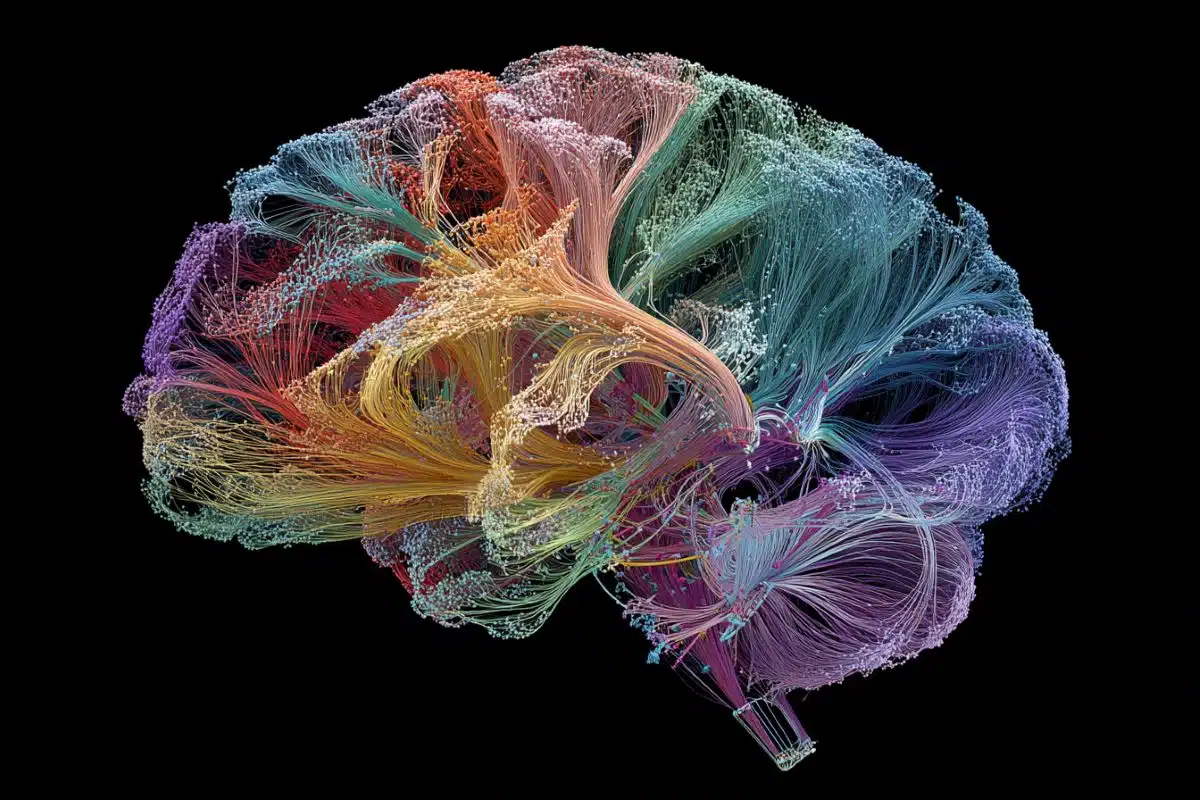
The study reveals that psychedelics fundamentally reorganize the brain by breaking down internal network boundaries and forcing usually separate systems to “talk” to one another.
Key Facts
- The Mega-Analysis: The study analyzed over 500 brain imaging sessions from 267 participants, overcoming the limitations of small, isolated studies caused by high costs and strict drug regulations.
- Network Breakdown: Normally, brain systems (like vision or emotion) are “modular,” staying within their own lanes. Psychedelics weaken these internal connections, making the brain’s structure less rigid.
- The “Cross-Talk” Effect: While internal networks weaken, communication between different networks surges. This global integration likely explains the merging of senses (synesthesia) and the ego-dissolving experiences reported by users.
- The “Common Denominator”: For the first time, researchers proved that psilocybin, LSD, mescaline, DMT, and ayahuasca all produce this exact two-step pattern, regardless of their specific chemical makeup.
- A Regulatory Yardstick: Scientists believe these findings provide a standardized “blueprint” that could help regulators loosen restrictions and guide the engineering of new mental health treatments.
Source: McGill University
Scientists have demonstrated, for the first time, that several psychedelic drugs – including psilocybin, LSD, mescaline, DMT and ayahuasca – produce a common pattern of brain activity despite their distinct chemistries.
An international consortium led by a McGill University researcher pooled brain imaging data from labs across five countries, creating the largest study of its kind to date.
The findings, published in Nature Medicine, could help guide the design of future treatments for mental health disorders.
“This is a breakthrough in how we think about psychedelic drugs,” said senior author Danilo Bzdok, Associate Professor in McGill’s Department of Biomedical Engineering and Canada CIFAR Artificial Intelligence Chair at Mila. “For the first time, we show there’s a common denominator among drugs that we currently consider completely separate.”
Two measurable changes in the brain
While different psychedelics have shown benefits for some mental health conditions, how they produce similar effects despite their chemical differences remains a mystery. The meta-analysis identified two consistent neural effects across five of the most common drugs.
Normally, each brain system communicates strongly within itself, maintaining tight, organized networks. The researchers found that under the influence of psychedelics, these connections weaken, making the networks less rigidly structured.
The second neural effect is that psychedelics increase communication between different brain networks, allowing signals to cross boundaries that are usually separate. This “cross-talk” may help explain the hallucinations and other unusual thoughts, sensations and perceptions people report during psychedelic experiences.
An ‘X-ray’ of global psychedelic research
The meta-analysis combined results from 11 datasets, analyzing more than 500 brain imaging sessions from 267 participants.
Psychedelic neuroscience studies are typically small, often limited to 10 to 30 participants because of high costs and strict regulations. Studying five different psychedelics in a single experiment would be nearly impossible, the authors note.
“This approach gives us an X-ray view of the entire research community,” said Bzdok.
The thawing of ‘psychedelic research winter’
Interest in psychedelics for mental health treatment has surged in recent years, fuelled in part by advances in brain imaging technologies. The revival follows what authors call the “psychedelic research winter” of the 1970s, when studies were limited by criminalization and associations with counterculture.
“Many drug therapies for depression, for example, have changed little over the past decades. Psychedelics may represent the most promising shift in mental health treatment since the 1980s,” said Bzdok.
He added that, as researchers in this emerging field still face logistical hurdles, the results provide a yardstick against which future studies can be measured and may help move the needle toward loosening strict regulations.
About the study
“An international mega-analysis of psychedelic drug effects on brain circuit function” by Manesh Girn and Danilo Bzdok et al., was published in Nature Medicine.
Key Questions Answered:
A: While the “big picture” reorganization is the same (weakening networks and increasing cross-talk), the intensity and duration vary based on how each drug interacts with specific serotonin receptors. Think of it like music: the “universal fingerprint” is the genre, but each drug plays a different song within that genre.
A: Not necessarily messier—just more flexible. By breaking down the rigid, “habitual” patterns of communication (which are often over-active in depression or OCD), the brain is given a chance to form new, healthier connections. It’s like hitting a “reset” button on the brain’s wiring.
A: Because it’s nearly impossible for one lab to legally and financially test five different Schedule I drugs. By pooling data from labs worldwide, the researchers created a high-resolution view that no single study could achieve, essentially “looking through” the red tape of psychedelic research.
Editorial Notes:
- This article was edited by a Neuroscience News editor.
- Journal paper reviewed in full.
- Additional context added by our staff.
About this psychopharmacology and neuroscience research news
Author: Keila DePape
Source: McGill University
Contact: Keila DePape – McGill University
Image: The image is credited to Neuroscience News
Original Research: Open access.
“An international mega-analysis of psychedelic drug effects on brain circuit function” by Manesh Girn, Manoj K. Doss, Leor Roseman, Katrin H. Preller, Fernanda Palhano-Fontes, Lorenzo Pasquini, Frederick S. Barrett, Pablo Mallaroni, Natasha L. Mason, Christopher Timmermann, Drummond E. McCulloch, Patrick M. Fisher, Brian S. Winston, Flora Moujaes, Felix Muller, Matthias E. Liechti, Franz X. Vollenweider, Johannes G. Ramaekers, Kim Kuypers, Draulio B. Araujo, Olaf Sporns, Joshua Siegel, Nico Dosenbach, David J. Nutt, Robin L. Carhart-Harris, Emmanuel A. Stamatakis & Danilo Bzdok. Nature Medicine
DOI:10.1038/s41591-026-04287-9
Abstract
An international mega-analysis of psychedelic drug effects on brain circuit function
Psychedelic drugs are re-emerging as promising scientific and clinical tools. However, despite a rapidly expanding literature on their therapeutic value, the neural mechanisms underlying psychedelic effects remain unclear.
Resting-state functional magnetic resonance imaging studies of acute psychedelic effects, conducted independently by several research groups, have so far yielded fragmented and sometimes inconsistent findings.
Here, to help facilitate greater convergence, we conducted a ‘mega-analysis’ integrating 11 independent resting-state functional magnetic resonance imaging datasets across five psychedelic drugs (psilocybin, lysergic acid diethylamide, mescaline, N,N-dimethyltryptamine and ayahuasca) from research groups spanning three continents and five countries.
By applying a uniform preprocessing pipeline and a Bayesian hierarchical modeling framework, we discovered several common features in the induced alterations to brain function across drugs and sites.
Most prominently, we identified a core signature of increased functional connectivity between transmodal (default, frontoparietal and limbic) and unimodal networks (visual and somatomotor), with subnetwork specificity.
Furthermore, key subcortical regions (thalamus, caudate and putamen) and the cerebellum exhibited altered coupling with sensorimotor networks. In contrast to several single-site reports, Bayesian modeling revealed weak-to-moderate and selective reductions in within-network functional connectivity, with substantial variability across drugs and networks.
Together, these findings extend past work by demonstrating that psychedelics reconfigure large-scale cortical organization while selectively engaging subcortical circuitry.
This study provides the most comprehensive synthesis of psychedelic brain action to date, helping resolve inconsistencies and offering a probabilistic map of how psychedelics alter large-scale brain organization.
We hereby provide a cornerstone to benchmark and shepherd future psychedelic neuroimaging research.