

Summary:
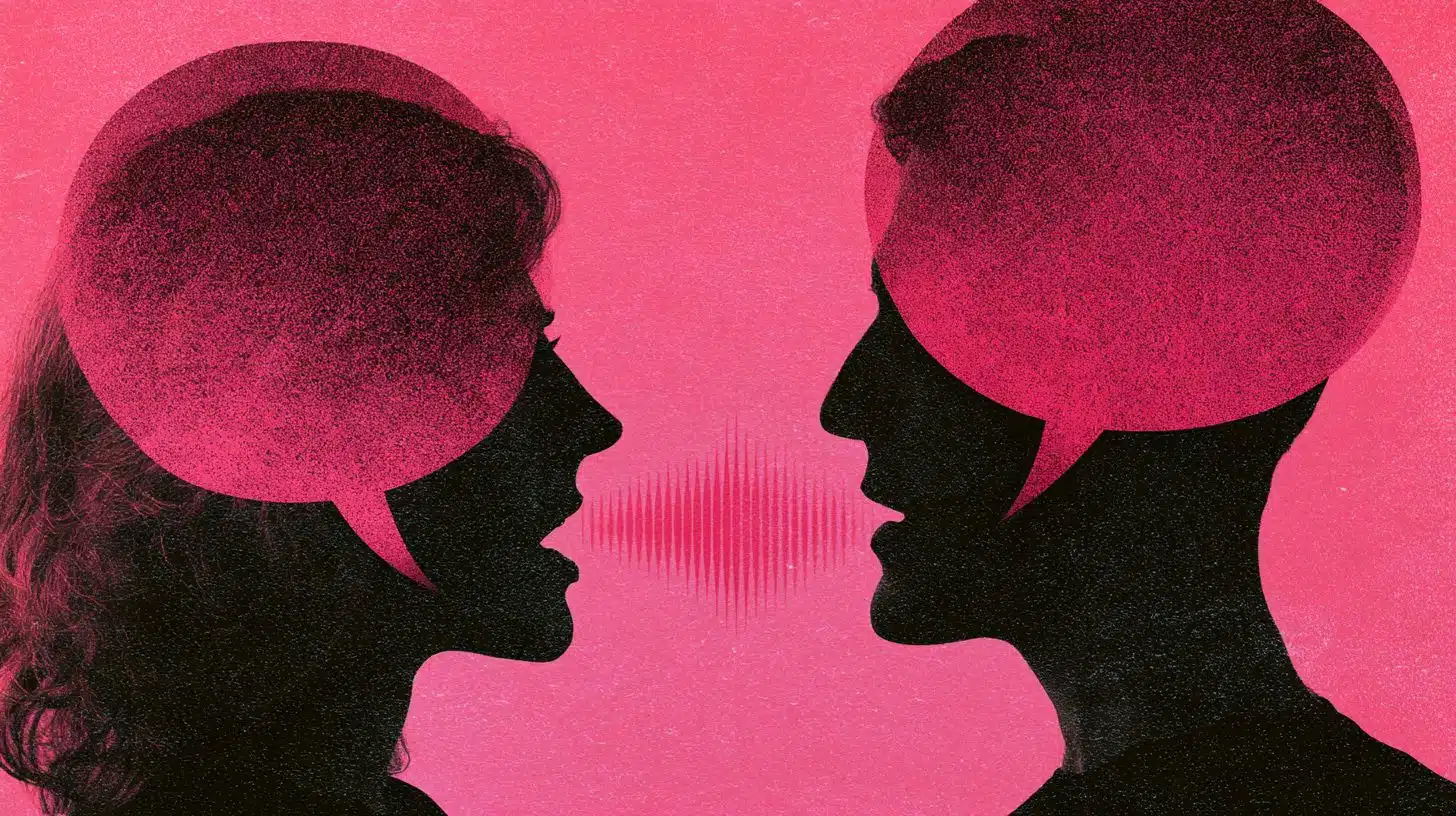
A cognitive science investigation led by Kathryn O’Nell and colleagues reveals that the most enjoyable and engaging human conversations follow a distinct statistical rhythm known as “pink noise.” Rather than adhering to rigid, linear exchanges or purely chaotic shifts, satisfying dialogues feature scale-invariant fluctuations in semantic similarity, periods of close conceptual alignment interspersed with novel divergences and mutual realignment.
Analyzing naturalistic dialogue datasets across personal encounters, speed-dating rounds, and podcasts, alongside AI generation benchmarks using Claude Sonnet 3.7, the researchers demonstrated that pink noise reliably predicts conversational enjoyment across human and machine-generated exchanges.
Key Facts:
- Scale-Free Semantic Dynamics: Highly rated conversations exhibit “pink noise” (1/f noise) in semantic similarity across time scales, characterized by structured rhythms of conceptual alignment, spontaneous divergence, and collaborative realignment.
- Predictor of Subjective Enjoyment: Across multiple independent human interaction datasets, including laboratory dialogues, speed-dating dates, and two-host podcast exchanges, the presence of semantic pink noise directly correlated with higher reported conversational enjoyment.
- Spontaneous AI Reproduction: When prompted to generate enjoyable conversational scripts without explicit instructions regarding temporal dynamics, the large language model Claude Sonnet 3.7 spontaneously injected pink noise, reflecting patterns internalized from human literary and conversational training data.
Source: AAAS
Human conversation is often described as an art, governed by intangible chemistry, mutual wit, and social intuition. Traditional linguistic and cognitive models have long framed spoken interaction through a utilitarian lens: a linear, transactional exchange designed to transfer information from speaker to listener as efficiently as possible.
Yet anyone who has experienced an awkward, robotic dinner exchange knows that pure communicative efficiency does not equal a good conversation. The interactions people cherish most rarely move in a straight line; they meander, find unexpected common ground, venture into uncharted tangents, and loop back seamlessly.
In an investigation published by cognitive scientist Kathryn O’Nell and colleagues, researchers applied complex systems analysis to decode the mathematical signature of conversational chemistry.
Their findings demonstrate that enjoyable dialogues are governed by pink noise, a self-similar, scale-invariant temporal dynamic where semantic sharedness ebbs and flows in a structured, non-linear dance.
What Does Pink Noise Sound Like in Speech?
In physics and acoustic engineering, “pink noise” (or 1/f noise) occupies a mathematical sweet spot between absolute predictability and sheer randomness. While white noise is entirely uncorrelated chaos and brown noise exhibits sluggish random walks, pink noise balances short-term adaptability with long-term memory. It appears ubiquitously in self-organizing natural phenomena, from cardiac rhythms and brain waves to classical musical compositions and fractal coastlines.
Translating this concept to linguistic cognition, O’Nell and colleagues tracked temporal fluctuations in semantic similarity, measuring how closely speakers’ vocabulary, conceptual choices, and thematic threads aligned from one speaking turn to the next.
The authors characterized how pink noise manifests in natural dialogue:
“[Speakers] remain aligned for a while, diverge as one introduces something new, then realign as the other picks it up and develops it further.”
If two speakers remain permanently aligned without diverging, the exchange devolves into sterile repetition or predictable agreement. Conversely, if partners diverge constantly without mutual uptake, the conversation becomes disjointed and alienating. Pink noise represents the statistical balance: an organic cycle of shared focus, innovative deviation, and harmonious re-convergence.
Testing Human Datasets: Speed Dating to Podcasts
To evaluate whether this temporal pattern tracks subjective conversational satisfaction, the research team analyzed two preexisting datasets of two-person dialogues where participants systematically rated how much they enjoyed interacting with their partner.
The quantitative results confirmed a strong, positive relationship: dyads whose semantic trajectories exhibited robust pink-noise dynamics reported significantly greater mutual enjoyment and interpersonal rapport.
To test whether this phenomenon extends beyond constrained laboratory settings, the investigators examined naturalistic real-world interactions:
- Speed-Dating Exchanges: Brief romantic encounters featuring strong pink-noise dynamics corresponded to higher attraction, perceived connection, and mutual interest in future contact.
- Two-Host Podcasts: Audio dialogues between professional podcast co-hosts naturally exhibited marked pink-noise distributions, demonstrating that conversational chemistry in public broadcasting relies on the same non-linear structural cadence.
AI Replicates the Human Dynamic
To determine whether pink noise is deeply embedded within the architecture of human storytelling and discourse, the researchers turned to advanced generative artificial intelligence.
The team prompted the large language model Claude Sonnet 3.7 to write natural dialogue scripts under two distinct conditions: generate dialogues that were either highly enjoyable and engaging, or unenjoyable and tedious. Crucially, the model was given no mathematical guidance, technical prompts, or instructions regarding statistical noise, semantic metrics, or temporal frequencies.
Computational analysis of the resulting text revealed that Claude Sonnet 3.7 spontaneously injected pronounced pink-noise dynamics into the scripts designed to be enjoyable. In contrast, the scripts generated to be unenjoyable exhibited flat, disrupted, or chaotic semantic structures lacking the characteristic $1/f$ signature.
The researchers suggest this spontaneous behavior emerges because the AI internalized the deep statistical structure of engaging human relationships from its vast ingestion of human-authored literature, plays, and transcripts.
Rethinking Social Cognition and Dialogue Design
The study challenges classical views of communication as a purely linear means to an end, demonstrating that conversational pleasure derives from the structural journey of the exchange itself.
By defining the mathematical cadence of rapport, this work provides practical frameworks for training conversational agents, designing socially intelligent AI companions, and understanding social communication barriers in clinical neurodevelopmental conditions where conversational rhythm is altered.
Questions and Answers
What is “pink noise” in the context of human conversation?
In conversation, pink noise refers to structured, scale-invariant fluctuations in semantic similarity over time. Instead of staying strictly on-topic (monotony) or constantly jumping to unrelated ideas (chaos), speakers stay conceptually aligned for a period, diverge as one person introduces a novel tangent, and then realign as the partner explores and develops the new topic.
How does pink noise affect how much people enjoy chatting?
Statistical analyses of multiple dialogue datasets, including speed dates and podcasts, revealed that conversations with higher levels of pink noise were consistently rated as more enjoyable, engaging, and socially satisfying by participants.
Did artificial intelligence understand conversational pink noise?
Yes. When prompted to generate “enjoyable” dialogues without any technical or mathematical hints, Claude Sonnet 3.7 naturally generated scripts featuring semantic pink noise, showing that large language models mirror the complex communicative dynamics embedded in human literature.
Editorial Notes:
- This article was edited by a Neuroscience News editor.
- Journal paper reviewed in full.
- Additional context added by our staff.
About this neuroscience Research:
- Media Contact: AAAS Press Team
- Source: AAAS
- Image Credit: Image credited to Neuroscience News
- Original Research is Open Access: Science Advances (Nov 6, 2026). “Pink noise in dyads’ semantic similarity trajectories predicts conversation enjoyment.” Authors: Kathryn C. O’Nell, Kiara L. Sanchez, and Emily S. Finn.
- DOI: 10.1126/sciadv.aeb2684
Abstract
Pink noise in dyads’ semantic similarity trajectories predicts conversation enjoyment
Conversation is a core component of human social life. Many influential theories treat conversation as a linear system, i.e., the sum of its parts. However, linear accounts of semantic entrainment lose explanatory power at their upper limits: Discussing perfectly aligned opinions becomes boring.
We propose an alternate account that considers the multiscale organization of semantic similarity over the course of a conversation, as indexed by pink noise.
Here, we test whether pink noise can be found in interlocutors’ conavigated trajectories through semantic space. Not only is pink noise present, but its strength predicts positive conversation outcomes like enjoyment and connection, increases with practice, and is reflected in a large language model’s representation of conversation quality.
These results demonstrate an important role for scale-free dynamics in characterizing successful conversation.


