

Summary:
Recording single-neuron activity in people with tetraplegia via intracortical brain-computer interfaces (BCIs), researchers found that motor cortex activity when watching actions scales directly with how human-like the actor appears. The findings challenge the concept of specialized “mirror neuron” cells, revealing instead a distributed network modulated by both visual realism and top-down cognitive recognition.
Key Facts:
- Graded Response to Human Likeness: Motor cortex observational activity is strongest when participants watch realistic human hands and progressively weakens when observing robotic grippers, three-pronged claws, or abstract cubes.
- Network Dynamics Over Dedicated Cells: Observational signaling is driven by broad ensemble networks that scale firing rates and recruitment based on anthropomorphic features, rather than discrete, dedicated “mirror neuron” cells.
- Cognitive “Aha” Moments Shift Firing: Observational motor activity increased after a participant consciously recognized that an abstract dot-pattern animation represented a hand, proving that top-down cognitive context directly primes motor responses.
Source: Brown University / Mass General Brigham / VA Center for Neurorestoration and Neurotechnology
For decades, neuroscientists have studied the phenomenon of motor observation: the observation that neurons in the motor cortex fire not only when an individual carries out a physical action, such as reaching or grasping, but also when merely observing someone else execute the same motion. Often attributed to dedicated “mirror neurons,” this mirroring capacity is considered central to motor learning, imitation, and social cognition across humans and non-human primates.
However, the precise mechanisms governing how these observational circuits decode external actions have remained debated.
Now, in a study published in the Proceedings of the National Academy of Sciences (PNAS), a collaborative team from Brown University, the Mass General Brigham Center for Neurotechnology and Neurorecovery, and the VA Center for Neurorestoration and Neurotechnology demonstrates that observational activity in the human motor cortex is continuously tuned to how human-like the observed agent appears.
“The main motivation for this work was to look at how visual feedback may influence people’s ability to use BCIs to control different types of external devices like computer cursors or assistive robotics,” said lead author Jacob Gusman, who conducted the research as a graduate student at Brown University. “We also gained some fundamental insights into basic neuroscience questions surrounding this idea of mirror neurons.”
Intracortical Recordings Reveal Graded Network Responses
The study was conducted as part of the ongoing BrainGate clinical trial, which develops intracortical brain-computer interfaces to restore communication and mobility to individuals paralyzed by neurological injury or illness.
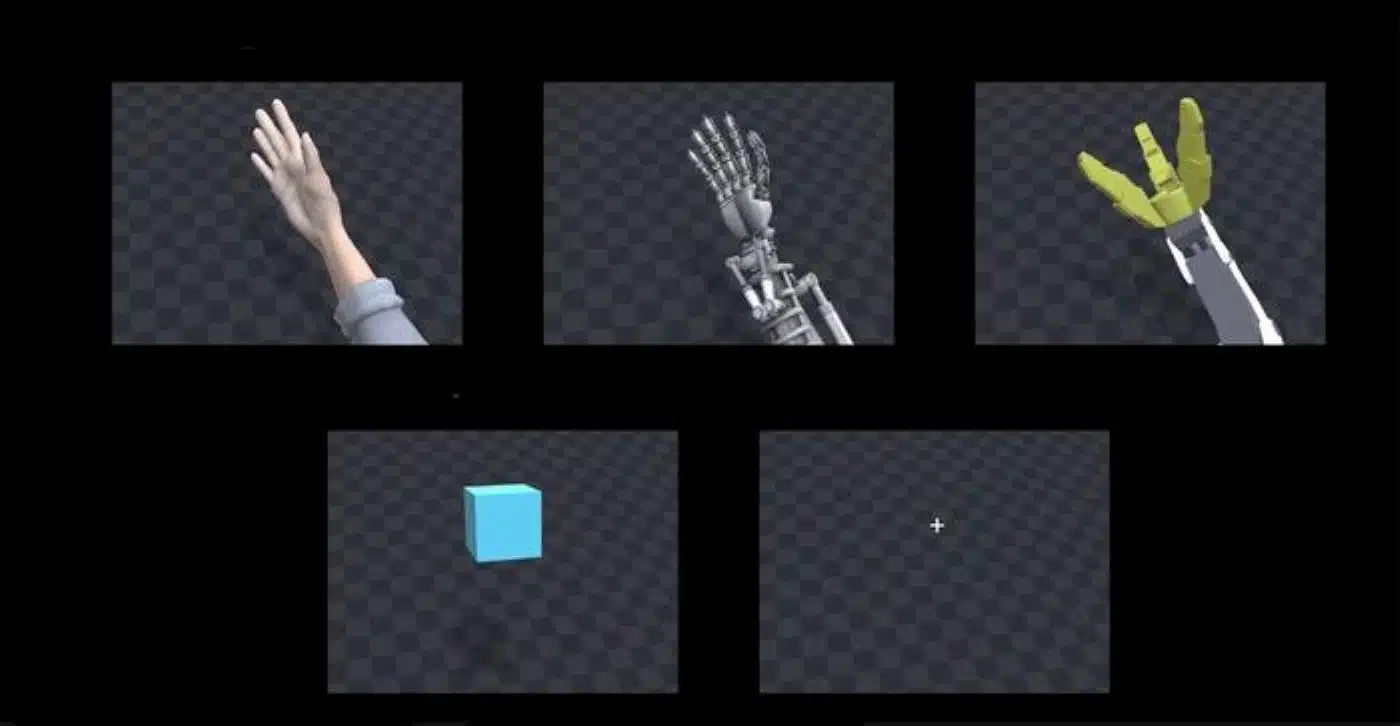
Researchers worked with two participants living with tetraplegia who had microelectrode arrays surgically implanted in the hand-knob area of the motor cortex. These arrays enabled the team to record single-neuron and population-level activity in real time while participants viewed animated effectors performing pinch and power grips.
The visual agents varied along a spectrum of anthropomorphism:
- A photorealistic human hand
- An anthropomorphic robotic hand
- A three-pronged mechanical claw
- An abstract geometric cube
The microelectrode data revealed that observational activity scaled with physical realism. The natural human hand elicited the strongest neural discharge, with activity tapering off in a graded manner as the effectors became more mechanical and abstract. This graded modulation occurred across the population level, with more neurons recruited, and at the single-cell level, where individual firing rates accelerated with realistic stimuli.
“What this suggests is that observational activity isn’t driven by specialized ‘mirror neuron’ cells,” Gusman explained. “It’s really a network effect that’s sensitive to how anthropomorphic the observed stimuli are.”
Active Motor Control Overrules Visual Fidelity
Interestingly, when participants were instructed to actively attempt the physical grasp while watching the animated effectors, the difference across agents disappeared.
During active movement intention, all effectors, whether human hand or mechanical claw, elicited robust, equivalent levels of motor cortex activation. The researchers noted that internal motor intention produces signals that substantially outweigh passive observational responses, suggesting that the human-likeness of a robotic prosthesis or digital avatar matters far less once a user is actively controlling it.
Top-Down Cognition Drives Motor Decoding
The team also tested participants using dynamic dot-pattern animations of hands. While dense, easily recognizable hand configurations elicited strong motor firing, the experiment uncovered a pivotal cognitive dimension.
During an exploratory trial with ambiguous dot patterns, one participant experienced an unprompted “aha” moment, suddenly recognizing that the abstract constellation of dots formed a grasping hand. Comparing neural recordings before and after this conscious realization revealed an immediate surge in motor cortex firing across degrees of visual realism.
“At least for this one participant, his recognition that this dot-pattern stimulus resembled a human hand appeared to trigger this hand area of his motor cortex to begin responding while he watched the stimulus,” Gusman noted. “At a minimum, this finding suggests that in addition to bottom-up visual input, top-down contextual cues may also be involved in producing this mirror-like response.”
Informing the Next Generation of Neural Prosthetics
Beyond resolving core neuroscientific questions about mirror-like processing, the findings offer practical design rules for neuroengineers building brain-controlled assistive technologies.
“The ultimate goal of the BrainGate clinical trial is to help people who have lost the ability to move or communicate after an injury or illness,” said co-author Leigh Hochberg, professor of engineering and neuroscience at Brown University and director of the BrainGate trial. “Along the way, we’re making important discoveries about how the brain plans and executes body movements… These findings will help to inform the next generation of implantable BCIs for people with neurologic injury.”
Editorial Notes:
- This article was edited by a Neuroscience News editor.
- Journal paper reviewed in full.
- Additional context added by our staff.
About this Neuroscience and Neurotech Research:
- Media Contact: Kevin Stacey
- Source: Brown University
- Image Credit: Image credited to BrainGate Clinical Trial / Brown University
- Original Research is Open Access: PNAS (September 21, 2026). “Observation-related activity in the human motor cortex increases with effector anthropomorphicity.” Authors: Jacob T. Gusman, Zoe C. Beckman, Tyler S. Singer-Clark, Angelique C. Paulk, Anastasia Kapitonava, Tommy Hosman, Shane Allcroft, Alexander J. Acosta, Claire Nicolas, Daniel B. Rubin, John P. Donoghue, Carlos E. Vargas-Irwin, and Leigh R. Hochberg.
- DOI: 10.1073/pnas.2537457123
Abstract
Observation-related activity in the human motor cortex increases with effector anthropomorphicity
Neurons in the motor cortex can be engaged not only in motor execution but also during observation of movements performed by other anthropomorphic agents (i.e., humans or monkeys). However, it is unknown how motor cortical neurons respond during observation of the range of assistive or prosthetic devices controlled by people using intracortical brain–computer interfaces (iBCIs).
We recorded single-unit activity in the precentral gyrus while iBCI users viewed grasp-like movements performed by a spectrum of virtual effectors that included human, robotic, and hand-like dot stimuli. We found a relationship between neural modulation and effector anthropomorphicity (i.e., human-likeness) that existed on an ensemble-wide and individual-neuron level, suggesting that human motor cortex activity incrementally increases in response to the visually observed agent’s human-likeness.
Both solicited and spontaneous feedback from the participant indicated a relationship between neural activity and subjective assessments of anthropomorphicity, revealing a powerful contribution of context on observation-induced activity in the motor cortex.
The activity of the motor cortex remained similar during attempted hand movements while different effectors were being observed, suggesting that intuitive external device control via iBCIs may not be overtly affected by the anthropomorphicity of the effector.


