Brush border microvilli are microscopic cellular membrane protrusions that increase the surface area of cells and carry out a wide variety of functions, including absorption, secretion and cellular adhesion. Stereocilia, on the other hand, are mechanosensing organelles of hair cells, which respond to fluid motion in numerous types of animals for various functions, including hearing and balance. The two structures are located in separate parts of the human body and perform vastly different functions, despite the very-similar looks and features they have.
The similarities between the two, in fact, are far more than just looks. Mechanistically, the two resembles one another just as close.
HKUST structural biologist Mingjie Zhang and his team have found that the microvilli and the stereocilia tip-link complexes, despite only having Harmonin in common, are formed via strikingly similar interaction modes. Their findings were published in the January 25, 2016 issue of the journal Developmental Cell.
“While brush border microvilli resemble the relatively well-characterized stereocilia of hair cells, the mechanistic basis of tip-link complex organization in brush border microvilli is poorly understood,” said Professor Mingjie Zhang.
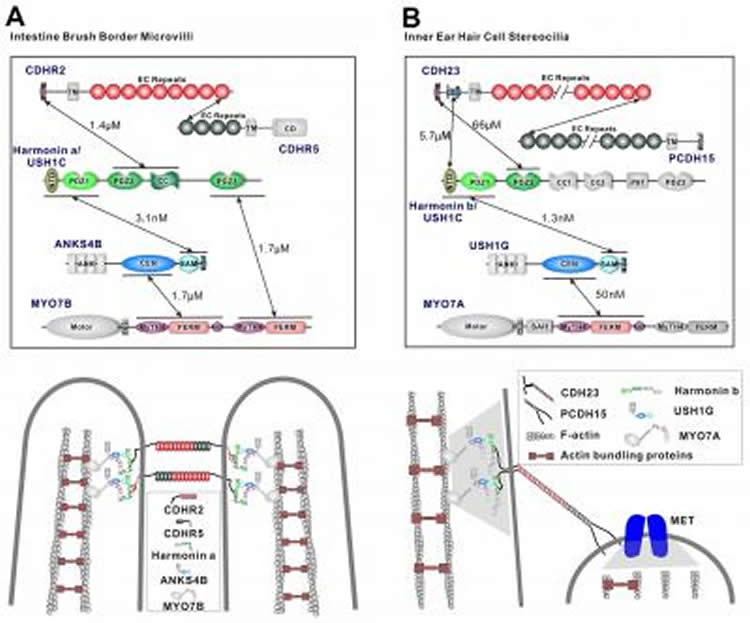
In the study, the team of HKUST researchers performed systematic biochemical and structural characterizations of the protein interaction network residing at the cytoplasmic face of the brush border inter-microvilli tip- link. The researchers found that both the brush border inter-microvillar tip link complex and the inner ear stereocilia tip link complex both utilize adhesive, heteromeric cadherin family proteins to build filamentous inter-microvillar/ inter-stereocilia tip links that can sustain mechanical strains. Both systems use two scaffold proteins that include Harmonin as the hub to organize the respective multi-protein complex within each system.
“These results not only provide insight into the mechanistic bases of brush border microvilli formation and maintenance, but may also be valuable for understanding of some gut and/or kidney diseases caused by perturbations of brush border microvilli structures,” said Professor Zhang. “A single mutation of genes encoding the stereocilia tip link complex can cause a disease as debilitating as Usher syndrome, while corresponding mutations in gut microvilli do not appear to cause obvious diseases in our guts. The results of our study can help scientists and clinicians to identify mutations of genes that may cause digestive diseases.”
Funding: This research was supported by RGC Hong Kong.
The authors report no financial or other conflicts of interest.
Source: Sherry No – Hong Kong University of Science and Technology
Image Source: The image is credited to HKUST Division of Life Science
Original Research: Abstract for “Mechanistic Basis of Organization of the Harmonin/USH1C-Mediated Brush Border Microvilli Tip-Link Complex” by Jianchao Li, Yunyun He, Qing Lu, and Mingjie Zhang in Developmental Cell. Published online January 25 2016 doi:10.1016/j.devcel.2015.12.020
Abstract
Mechanistic Basis of Organization of the Harmonin/USH1C-Mediated Brush Border Microvilli Tip-Link Complex
Highlights
•The brush border inter-microvilli link complex assembly is characterized
•The Harmonin/ANKS4B/Myo7B complex links cadherins with actin bundles
•Harmonin acts as the key scaffold of the inter-microvilli tip-link complex
•Despite minimal overlap, microvilli and stereocilia tip-link complexes are similar
Summary
Brush border microvilli are actin-based protrusions lining the apical surface of epithelial cells in intestines and proximal tubules of kidneys. While brush border microvilli resemble the relatively well-characterized stereocilia of hair cells, the mechanistic basis of tip-link complex organization in microvilli is poorly understood. Here, we have biochemically and structurally characterized the following pairs of interactions: protocadherin 24 and Harmonin (also known as USH1C or AIE-75), Harmonin and myosin VIIb (MYO7B), Harmonin and ANKS4B, and ANKS4B and MYO7B. We show that Harmonin, ANKS4B, and MYO7B form a stable ternary complex for anchoring microvilli tip-link cadherins. Despite having only Harmonin in common, the microvilli and the stereocilia tip-link complexes are formed via strikingly similar interaction modes. These results not only provide insight into the mechanistic bases of brush border microvilli formation and maintenance but may also be valuable for understanding some gut and/or kidney diseases caused by perturbations of brush border microvilli structures.
“Mechanistic Basis of Organization of the Harmonin/USH1C-Mediated Brush Border Microvilli Tip-Link Complex” by Jianchao Li, Yunyun He, Qing Lu, and Mingjie Zhang in Developmental Cell. Published online January 25 2016 doi:10.1016/j.devcel.2015.12.020