Summary: Researchers developed a groundbreaking technology called LinCx, a custom-built biological “wire” designed to bypass broken or disrupted brain connections.
The study demonstrates a method for creating precise electrical synapses between specific neurons, offering a potential alternative to long-term medication or external brain stimulation for treating neurological disorders.
Key Research Findings
- Cellular Precision: Unlike drugs or broad electrical stimulation that affect large populations of cells, LinCx allows for the creation of new electrical connections between carefully chosen, individual neurons.
- The “Bypass” Mechanism: Instead of repairing damaged synapses, the technology installs a new electrical “bypass” between neurons, strengthening communication without modifying existing native connections.
- Protein Engineering: The “wires” are based on engineered proteins from fish that naturally form electrical synapses. These molecules are redesigned to dock only with a specific engineered partner, preventing unintended connections with native brain proteins.
- Behavioral Impact:
- In Mice: Targeted connections strengthened communication within specific circuits, reshaped brain-wide activity, and altered social interactions and stress responses.
- In Worms: The addition of new connections successfully altered temperature-seeking behaviors.
- Closing the Gap: LinCx overcomes the limitations of prior tools—like optogenetics—which often require external stimulation or result in unintended “crosstalk” between cell types.
Source: Duke University
Broken or disrupted circuits in the brain contribute to many neurological disorders. A new custom-built biological “wire” developed at Duke University School of Medicine points the way toward a new treatment approach — bypassing broken brain connections, rather than relying on long-term medication or external stimulation.
Researchers led by Kafui Dzirasa, MD, PhD, developed a technology called LinCx that allows scientists to create new electrical connections between carefully chosen neurons. Unlike existing tools that often influence many cells at once, this approach enables selective, long‑lasting changes in how defined brain circuits function.
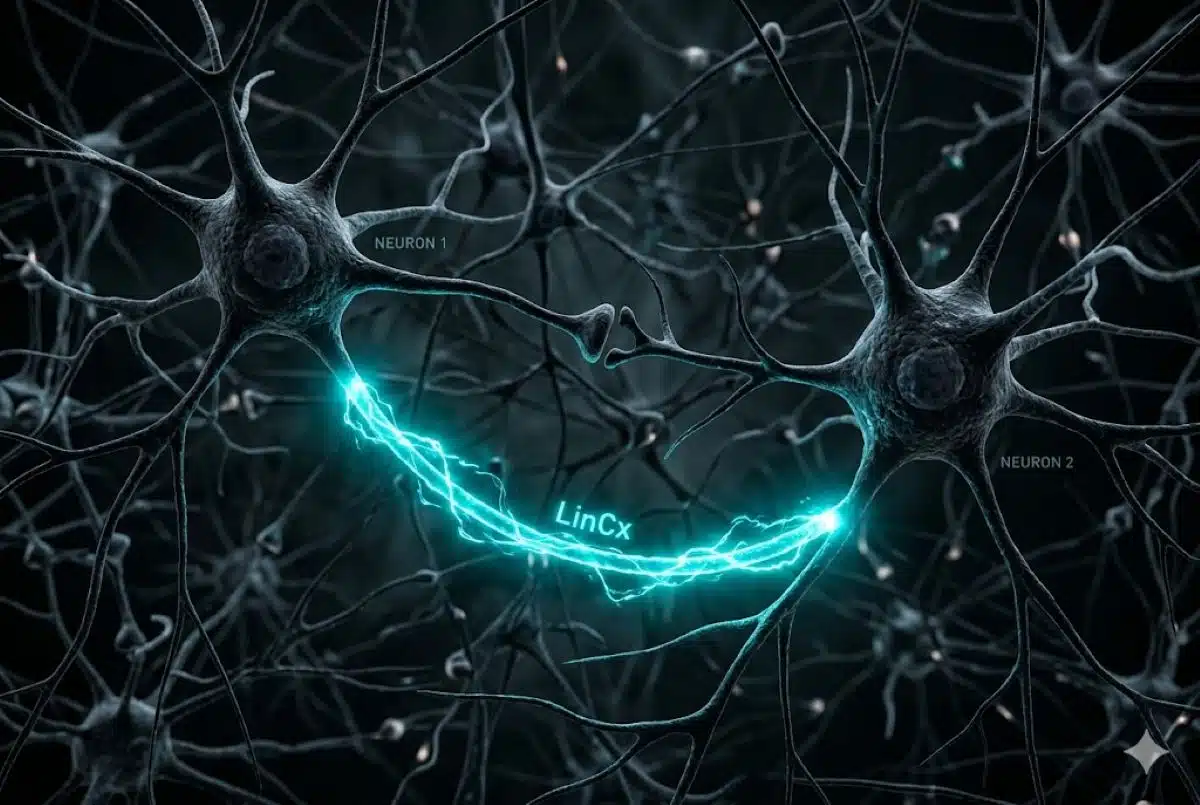
The study is published in Nature on May 13, 2026.
“By introducing a way to plug in new electrical connections with cellular‑level precision, our study marks a major step forward in the ability to edit brain circuitry and understand how neural networks give rise to behavior,“ said Dzirasa, the A. Eugene and Marie Washington Presidential Distinguished Professor of Psychiatry & Behavioral Sciences, Behavioral Medicine & Neurosciences.
Rather than repairing faulty synapses, the technique installs a new electrical “bypass” between specific neurons, strengthening communication without directly modifying existing connections.
The technology is based on proteins originally found in fish that naturally form electrical synapses. Using protein engineering, the researchers redesigned these molecules so they dock only with a matching engineered partner and not with native brain proteins. Laboratory screening, including a newly developed fluorescence‑based assay, identified pairs with high specificity that reliably passed electrical signals between cells.
In mice, targeted electrical connections strengthened communication within specific circuits, reshaped brain‑wide activity patterns, and produced measurable changes in behavior, including social interaction and stress responses.
The team demonstrated the system’s versatility in both worms and mice. In worms, adding new connections altered temperature‑seeking behavior. In mice, targeted electrical connections strengthened communication within specific circuits, reshaped brain‑wide activity patterns, and produced measurable changes in behavior, including social interaction and stress responses.
“For decades, neuroscience has lacked tools that can precisely control communication between specific cell types,” Dzirasa said.
Drugs, electrical stimulation, and optogenetics typically affect broad populations of cells, while prior attempts to use electrical synapses often resulted in unintended connections. LinCx overcomes these limitations and may be able to improve on these tools without requiring external stimulation.
“We will next test whether LinCx is powerful enough to override synaptic deficits induced by lifelong genetic disruptions,” he said.
Other Duke authors: Elizabeth Ransey, Gwenaëlle E. Thomas, Ryan Bowman, Elise Adamson, Kathryn K. Walder-Christensen, Hannah Schwennesen, Caly Ferguson, Stephen D. Mague, Nenad Bursac.
Funding: The Burroughs Wellcome Fund, the Ernest E. Just Life Science Institute, the Hartwell Foundation, Hope for Depression Research Foundation, Howard Hughes Medical Institute, and the National Institutes of Health.
Key Questions Answered:
A: Scientists use protein engineering to create matching molecular “partners.” When these proteins meet at specific neurons, they dock together to form a functional electrical bridge (an electrical synapse) that allows signals to pass directly between the cells.
A: While the study showed changes in social and stress behaviors in mice, the immediate goal is medical: overriding the synaptic deficits caused by genetic disruptions or neurological disorders. The precision of the tool is designed to restore healthy function rather than arbitrarily “edit” traits.
A: It points toward a future where we don’t need external electrodes or hardware. Because LinCx is a purely biological intervention, it could potentially treat broken circuits internally and permanently.
Editorial Notes:
- This article was edited by a Neuroscience News editor.
- Journal paper reviewed in full.
- Additional context added by our staff.
About this neurotech research news
Author: Fedor Kossakovski
Source: Duke University
Contact: Fedor Kossakovski – Duke University
Image: The image is credited to Neuroscience News
Original Research: Open access.
“Long-term editing of brain circuits using an engineered electrical synapse” by Elizabeth Ransey, Gwenaëlle E. Thomas, Elias M. Wisdom, Agustin Almoril-Porras, Ryan Bowman, Elise Adamson, Kathryn K. Walder-Christensen, Jesse A. White, Dalton N. Hughes, Hannah Schwennesen, Caly Ferguson, Kay M. Tye, Stephen D. Mague, Longgang Niu, Zhao-Wen Wang, Daniel Colón-Ramos, Rainbo Hultman, Nenad Bursac & Kafui Dzirasa. Nature
DOI:10.1038/s41586-026-10501-y
Abstract
Long-term editing of brain circuits using an engineered electrical synapse
Electrical signalling across distinct populations of brain cells underpins cognitive and emotional function. However, approaches that selectively regulate electrical signalling between two cellular components of a mammalian neural circuit remain sparse.
Here we engineered an electrical synapse composed of two connexin proteins found in Morone americana (white perch fish)—connexin 34.7 and connexin 35—to accomplish mammalian circuit modulation.
By exploiting protein mutagenesis, devising a new in vitro system for assaying connexin hemichannel docking, and performing computational modelling of hemichannel interactions, we uncovered a structural motif that contributes to electrical synapse formation.
Targeting this motif, we designed connexin 34.7 and connexin 35 hemichannels that dock with each other to form an electrical synapse but not with other major connexins expressed in the mammalian central nervous system.
We validated this electrical synapse in vivo using worms (Caenorhabditis elegans) and mice (Mus musculus). We demonstrate that it can strengthen communication across neural circuits composed of pairs of distinct cell types and modify behaviour accordingly.
Thus, we establish ‘long-term integration of circuits using connexins’ (LinCx) for precision circuit editing in mammals.